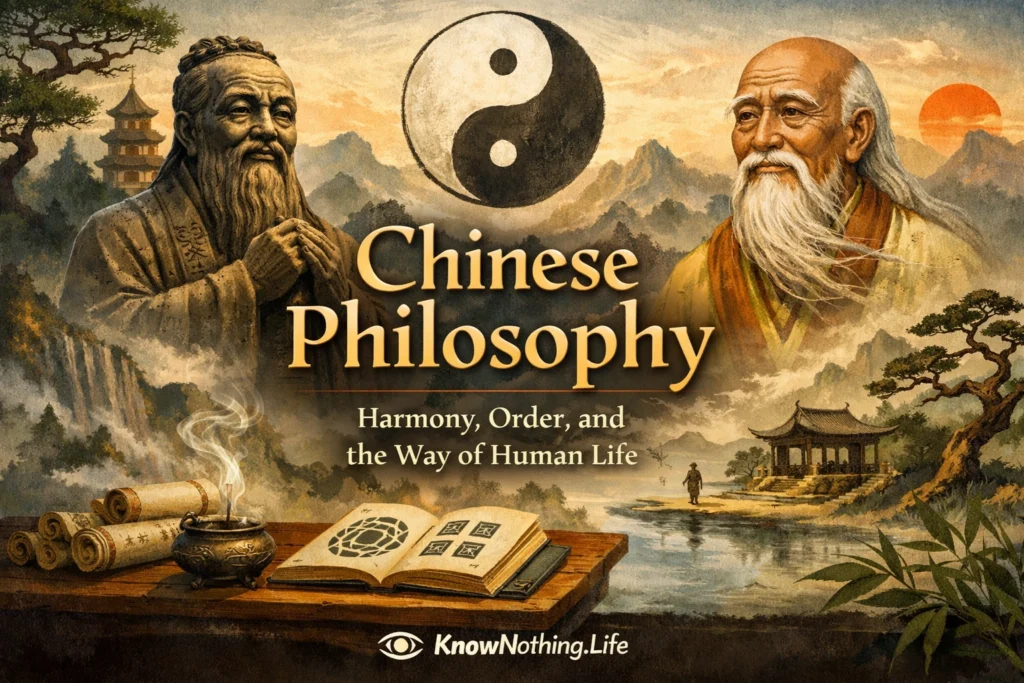
Chinese philosophy represents one of the richest and most enduring intellectual traditions in human history, shaped by centuries of reflection on ethics, governance, nature, and the human condition. Rather than focusing primarily on abstract metaphysics, Chinese thinkers have traditionally emphasized practical wisdom—how to live well, cultivate virtue, and create a harmonious society. Rooted in ancient texts and evolving through historical upheavals, Chinese philosophy offers a deeply integrated vision of personal conduct, social responsibility, and alignment with the natural world.
At its core, Chinese philosophy is concerned with balance and relationship—between individuals and society, humans and nature, action and restraint. Concepts such as harmony (he), the Way (Dao), and virtue (de) serve as guiding principles for understanding both personal life and political order. This tradition does not seek universal truths in isolation but instead explores how wisdom emerges through context, experience, and the cultivation of character. As a result, Chinese philosophy remains profoundly relevant, offering insights into both ancient and modern challenges of human existence.
Confucianism and the Ethics of Social Harmony
One of the central pillars of Chinese philosophy is Confucianism, founded by Confucius in the 6th century BCE. His teachings, preserved in the Analects, emphasize the importance of moral character, proper conduct, and the cultivation of virtue within social relationships. Confucius believed that a well-ordered society begins with the individual, who must develop qualities such as benevolence (ren), righteousness (yi), and propriety (li). These virtues are not abstract ideals but practical guides for behavior in everyday life.
Confucius famously stated, “The superior man is modest in his speech, but exceeds in his actions,” highlighting the primacy of ethical conduct over mere rhetoric. His philosophy places particular emphasis on relationships—between parent and child, ruler and subject, friend and friend—arguing that harmony arises when individuals fulfill their roles with integrity and respect. Education and self-cultivation are central to this process, as they enable individuals to refine their character and contribute positively to society.
Later Confucian thinkers expanded and refined these ideas. Mencius argued that human nature is inherently good, emphasizing the importance of nurturing moral instincts through proper education and environment. In contrast, Xunzi maintained that human nature is inherently self-interested and must be disciplined through ritual and law. Despite their differences, both thinkers shared Confucius’s commitment to ethical cultivation and social harmony, illustrating the dynamic evolution of Confucian thought.
Daoism and the Way of Nature
In contrast to the structured ethics of Confucianism, Daoism offers a more fluid and contemplative approach to life, emphasizing alignment with the natural order. The foundational figure of this tradition is Laozi, traditionally credited with authoring the Dao De Jing. This text presents the Dao, or “the Way,” as the fundamental principle underlying all existence—an ineffable and ever-changing force that cannot be fully captured in language. Laozi writes, “The Dao that can be spoken is not the eternal Dao,” suggesting that ultimate reality transcends conceptual understanding.
Daoism encourages individuals to live in harmony with the Dao by embracing simplicity, spontaneity, and non-action (wu wei). Rather than striving to control or dominate the world, Daoist philosophy advocates a gentle and adaptive approach, allowing things to unfold naturally. This perspective challenges conventional notions of success and achievement, proposing instead that true wisdom lies in understanding and aligning with the rhythms of life.
Another key figure in Daoism is Zhuangzi, whose writings expand on the themes of relativity, transformation, and the limits of human knowledge. In the Zhuangzi, he explores the fluidity of identity and the illusion of fixed distinctions, famously recounting the story of dreaming he was a butterfly and questioning whether he was a man dreaming of being a butterfly or a butterfly dreaming of being a man. This story illustrates the Daoist emphasis on perspective and the inherent uncertainty of human understanding.
Legalism and the Structure of Power
While Confucianism and Daoism focus on ethics and harmony, Legalism offers a more pragmatic and often austere approach to governance. Emerging during the tumultuous Warring States period, Legalism emphasizes the importance of law, order, and centralized authority in maintaining social stability. Key figures such as Han Feizi argued that human behavior is fundamentally self-interested and that strict laws and enforcement are necessary to ensure compliance and prevent chaos.
In works such as the Han Feizi, this philosophy advocates for a system in which rulers maintain control through clear rules, rewards, and punishments, rather than relying on moral persuasion. Han Feizi wrote, “If rewards are certain and punishments severe, the people will not dare to disobey,” reflecting a view of governance grounded in practical effectiveness rather than ethical ideals. This approach contrasts sharply with Confucian emphasis on virtue but addresses the same fundamental concern: how to create a stable and orderly society.
Legalism played a significant role in the unification of China under the Qin Dynasty, demonstrating its practical impact on political history. Although often criticized for its harshness, Legalism contributed to the development of administrative systems and legal frameworks that influenced later Chinese governance. Its legacy highlights the diversity of Chinese philosophical thought and the ongoing tension between moral and pragmatic approaches to power.
Buddhism in China and Philosophical Synthesis
Buddhism, originating in India, entered China around the first century CE and gradually became integrated into Chinese philosophical traditions. Influenced by native ideas, Chinese Buddhism developed unique schools such as Chan (Zen), which emphasize direct experience and intuitive insight. Central to Buddhist thought is the teaching of Siddhartha Gautama, whose insights into suffering, impermanence, and non-self resonated deeply with Chinese thinkers.
Chinese interpretations of Buddhism often sought to harmonize its teachings with Confucian and Daoist principles, creating a rich synthesis of ideas. For example, the Chan tradition emphasizes meditation and the direct realization of one’s true nature, often using paradoxical statements to transcend ordinary thinking. A well-known Chan saying states, “Before enlightenment, chop wood, carry water. After enlightenment, chop wood, carry water,” illustrating the continuity between ordinary life and spiritual awakening.
This integration of Buddhist thought into Chinese philosophy reflects a broader tendency toward synthesis and adaptation. Rather than rejecting new ideas, Chinese traditions often incorporate and reinterpret them, creating a dynamic and evolving intellectual landscape. The result is a philosophical tradition that is both deeply rooted and open to transformation, capable of addressing new challenges while preserving its core insights.
Key Themes and Philosophical Contributions
Chinese philosophy is unified by several recurring themes, chief among them the importance of harmony and balance. Whether in the ethical relationships emphasized by Confucianism, the natural alignment advocated by Daoism, or the structured order of Legalism, the goal is to create a stable and coherent system in which individuals and society can flourish. This focus on harmony reflects a holistic understanding of reality, in which all elements are interconnected and mutually influential.
Another central theme is the emphasis on self-cultivation as the foundation of both personal and social well-being. Chinese philosophers consistently stress the importance of developing moral character, wisdom, and discipline as a means of achieving harmony. This process is not limited to intellectual understanding but involves the transformation of one’s habits, attitudes, and actions through continuous practice.
Chinese philosophy also contributes to the study of governance, ethics, and human nature, offering diverse perspectives on how societies should be organized and individuals should behave. Its integration of philosophical reflection with practical concerns makes it particularly relevant to real-world issues, from leadership and education to environmental sustainability and social responsibility.
Contemporary Relevance and Global Influence
In the modern world, Chinese philosophy continues to influence both Eastern and Western thought, offering valuable insights into the challenges of contemporary life. Its emphasis on balance, adaptability, and interconnectedness resonates with current concerns about sustainability, social cohesion, and mental well-being. Practices such as mindfulness and holistic health, often associated with Eastern traditions, draw on principles found in Daoist and Buddhist thought.
Chinese philosophical ideas have also contributed to global discussions on ethics and governance, particularly in the context of cultural exchange and globalization. The Confucian emphasis on community and responsibility offers a counterpoint to more individualistic approaches, while Daoist principles of flexibility and harmony provide alternative models for navigating complexity and change.
As the world becomes increasingly interconnected, the insights of Chinese philosophy remain highly relevant, offering a framework for understanding both individual and collective challenges. Its enduring legacy lies in its ability to adapt to new contexts while preserving its core values, demonstrating the timeless nature of its wisdom.
Final Reflections on Chinese Philosophy
Chinese philosophy stands as a testament to the power of reflective thought grounded in lived experience, offering a comprehensive vision of life that integrates ethics, nature, and society. Its diverse traditions provide multiple pathways for understanding the world, each contributing to a broader tapestry of wisdom that has shaped Chinese culture for millennia.
As Confucius observed, “It does not matter how slowly you go as long as you do not stop.” This insight reflects the enduring spirit of Chinese philosophy, which values persistence, balance, and the continuous pursuit of harmony. By emphasizing both individual growth and collective well-being, it offers a model of philosophy that is deeply practical and profoundly human.
In the end, Chinese philosophy endures because it addresses fundamental questions of existence with clarity, depth, and compassion. Its teachings invite us to cultivate wisdom, act with integrity, and live in harmony with the world around us, providing guidance that remains as relevant today as it was in ancient times.