Formal logic is the disciplined study of valid inference, the abstract structure underlying sound reasoning across mathematics, philosophy, and the sciences. Rather than focusing on the content of arguments, formal logic investigates their form—those patterns of inference that guarantee truth-preservation from premises to conclusion. Whether expressed through symbolic notation or natural language analysis, formal logic seeks to answer a foundational question: What makes an argument valid, regardless of what it is about? In this sense, it provides the architecture of rational thought itself.
The roots of formal logic stretch back to Aristotle, whose Organon laid out the first systematic account of syllogistic reasoning. Over centuries, logic evolved from a philosophical discipline into a mathematically rigorous field, particularly through the work of thinkers such as Gottlob Frege, Bertrand Russell, and Kurt Gödel. Today, formal logic forms the backbone of computer science, linguistics, and artificial intelligence, while continuing to illuminate the structure of human reasoning.
The Foundations of Formal Logic
At its core, formal logic distinguishes between arguments that are valid and those that are not, independent of the truth of their premises. An argument is valid if its conclusion follows necessarily from its premises—if it is impossible for the premises to be true and the conclusion false. This concept of validity is central to formal logic, separating it from rhetoric or persuasion, which may rely on psychological or emotional appeal rather than strict reasoning.
The classical formulation of logical validity was first systematically developed by Aristotle in his syllogistic logic. For example, the argument “All humans are mortal; Socrates is a human; therefore, Socrates is mortal” exemplifies a valid syllogism because its structure guarantees the truth of the conclusion given the premises. Aristotle’s insight was to recognize that such arguments share a common form, regardless of the specific terms involved. As he wrote in Prior Analytics, “A syllogism is discourse in which, certain things being stated, something other than what is stated follows of necessity.”
The transition to modern formal logic occurred in the 19th century with Gottlob Frege, whose Begriffsschrift introduced a formal language capable of representing complex logical relationships. Frege’s work extended logic beyond subject-predicate forms into predicate logic, enabling the analysis of quantifiers (“all,” “some”) and relations. This marked a decisive shift from traditional logic to a symbolic and mathematical discipline, laying the groundwork for contemporary logic and its applications.
Propositional and Predicate Logic
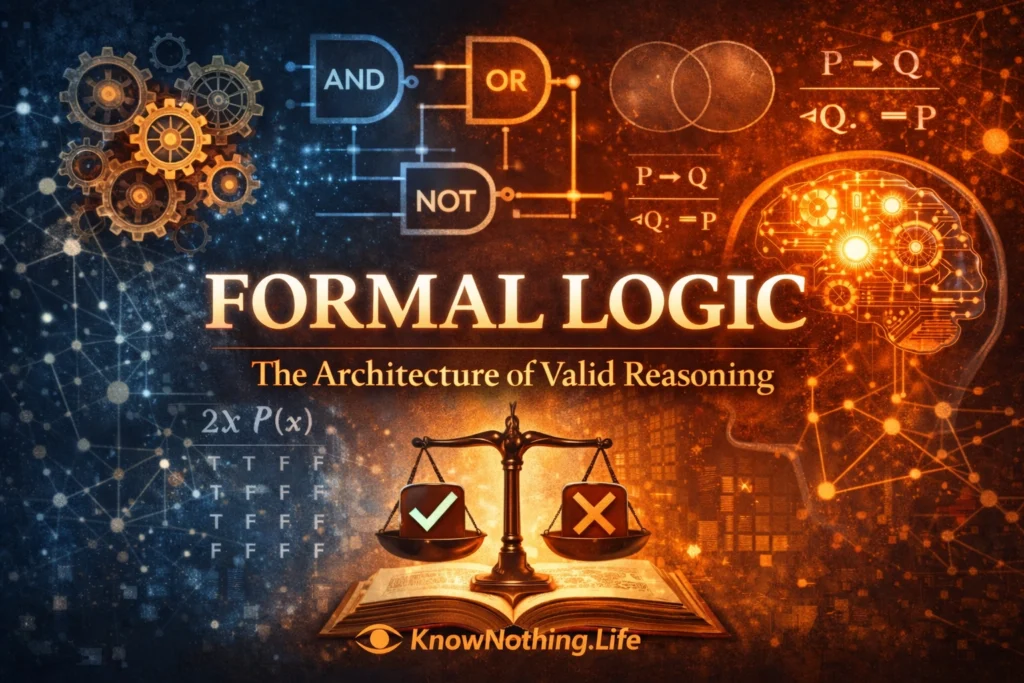
Formal logic is often divided into propositional logic and predicate logic, each addressing different levels of structure within arguments. Propositional logic deals with whole statements (propositions) and their logical connections, such as conjunction (“and”), disjunction (“or”), and negation (“not”). It provides tools for analyzing arguments where the internal structure of statements is not examined, focusing instead on how truth values combine through logical operators.
Predicate logic, by contrast, penetrates deeper into the structure of statements, analyzing how properties and relations apply to objects. Developed by Gottlob Frege and later refined by Bertrand Russell and Alfred North Whitehead in Principia Mathematica, predicate logic introduces quantifiers and variables, allowing for the precise expression of statements like “For every x, if x is human, then x is mortal.” This level of formalization made it possible to capture mathematical reasoning within a logical framework.
The power of predicate logic lies in its expressive capacity. It can represent not only simple categorical relationships but also complex structures involving identity, functions, and nested quantifiers. As Russell famously observed, “Mathematics may be defined as the subject in which we never know what we are talking about, nor whether what we are saying is true”—a remark that underscores the abstraction and formalism of logical systems. Predicate logic thus bridges philosophy and mathematics, providing a universal language for rigorous reasoning.
Systems, Symbols, and Formal Languages
A formal logical system consists of a precisely defined language, a set of axioms, and rules of inference. The language specifies the symbols and their permissible combinations; the axioms establish foundational truths; and the rules of inference determine how new statements can be derived. Together, these components create a self-contained system in which reasoning can be carried out mechanically and unambiguously.
The development of symbolic logic transformed reasoning into a formal procedure. George Boole introduced algebraic methods for logic in The Laws of Thought, demonstrating that logical operations could be expressed mathematically. Later, David Hilbert advanced the program of formalism, seeking to ground all of mathematics in a complete and consistent system of axioms. Hilbert famously declared, “We must know—we will know,” expressing confidence in the power of formal systems to capture all mathematical truths.
However, the aspiration for complete formalization encountered profound limits with the work of Kurt Gödel. In his incompleteness theorems, Gödel proved that any sufficiently powerful formal system cannot be both complete and consistent: there will always be true statements that cannot be proven within the system. This result revealed inherent constraints on formal logic, challenging the idea that all truths could be derived through purely formal means and reshaping the philosophy of mathematics.
Validity, Soundness, and Proof
Formal logic distinguishes carefully between validity and soundness. An argument is valid if its conclusion follows logically from its premises; it is sound if, in addition, its premises are true. This distinction is crucial: a valid argument can still have a false conclusion if its premises are false. Formal logic, therefore, concerns itself primarily with the structure of reasoning rather than the empirical truth of statements.
Proof theory, a central branch of formal logic, studies the nature of formal proofs—sequences of statements derived according to specified rules. In systems such as natural deduction and sequent calculus, proofs are constructed step by step, ensuring that each inference is justified. Gerhard Gentzen played a key role in developing these systems, emphasizing the structural properties of proofs rather than their semantic interpretation.
Complementing proof theory is model theory, which examines the relationship between formal languages and their interpretations. While proof theory focuses on derivability, model theory investigates truth in structures—whether a statement holds in a given interpretation. Together, these perspectives provide a comprehensive understanding of logical systems, linking syntax (formal structure) with semantics (meaning). As Alfred Tarski articulated, “The concept of truth… is to be defined in terms of satisfaction,” highlighting the formal relationship between language and reality.
Applications of Formal Logic
Formal logic has far-reaching applications beyond philosophy, shaping fields as diverse as computer science, linguistics, and artificial intelligence. In computer science, logical systems underpin programming languages, algorithms, and verification methods. Boolean logic, derived from the work of George Boole, forms the basis of digital circuits, enabling the design of modern computers. Logical frameworks also guide the development of software verification, ensuring that programs behave as intended.
In linguistics, formal logic provides tools for analyzing the structure of language and meaning. The work of Richard Montague demonstrated that natural language could be treated with the same formal rigor as logical systems, leading to the development of formal semantics. This approach allows linguists to model how meaning is constructed and interpreted, bridging the gap between language and logic.
Artificial intelligence represents another domain deeply influenced by formal logic. Early AI systems relied heavily on logical inference, using formal rules to simulate reasoning processes. Although contemporary AI incorporates probabilistic and machine learning methods, logic remains essential for knowledge representation and reasoning. As John McCarthy, one of the founders of AI, noted, “As soon as it works, no one calls it AI anymore”—a reflection of how foundational logical principles become invisible once integrated into technology.
Limitations and Critiques
Despite its power, formal logic has faced significant critiques and recognized limitations. One major concern is its abstraction: by focusing on form rather than content, formal logic may overlook the contextual and pragmatic aspects of reasoning. Critics argue that real-world reasoning often involves uncertainty, ambiguity, and informal heuristics that cannot be fully captured by rigid formal systems.
Philosophers such as Ludwig Wittgenstein challenged the assumption that logical structure underlies all meaningful discourse. In his later work, particularly Philosophical Investigations, Wittgenstein emphasized the diversity of language games and the context-dependent nature of meaning. “For a large class of cases… the meaning of a word is its use in the language,” he wrote, suggesting that formal logic represents only one aspect of linguistic practice.
Similarly, developments in non-classical logics—such as modal logic, intuitionistic logic, and fuzzy logic—have expanded the scope of formal reasoning. These systems address phenomena like necessity, belief, and vagueness, which classical logic struggles to accommodate. The proliferation of logical systems reflects both the adaptability of formal logic and the recognition that no single framework can capture all aspects of reasoning.
Conclusion
Formal logic stands as one of the most profound intellectual achievements in human history, providing a systematic framework for understanding valid reasoning. From the syllogisms of Aristotle to the symbolic systems of Gottlob Frege and the revolutionary insights of Kurt Gödel, the development of logic has transformed our conception of knowledge, truth, and inference.
Yet formal logic is not merely an abstract discipline; it is a living field that continues to evolve, influencing science, technology, and philosophy. Its methods shape the design of computers, the analysis of language, and the foundations of mathematics. At the same time, its limitations remind us that reasoning is a complex and multifaceted human activity, extending beyond the boundaries of formal systems.
In the end, formal logic reveals both the power and the limits of rational thought. It shows how far structure and precision can take us—and where interpretation, context, and creativity must take over. As the history of logic demonstrates, the pursuit of perfect reasoning is both an enduring aspiration and an invitation to deeper philosophical reflection.