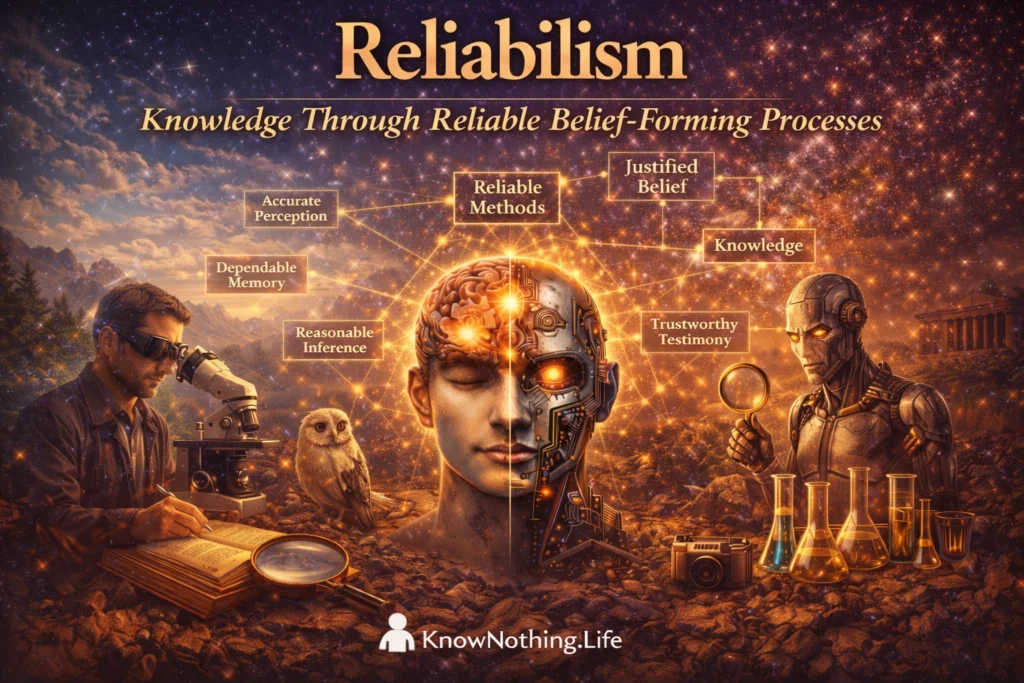
Reliabilism is one of the most influential contemporary theories of epistemic justification, offering a distinctive response to the challenges posed by skepticism and the limitations of traditional accounts of knowledge. Rather than focusing on whether a believer can consciously justify their beliefs, reliabilism shifts attention to the processes that produce those beliefs. According to this view, a belief is justified—and may count as knowledge—if it is formed through a process that reliably leads to truth.
This approach emerged in the late 20th century as a response to problems in classical epistemology, particularly those highlighted by Edmund Gettier. Gettier’s challenge showed that justified true belief is insufficient for knowledge, prompting philosophers to reconsider what justification entails. Reliabilism offers a solution by emphasizing the objective reliability of belief-forming mechanisms rather than subjective justification.
The theory is most closely associated with Alvin Goldman, whose work Epistemology and Cognition helped establish reliabilism as a central position in modern epistemology. By grounding justification in the reliability of cognitive processes, reliabilism provides a naturalistic account of knowledge that aligns closely with scientific understanding of the mind.
The Core Idea of Reliabilism
At its core, reliabilism defines justification in terms of the reliability of belief-forming processes. A process is considered reliable if it tends to produce true beliefs more often than false ones. Examples of such processes include normal perception, memory, and logical reasoning under appropriate conditions. If a belief arises from one of these reliable processes, it is considered justified—even if the individual cannot articulate the reasons behind it.
This marks a significant departure from traditional theories that emphasize internal justification. In classical epistemology, a belief is justified if the believer has access to reasons or evidence supporting it. Reliabilism, by contrast, allows for justified beliefs that are not consciously supported by reasons. For instance, a person may know that there is a tree in front of them simply by seeing it, without needing to provide a detailed justification for their perception.
The appeal of reliabilism lies in its ability to account for everyday knowledge. Much of what we know does not depend on explicit reasoning but on the functioning of cognitive systems that have evolved to track truth. By focusing on these systems, reliabilism provides a more realistic account of how knowledge operates in practice.
Goldman and the Development of Reliabilism
The modern formulation of reliabilism is largely credited to Alvin Goldman, who introduced the theory in his influential paper “A Causal Theory of Knowing” and later developed it in Epistemology and Cognition. Goldman argued that knowledge requires a causal connection between belief and truth, mediated by reliable processes.
Goldman’s approach emphasizes that beliefs must not only be true but must also arise in the right way. A belief that happens to be true by accident does not count as knowledge. Instead, the belief must be produced by a process that reliably tracks the truth. This idea addresses the problem of epistemic luck, which undermines the classical definition of knowledge.
In developing reliabilism, Goldman also drew on insights from cognitive science, suggesting that epistemology should be informed by empirical research into how the mind works. This naturalistic orientation distinguishes reliabilism from more traditional approaches, positioning it as a bridge between philosophy and science.
Reliabilism and the Gettier Problem
One of the primary motivations for reliabilism is its ability to address Gettier problems. In these cases, a belief is justified and true, yet it seems to fall short of knowledge because its truth is due to luck. Reliabilism seeks to eliminate this problem by requiring that beliefs be formed through reliable processes.
In a typical Gettier case, the belief is not produced by a process that reliably leads to truth. Instead, it involves a breakdown in the connection between justification and truth. By focusing on reliability, reliabilism ensures that justified beliefs are not merely true by coincidence but are systematically linked to reality.
However, reliabilism does not completely eliminate all forms of epistemic luck. Some critics argue that there are cases in which a belief is produced by a generally reliable process but still happens to be true by chance. These challenges have led to refinements of the theory, including the introduction of additional conditions to strengthen the connection between belief and truth.
Internalism vs. Externalism
Reliabilism is a form of externalism, a position that contrasts with internalist theories of justification. Internalists argue that justification depends on factors accessible to the subject’s conscious awareness, such as reasons or evidence. Externalists, by contrast, maintain that justification can depend on factors outside the subject’s awareness, such as the reliability of cognitive processes.
This distinction has significant implications for how we understand knowledge. Under internalism, a person must be able to justify their beliefs through reflection. Under reliabilism, however, a belief can be justified even if the person cannot explain why it is justified, as long as it is produced by a reliable process.
The debate between internalism and externalism reflects deeper questions about the nature of knowledge and the role of the knower. Reliabilism challenges the traditional emphasis on conscious justification, suggesting that knowledge is more closely tied to the functioning of cognitive systems than to the ability to articulate reasons.
Challenges and Criticisms
Despite its strengths, reliabilism faces several important criticisms. One major challenge concerns the definition of reliability. What counts as a reliable process, and how is reliability measured? Cognitive processes may be reliable in some contexts but not in others, making it difficult to establish clear criteria.
Another criticism involves cases of “new evil demon” scenarios, in which individuals have beliefs formed by processes that would normally be reliable but are deceived by external factors. In such cases, reliabilism may deny that the beliefs are justified, even though they seem reasonable from the subject’s perspective. This raises questions about whether reliabilism adequately accounts for the subjective aspect of justification.
Additionally, critics argue that reliabilism may allow for knowledge without understanding. If a belief is produced by a reliable process, it may count as knowledge even if the individual lacks insight into why it is true. This challenges the idea that knowledge involves not only truth but also comprehension.
Reliabilism and Contemporary Epistemology
In contemporary philosophy, reliabilism remains a central and evolving theory. It has been integrated into broader frameworks, including virtue epistemology, which emphasizes the role of intellectual virtues in producing reliable beliefs. These approaches combine the strengths of reliabilism with a focus on the character and abilities of the knower.
Reliabilism has also influenced discussions in social epistemology, where the reliability of information sources, such as experts and institutions, is a key concern. In an age of information overload, evaluating the reliability of belief-forming processes has become increasingly important.
Furthermore, reliabilism aligns closely with developments in cognitive science and artificial intelligence, which study how systems process information and produce beliefs. This interdisciplinary connection reinforces the relevance of reliabilism as a framework for understanding knowledge in both human and artificial contexts.
Conclusion
Reliabilism offers a powerful and innovative account of epistemic justification, shifting the focus from subjective reasoning to the objective reliability of belief-forming processes. By emphasizing the connection between belief and truth, it provides a compelling response to the challenges posed by skepticism and Gettier problems.
From the pioneering work of Alvin Goldman to its integration with contemporary research in cognitive science, reliabilism has reshaped the landscape of epistemology. Its naturalistic approach reflects a broader trend toward understanding knowledge in terms of real-world processes rather than abstract ideals.
As epistemology continues to evolve, reliabilism remains a central point of reference, highlighting the importance of reliability in the pursuit of knowledge. While challenges remain, its core insight—that knowledge depends on processes that reliably track truth—continues to guide philosophical inquiry into the nature of belief and justification.