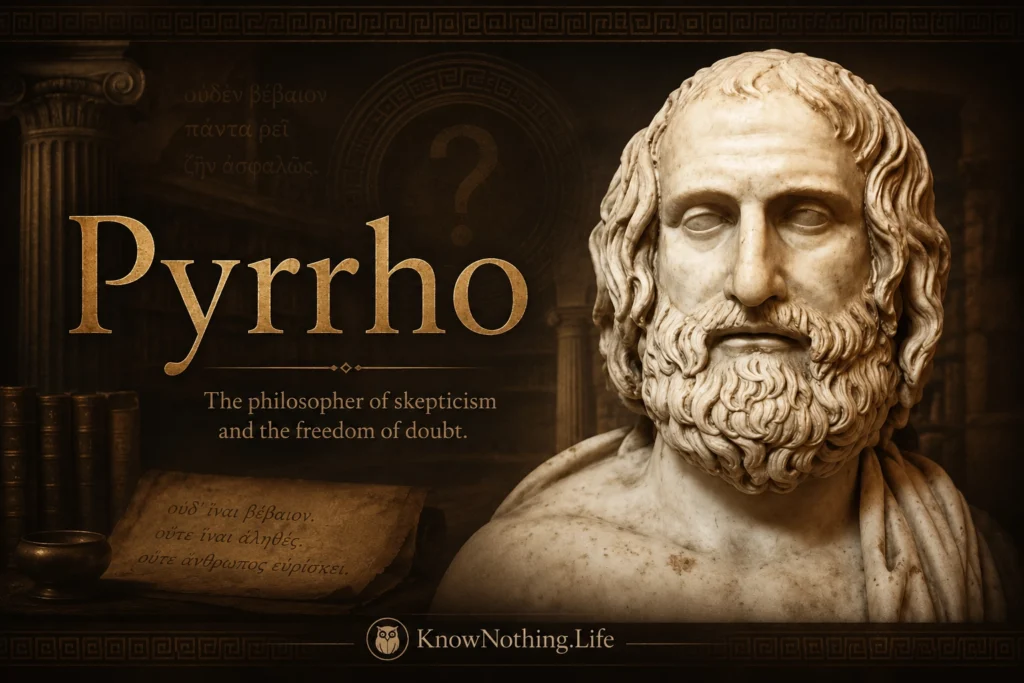
Pyrrho of Elis was born sometime around 365–360 BCE in the Greek city of Elis, in the northwestern Peloponnese. Unlike Plato, Aristotle, or Epicurus, he left behind no school texts, systematic treatises, or dialogues. His biography is therefore difficult to reconstruct. What survives is a mixture of ancient testimony, later anecdotes, and fragments connected to his most important follower, Timon of Phlius. Yet even through that uncertain evidence, Pyrrho appears as one of the most original figures in ancient philosophy: a thinker who turned doubt from a debating technique into a discipline of life.
Ancient sources suggest that Pyrrho may first have trained as a painter before turning to philosophy. He became associated with Anaxarchus of Abdera, a philosopher linked to the Democritean tradition, and this connection placed Pyrrho near the intellectual currents of atomism, ethical detachment, and anti-dogmatic reflection. His home city of Elis later honored him, and reports say he was respected there as a figure of unusual calm and independence. But Pyrrho’s fame came less from public office or writing than from the impression he made on those who saw how he lived.
Alexander’s Expedition and the East
One of the most striking traditions about Pyrrho is that he accompanied Alexander the Great’s expedition eastward, traveling with Anaxarchus and other intellectuals attached to the Macedonian campaign. Ancient reports say that during this journey he encountered Indian “gymnosophists,” or naked sages, and perhaps Persian Magi. Later writers claimed that these encounters influenced his philosophy, especially his indifference toward conventional values and his search for tranquility. The evidence is uncertain, but the story has remained important because it places Pyrrho at a rare crossroads between Greek philosophy and foreign ascetic wisdom.
Whether or not Indian thought decisively shaped him, the expedition itself likely exposed Pyrrho to the instability of ordinary human judgments. Empires rose and fell, customs differed radically, and what one people treated as sacred another might ignore. A philosopher who traveled through such a world could easily begin to suspect that human beings mistake habit for truth. Pyrrho’s later outlook seems built around exactly that suspicion: things appear to us in one way or another, but we should be cautious about claiming to know what they are by nature.
No Writings and the Problem of Evidence
Pyrrho wrote nothing that survives, and the best ancient source for his thought was his student Timon of Phlius. Timon wrote poems and prose works, including the Silloi, or Lampoons, and a work called Pytho, but these survive only in fragments and later reports. Much of what modern readers call Pyrrho’s philosophy comes through a complicated chain: Timon’s account, summarized by Aristocles of Messene, preserved by Eusebius centuries later. That means any biography of Pyrrho must be honest about uncertainty.
This uncertainty is not a weakness in the story; it is strangely appropriate. Pyrrho became the namesake of a tradition that warned against confident claims, and the evidence about him itself resists certainty. Diogenes Laertius later wrote plainly that “Pyrrho himself, indeed, left no writings.” That fact makes it hard to separate Pyrrho’s own views from later Pyrrhonism, especially the more developed skepticism of Aenesidemus and Sextus Empiricus. The historical Pyrrho may not have been a “Pyrrhonian” in the full later sense. He was the inspiring figure around whom a later skeptical tradition organized itself.
The Aristocles Passage
The most important testimony about Pyrrho is the so-called Aristocles passage, which reports Timon’s account of Pyrrho’s teaching. According to this passage, the person who wants happiness must consider three questions: what things are like by nature, what attitude we should take toward them, and what result will follow from that attitude. The reported answer is radical. Things are described as indifferent, unstable, and undecidable, and for that reason our perceptions and opinions should not be treated as finally true or false.
The passage is difficult, and scholars disagree about how to interpret it. On one reading, Pyrrho made a metaphysical claim: things themselves are indeterminate. On another reading, he made an epistemological claim: human beings cannot determine what things are in themselves. Either way, the practical result is similar. We should avoid dogmatic commitment. The formula often connected with Pyrrho is “no more this than that,” meaning that things should not be asserted to be one way rather than another in any final, absolute sense. This is not ordinary indecision. It is a disciplined refusal to mistake appearance for reality.
Suspension, Speechlessness, and Tranquility
The goal of Pyrrho’s outlook was not intellectual paralysis for its own sake. It was tranquility, or ataraxia. If we stop insisting that things are truly good, bad, honorable, shameful, desirable, or terrible by nature, then many of the disturbances that dominate ordinary life lose their force. We still experience hunger, pain, weather, danger, and social customs, but we no longer add the extra torment of dogmatic judgment. We live according to appearances without claiming to know the hidden nature of things.
The Aristocles passage says that the result of Pyrrho’s attitude is first aphasia, often understood as non-assertion or speechlessness, and then ataraxia. The movement is important. The skeptic is not merely silent because he has nothing to say; he becomes free from the compulsive need to declare how things really are. Later Pyrrhonists would develop this into a method of suspending judgment by setting opposing arguments against one another. Pyrrho himself appears more like a moral exemplar: someone whose freedom from dogmatic valuation produced extraordinary calm.
A Life of Radical Indifference
Ancient anecdotes portray Pyrrho as almost unbelievably undisturbed. Some stories say he ignored dangers, precipices, carts, or dogs, and had to be protected by friends. Modern scholars treat these tales cautiously, since they may be exaggerations designed to dramatize his philosophy. Still, they show how later antiquity remembered him: as a man who had trained himself not to react in ordinary ways to fear, pain, insult, or fortune. His life became a philosophical performance.
Other reports are more plausible and more revealing. Pyrrho was said to have lived simply, traveled with his sister to market, cleaned household animals, and accepted ordinary tasks without shame. These details suggest that his indifference was not aristocratic contempt but freedom from status anxiety. He did not need to appear important. He did not need to win arguments. He did not need the world to confirm his judgments. In this sense, Pyrrho’s skepticism was ethical before it was technical. It aimed at a liberated relation to life.
Pyrrho and Later Pyrrhonism
The later school called Pyrrhonism developed more fully in the centuries after Pyrrho’s death. Aenesidemus, probably in the first century BCE, revived or reshaped skeptical practice, and Sextus Empiricus later preserved the most extensive surviving Pyrrhonian writings. These later skeptics used structured arguments, such as the Ten Modes and Five Modes, to generate suspension of judgment. Their method was dialectical: oppose every argument with an argument of equal force, and let the mind rest in suspension.
Pyrrho’s own approach seems less systematic. He did not leave handbooks of skeptical argument, and he may have been less interested in endless debate than in freedom from disturbance. Yet later Pyrrhonists took him as their symbolic founder because he embodied the goal they pursued. They could refine the arguments, but Pyrrho supplied the image: a human being no longer enslaved by the need for certainty. His importance lies not only in what he taught, but in the way his life became a model of skeptical serenity.
Legacy and Lasting Importance
Pyrrho probably died around 275–270 BCE. His direct influence in the ancient world may have been limited at first, but his name eventually became attached to one of the most important skeptical traditions in philosophy. Through Sextus Empiricus, Pyrrhonian skepticism later influenced Renaissance and early modern thinkers, including Montaigne, Descartes, Hume, and many others who wrestled with the limits of certainty. The word “Pyrrhonism” came to mean not casual doubt, but a deep challenge to dogmatic claims about knowledge, truth, value, and reality.
Pyrrho remains essential because he made skepticism existential. He did not merely ask whether knowledge is possible; he asked what kind of life becomes possible when the craving for certainty is loosened. His answer was not despair, but tranquility. To modern readers, Pyrrho can seem extreme, even impossible. Yet his challenge remains powerful: much of human misery comes not only from what happens, but from what we insist things must mean. Pyrrho’s legacy is the unsettling thought that peace may begin where certainty ends.