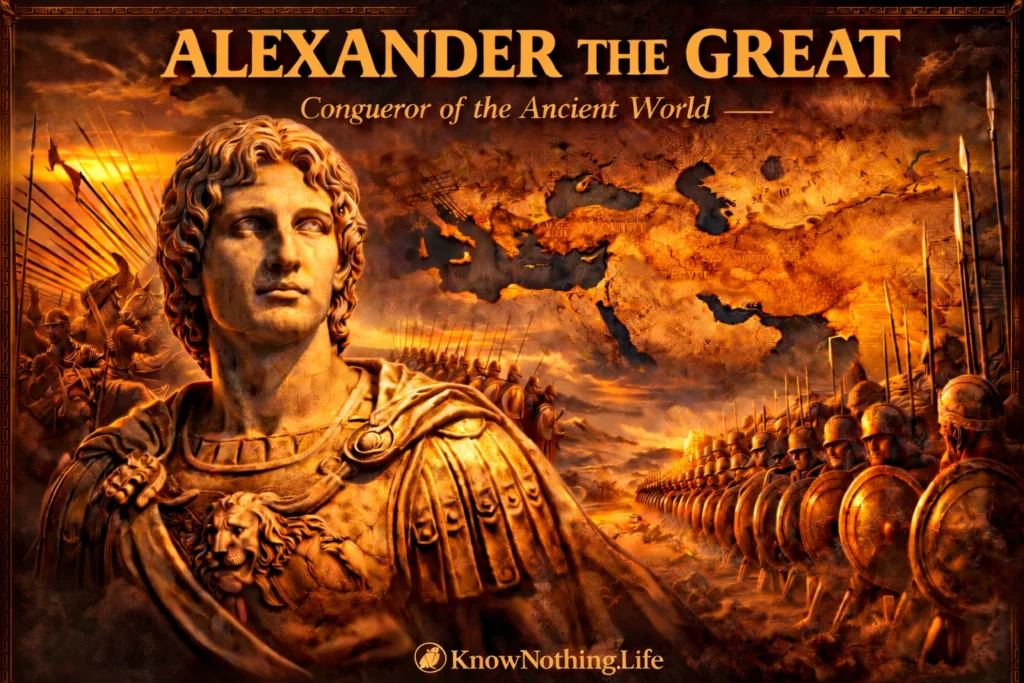
The legacy of Alexander the Great stands as one of the most extraordinary in human history, defined by military brilliance, cultural transformation, and an enduring mythos that borders on legend. In little more than a decade, Alexander forged one of the largest empires the ancient world had ever seen, stretching from Greece to Egypt and deep into Asia. Yet his significance extends beyond conquest; he reshaped the political, cultural, and intellectual landscape of the ancient world.
Born in 356 BCE in Pella, Alexander inherited both ambition and opportunity. The son of King Philip II of Macedon, he was raised in a court that valued strength, strategy, and education. Under the guidance of Aristotle, Alexander developed a deep appreciation for philosophy, science, and literature—an education that would influence his vision of empire. His life represents a convergence of intellect and action, where philosophical ideals met the realities of power.
Early Life and Formation
Alexander’s early years were marked by discipline and expectation. His father, Philip II, had transformed Macedon into a formidable military power, laying the groundwork for expansion beyond Greece. From a young age, Alexander was trained in warfare, leadership, and statecraft, preparing him for the responsibilities of kingship.
The influence of Aristotle on Alexander’s development cannot be overstated. Under his tutelage, Alexander studied philosophy, medicine, and the works of Homer, particularly the Iliad, which he reportedly carried with him on campaign. This education instilled in him a sense of destiny and a desire to achieve greatness, shaping his identity as both a warrior and a thinker.
A defining moment in his youth was the taming of the horse Bucephalus, an event that symbolized his courage and determination. According to historical accounts, Alexander recognized that the horse was frightened of its own shadow and turned it toward the sun, calming it. This episode reflects his ability to see what others overlooked—a trait that would define his leadership.
Rise to Power
In 336 BCE, following the assassination of Philip II, Alexander ascended to the throne at the age of 20. His succession was not without challenges; he faced internal dissent and external threats from Greek city-states seeking independence. Demonstrating decisive leadership, Alexander quickly consolidated power, suppressing rebellions and reasserting Macedonian dominance.
One of his first major actions was the destruction of Thebes, a powerful Greek city that had revolted against Macedonian rule. This act served as both a warning and a demonstration of his resolve, ensuring stability within Greece before he turned his attention outward.
With Greece secured, Alexander embarked on his campaign against the Persian Empire, fulfilling his father’s vision of expansion. This decision marked the beginning of a series of military campaigns that would redefine the boundaries of the known world.
Conquest of the Persian Empire
Alexander’s campaign against the Persian Empire began in 334 BCE with the crossing of the Hellespont into Asia Minor. His early victories, including the Battle of Granicus, demonstrated his tactical brilliance and the effectiveness of the Macedonian phalanx. These successes paved the way for deeper incursions into Persian territory.
The Battle of Issus in 333 BCE marked a turning point, as Alexander defeated the Persian king Darius III. Despite being outnumbered, Alexander’s strategic use of terrain and disciplined forces secured a decisive victory. This triumph established his reputation as a formidable commander and opened the path to further conquest.
Following Issus, Alexander continued his campaign through the eastern Mediterranean, capturing key cities such as Tyre and Gaza. His conquest of Egypt was met with relatively little resistance, and he was welcomed as a liberator. In Egypt, he founded the city of Alexandria, which would become a center of culture and learning for centuries.
Expansion into Asia
After consolidating his control over Egypt and the eastern Mediterranean, Alexander turned his attention to the heart of the Persian Empire. The decisive Battle of Gaugamela in 331 BCE resulted in the complete defeat of Darius III, effectively ending Persian dominance and establishing Alexander as the ruler of a vast empire.
Rather than stopping at Persia, Alexander continued his campaigns into Central Asia and India. His journey into these regions exposed his army to unfamiliar cultures, landscapes, and challenges. Despite resistance and logistical difficulties, he pressed forward, driven by a desire to reach the limits of the known world.
However, his troops eventually grew weary, particularly during the campaign in India. At the Hyphasis River, they refused to advance further, forcing Alexander to turn back. This moment highlights the limits of even the greatest ambition, as the realities of distance and endurance constrained his vision.
Leadership and Cultural Integration
Alexander’s leadership extended beyond the battlefield. He sought to unify his diverse empire through cultural integration, encouraging the blending of Greek and Eastern traditions. This approach is often referred to as Hellenization, reflecting the spread of Greek culture across conquered territories.
He adopted elements of Persian dress and customs, a decision that was controversial among his Macedonian followers. By doing so, he aimed to present himself as a universal ruler, capable of bridging cultural divides. His marriages, including that to Roxana of Bactria, further symbolize this effort to integrate different peoples.
Alexander’s founding of cities, particularly Alexandria in Egypt, played a crucial role in the dissemination of Greek culture. These cities became centers of trade, education, and intellectual exchange, shaping the cultural landscape of the ancient world long after his death.
Quotes and Key Ideas
Although Alexander is not known for philosophical writings, several statements attributed to him reflect his character and ambitions:
- “There is nothing impossible to him who will try.”
- “I am not afraid of an army of lions led by a sheep; I am afraid of an army of sheep led by a lion.”
- “Remember, upon the conduct of each depends the fate of all.”
- “To the strongest.” (reportedly his answer when asked who should inherit his empire)
These quotes reveal a leader driven by determination, courage, and a belief in individual responsibility. They capture the spirit of a figure who sought not only to conquer, but to inspire.
Death and Legacy
Alexander’s life came to an abrupt end in 323 BCE in Babylon at the age of 32. The cause of his death remains uncertain, with theories ranging from illness to poisoning. His sudden passing left his empire without a clear successor, leading to a period of fragmentation and conflict among his generals.
Despite the collapse of his political empire, Alexander’s cultural legacy endured. The Hellenistic period that followed saw the spread of Greek language, art, and philosophy across a vast region, influencing subsequent civilizations. His conquests facilitated the exchange of ideas and knowledge, contributing to the development of science, literature, and philosophy.
Alexander’s legacy is complex, encompassing both the achievements of a visionary leader and the consequences of relentless conquest. He remains a symbol of ambition, power, and the transformative potential of human action.
Conclusion
Alexander the Great stands as one of history’s most compelling figures, embodying the intersection of ambition, intellect, and action. His achievements in warfare and governance reshaped the ancient world, leaving a legacy that continues to be studied and debated.
Through his conquests, he not only expanded territories but also facilitated cultural exchange, creating a lasting impact on the development of civilization. His life illustrates both the possibilities and limitations of human ambition, offering a narrative that is as inspiring as it is cautionary.
In the centuries since his death, Alexander has been remembered as a hero, a conqueror, and a symbol of greatness. His story continues to captivate, reminding us of the enduring influence of those who dare to reshape the world.