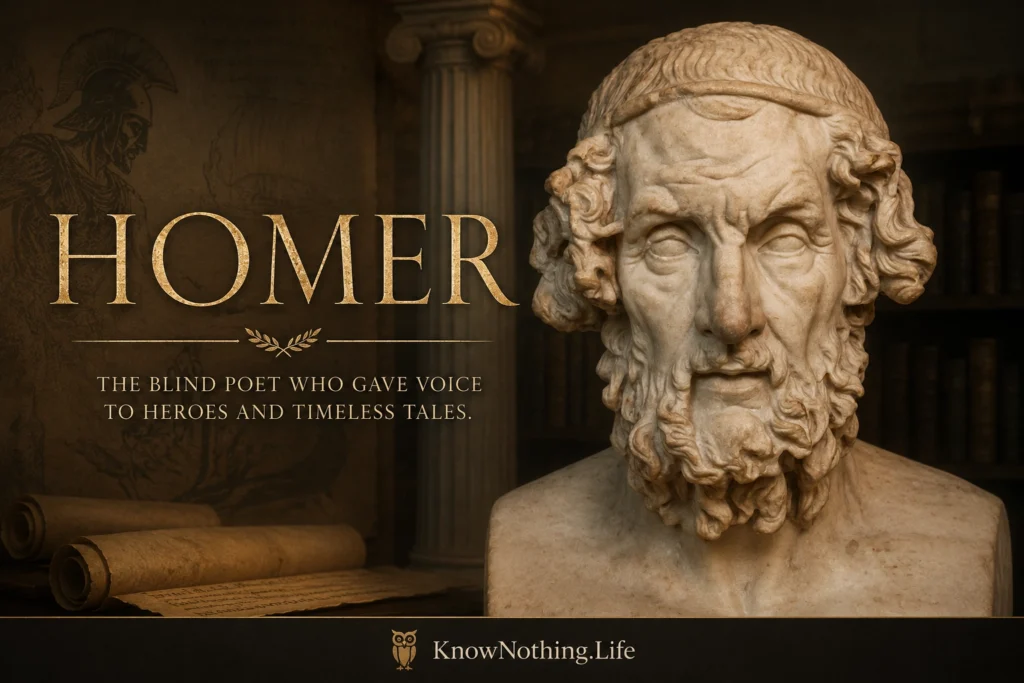
Homer stands at the beginning of Western literature, yet almost nothing certain is known about his life. Ancient tradition remembered him as a blind poet, a wandering singer, and the author of the Iliad and the Odyssey, but modern scholarship treats those traditions with caution. He may have lived sometime around the eighth century BCE, perhaps in Ionia or another Greek-speaking region of the eastern Aegean. Cities such as Smyrna, Chios, Colophon, and Ios all claimed some connection to him, but these claims reveal more about his later prestige than about verifiable biography.
This uncertainty does not make Homer unimportant. It makes him more fascinating. Unlike later writers whose letters, homes, schools, and patrons can be reconstructed, Homer survives almost entirely through the poems attributed to him. The “biography” of Homer is therefore inseparable from the history of epic performance, memory, and tradition. He may have been one extraordinary poet, a name attached to a long oral tradition, or the final shaping figure behind inherited songs. What remains undeniable is that the name Homer became the symbol of epic genius.
The Oral World of Epic Poetry
The Homeric poems grew out of an oral culture in which singers performed stories before audiences rather than writing books for private readers. These singers, often called aoidoi or bards, used meter, repeated phrases, type-scenes, and traditional formulas to compose and remember vast narratives. The famous Homeric epithets, such as “swift-footed Achilles” and “rosy-fingered Dawn,” are not merely decorative. They belong to a living poetic system designed for performance, rhythm, memory, and variation.
Modern understanding of Homer changed dramatically through the work of Milman Parry and Albert Lord, who showed how oral-formulaic poetry could generate long, complex epics without modern written authorship. This does not mean the Iliad and the Odyssey are careless patchworks. They are unified, powerful poems shaped by immense artistic intelligence. But their artistry belongs to a world where tradition and invention worked together. Homer, whether one person or a poetic name, represents the point where centuries of heroic song became enduring literature.
The Iliad and the Tragedy of Anger
The Iliad is not a complete story of the Trojan War. It focuses on a brief but devastating episode near the end of the war: the quarrel between Achilles and Agamemnon, Achilles’ withdrawal from battle, the death of Patroclus, Achilles’ return in rage, and his final encounter with Priam, the father of Hector. The poem begins with one of the most famous invocations in literature: “Sing, goddess, the anger of Peleus’ son Achilles.” From the first line, Homer announces that the true subject is not merely war, but destructive emotion.
Achilles’ anger brings suffering to Greeks and Trojans alike. He is heroic, magnificent, terrifying, and morally unstable. The poem does not simply glorify battle. It reveals the cost of honor when honor becomes absolute. Hector fights for Troy, family, and reputation; Achilles fights for glory and grief; Priam kneels before the killer of his son and asks for mercy. In that final scene, the Iliad becomes more than a war poem. It becomes a meditation on mortality, compassion, and the shared grief of enemies.
The Odyssey and the Longing for Home
The Odyssey tells a different kind of heroic story. Its opening asks the Muse to tell of “the man of many ways,” Odysseus, who wandered after the fall of Troy. Unlike Achilles, Odysseus is not defined by overwhelming force or tragic rage. He is defined by intelligence, endurance, disguise, speech, and survival. His greatness lies in adaptation. He escapes the Cyclops, resists Circe’s enchantment, hears the Sirens, descends to the underworld, survives shipwreck, and returns to Ithaca disguised as a beggar.
Yet the Odyssey is not only an adventure tale. It is a poem about identity, memory, hospitality, temptation, loyalty, and homecoming. Odysseus must return not only to a place, but to a role: husband, father, king, and human being after years of war and wandering. Penelope’s patience, Telemachus’s coming of age, Argos the dog’s recognition, and the bow contest all turn home into a moral and emotional test. The poem asks whether a person can come back from violence and still belong among the living.
Gods, Fate, and Human Greatness
Homer’s world is filled with gods, but the gods do not erase human responsibility. Zeus, Hera, Athena, Apollo, Poseidon, and Aphrodite intervene constantly, yet human beings still choose, suffer, boast, deceive, love, and die. The gods often magnify human conflict rather than solve it. They protect favorites, punish arrogance, and quarrel among themselves. Homer’s divine world is vivid, dramatic, and morally complicated.
The human characters matter precisely because they are mortal. In Homer, glory shines because life is brief. Achilles knows he may gain immortal fame only by accepting an early death. Odysseus longs for home because even immortality with Calypso cannot replace mortal belonging. One of the great Homeric truths is that human life is fragile, but not meaningless. The heroes are not admirable because they escape death. They are memorable because they act, speak, love, grieve, and endure beneath its shadow.
Language, Style, and Poetic Power
Homer’s poetry is marked by speed, clarity, repetition, and enormous emotional range. His similes are among the most powerful features of the epics. Warriors are compared to lions, storms, fires, trees, birds, and mothers. These similes do more than decorate battle scenes. They bring the whole natural and domestic world into the poem, reminding the listener that war is not separate from ordinary life. A battlefield can suddenly open into an image of farming, weather, childbirth, hunting, or grief.
The poems are also built from scenes of speech. Heroes persuade, insult, plead, lament, advise, and remember. Homer’s world is oral not only in composition but in values. To speak well is to reveal character. Achilles’ refusal, Hector’s farewell to Andromache, Priam’s plea, Odysseus’s lies, Penelope’s questions, and Telemachus’s first public speech all show that human destiny is shaped by words. The Homeric hero must be strong in action and powerful in language.
Works Attributed to Homer
The two works securely associated with Homeric fame are the Iliad and the Odyssey. In antiquity, other poems were also attributed to Homer, including parts of the Epic Cycle and the Homeric Hymns, but modern scholars generally treat those attributions as uncertain or traditional rather than secure. The Homeric Hymns are important ancient poems in their own right, addressed to gods such as Apollo, Demeter, Hermes, and Aphrodite, but they likely come from a broader Homeric tradition rather than from the same authorial hand as the great epics.
This distinction matters because “Homer” became not only a person’s name but a cultural authority. To call a poem Homeric was to place it near the source of Greek poetic prestige. The Iliad and the Odyssey became school texts, performance texts, moral examples, mythological sources, and artistic models. Ancient Greeks learned who their gods and heroes were through Homer, and later Europeans learned what epic poetry could be through him.
Legacy and Lasting Importance
Homer’s influence is almost impossible to measure. Greek tragedy, philosophy, history, Roman epic, Renaissance humanism, Romantic poetry, modern novels, war literature, translation theory, and comparative mythology all return to Homer. Aeschylus, Sophocles, Euripides, Plato, Aristotle, Virgil, Dante, Milton, Joyce, and countless others wrote in his shadow. The Iliad shaped how the West imagines war and glory; the Odyssey shaped how it imagines wandering, exile, intelligence, and return.
Homer remains essential because his poems are both ancient and permanently human. They preserve a vanished heroic world, yet they speak with startling directness about anger, grief, honor, loyalty, deception, longing, violence, and home. Whether Homer was one poet, a tradition, or a name given to the final form of inherited songs, the achievement remains extraordinary. The Iliad and the Odyssey do what the greatest literature always does: they make the distant past feel immediate, and they make human life larger by singing it.