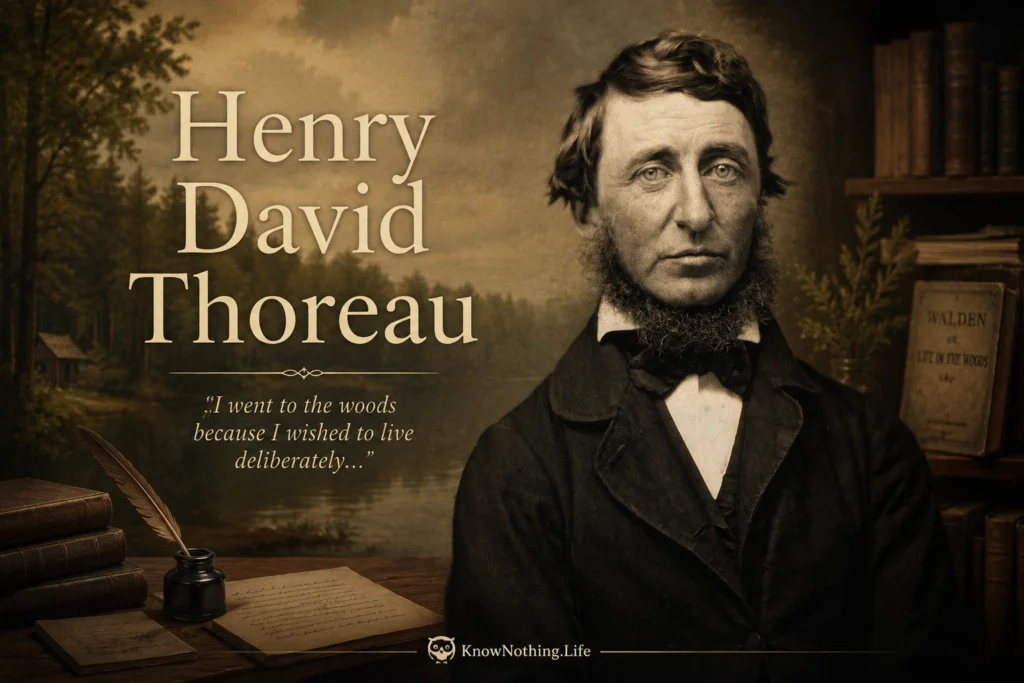
Henry David Thoreau was born David Henry Thoreau on July 12, 1817, in Concord, Massachusetts, a town that would become the physical and spiritual center of his life. He was the son of John Thoreau, a pencil maker, and Cynthia Dunbar Thoreau, and he grew up in a household shaped by work, reform-minded conversation, education, and practical independence. After graduating from Harvard College in 1837, he reversed his first and middle names and became known as Henry David Thoreau, though the change was informal rather than legally formalized.
Concord gave Thoreau more than a birthplace. It gave him a landscape, a moral problem, and a vocation. Its woods, ponds, rivers, farms, roads, and seasons became the field of his thought. He did not treat nature as scenery. He treated it as a living presence, a teacher, and a form of revelation. At a time when American society was expanding commercially and politically, Thoreau asked what kind of life was actually worth living. That question would guide everything he wrote.
Emerson, Transcendentalism, and Self-Reliance
Thoreau became closely associated with Ralph Waldo Emerson, who served as friend, mentor, employer, and sometimes critic. Through Emerson, he entered the circle of New England Transcendentalism, a movement that emphasized intuition, spiritual independence, moral reform, nature, and the dignity of the individual soul. Yet Thoreau was never merely Emerson’s disciple. He absorbed Transcendentalist ideals and then tested them with his body, labor, walking, measuring, planting, building, and observing.
Thoreau taught school, worked in his family’s pencil business, surveyed land, lectured, wrote essays, and kept a massive journal. He resisted conventional success because he distrusted the terms by which society measured it. “The mass of men lead lives of quiet desperation,” he wrote in Walden, one of the most famous sentences in American literature. The line is not a slogan of contempt. It is a diagnosis of lives spent obeying inherited expectations, earning unnecessary comforts, and forgetting the deeper possibilities of existence.
A Week on the Concord and Merrimack Rivers
Thoreau’s first book, A Week on the Concord and Merrimack Rivers, was published in 1849. It grew out of a boat trip he took with his brother John in 1839, before John’s early death from tetanus in 1842. The book is partly travel narrative, partly elegy, partly philosophical meditation, and partly literary experiment. Its outward subject is a river journey; its inward subject is memory, friendship, reading, time, and the movement of the soul through nature.
The book sold poorly, and Thoreau later had to take back unsold copies. Yet its commercial failure did not diminish its importance in his development. A Week showed Thoreau finding a form of writing that could move between observation and reflection, landscape and literature, personal grief and universal question. It also showed his resistance to simple genre. He was not merely a nature writer, philosopher, poet, or reformer. He was all of these at once.
Walden and Deliberate Living
On July 4, 1845, Thoreau moved into a small house he had built near Walden Pond, on land owned by Emerson. He lived there for two years, two months, and two days, supporting himself with modest labor, growing beans, reading, walking, receiving visitors, and observing the pond and surrounding woods. The experiment was not pure isolation. He walked into Concord, entertained guests, and remained connected to family and community. But Walden gave him distance from ordinary social assumptions.
Walden; or, Life in the Woods, published in 1854, transformed that experiment into one of the central books of American literature. Thoreau wrote, “I went to the woods because I wished to live deliberately.” The book is not a simple manual of rustic living. It is an argument for attention, economy, freedom, and awakening. Thoreau wanted to strip life down to its essentials so he could discover what was necessary and what was merely habit. His real subject was not the cabin, but consciousness.
Work, Simplicity, and Critique of Modern Life
Thoreau’s attack on materialism in Walden remains one of his most enduring contributions. He did not oppose tools, shelter, trade, or labor. He opposed the way people become possessed by their possessions. He saw houses, clothes, debts, ambitions, and social status turning into invisible prisons. “Our life is frittered away by detail,” he warned, urging readers to “Simplify, simplify.” The force of the line lies in its refusal to treat busyness as depth.
His simplicity was not laziness. Thoreau was a worker, walker, builder, surveyor, gardener, and meticulous observer. He objected not to effort but to misdirected effort. If a person spends life earning what he does not need, he has not become independent; he has become dependent on the machinery of desire. Thoreau’s economy was therefore moral and spiritual. It asked what a person must give up in order to become awake.
Civil Disobedience and Moral Resistance
In 1846, Thoreau spent a night in jail after refusing to pay a poll tax, partly in protest against slavery and the Mexican-American War. This experience helped shape his essay “Resistance to Civil Government,” first published in 1849 and later known as “Civil Disobedience.” The essay became one of the most influential political texts in modern history, especially for later traditions of nonviolent resistance. Thoreau begins with the motto, “That government is best which governs least,” but his deeper argument is about conscience.
For Thoreau, the individual must not surrender moral judgment to the state. If the law requires complicity in injustice, obedience becomes a form of participation. “Under a government which imprisons any unjustly,” he wrote, “the true place for a just man is also a prison.” This was not an abstract theory of rebellion. It was a demand that citizens take responsibility for the moral consequences of their compliance. Thoreau’s influence would later reach figures such as Mahatma Gandhi and Martin Luther King Jr., though each adapted him to very different historical struggles.
Abolitionism and Public Courage
Thoreau’s antislavery commitments deepened over time. He supported fugitives from slavery, condemned the Fugitive Slave Law, and attacked the moral corruption of a government that protected human bondage. In “Slavery in Massachusetts,” he denounced the state’s complicity in returning escaped people to slavery. He refused to treat slavery as a distant Southern issue. For him, it was a test of Northern conscience.
His 1859 essay “A Plea for Captain John Brown” remains one of his most controversial works. After Brown’s raid on Harpers Ferry, many respectable antislavery voices distanced themselves from him. Thoreau defended Brown’s courage and moral seriousness, even while Brown’s violence remains a difficult historical problem. Thoreau’s praise was not a general glorification of bloodshed. It was an indictment of a society that tolerated slavery while condemning those who risked their lives to oppose it. In that sense, his political writing was always aimed at moral sleep.
Walking, Wildness, and Natural Science
Thoreau’s later work increasingly joined literature, natural history, and environmental philosophy. His essay “Walking,” published after his death, contains one of his most famous declarations: “In Wildness is the preservation of the World.” The line is often misquoted as “wilderness,” but “wildness” is more precise. Thoreau did not mean only remote forests. He meant the untamed, living, generative force that resists reduction to property, routine, and control.
His journals, eventually filling many volumes, show a disciplined naturalist observing flowering dates, ice, birds, seeds, weather, animal tracks, forest succession, and seasonal change around Concord. Works published after his death, including The Maine Woods, Cape Cod, and Excursions, further revealed his range as a travel writer, natural observer, and philosopher of place. Thoreau’s environmental importance has grown because he understood nature as more than a resource. It was a world of relations in which human beings must learn humility.
Final Years and Lasting Legacy
Thoreau suffered from tuberculosis, which had troubled him periodically since young adulthood. He died in Concord on May 6, 1862, at the age of forty-four. At his funeral, Emerson said that the country did not yet know “how great a son it has lost.” That judgment proved prophetic. Thoreau’s reputation grew steadily after his death, especially through Walden, “Civil Disobedience,” his journals, and his later nature writings.
Henry David Thoreau remains essential because he joined inward freedom with outward responsibility. He asked readers to live deliberately, resist injustice, simplify desire, pay attention to nature, and refuse moral sleep. His life was not a retreat from the world, but a search for a truer way to inhabit it. He remains one of America’s most radical writers because his question still unsettles every age of comfort and distraction: what are we doing with the brief life we have been given?