Epicurus was born in 341 BCE on the island of Samos, during a period when Greek philosophy was rapidly evolving beyond its classical foundations. Unlike earlier thinkers who focused primarily on cosmology or metaphysics, Epicurus would become one of the first philosophers to place human happiness at the center of philosophical inquiry. His life and work emerged in the aftermath of Alexander the Great’s empire, a time marked by political fragmentation and uncertainty. In this shifting world, individuals increasingly sought personal stability and meaning rather than participation in civic life.
Epicurus’ family was of Athenian origin, and he later returned to Athens, where he would establish his philosophical school. Before founding his own movement, he studied under various teachers, including followers of Democritus, whose atomistic philosophy deeply influenced him. However, Epicurus did not merely adopt earlier ideas; he reshaped them into a system that addressed both the physical nature of the universe and the psychological needs of human beings. His education also included exposure to Platonic and Aristotelian traditions, though he ultimately rejected many of their core assumptions.
From an early stage, Epicurus demonstrated an independent and critical mind. He reportedly began teaching philosophy at a young age, developing his ideas outside the dominant schools of the time. This independence would remain a hallmark of his philosophy. Rather than seeking to align himself with established authorities, he constructed a system aimed at practical living—one that sought to eliminate fear, reduce suffering, and cultivate lasting tranquility.
The Garden and the Epicurean Community
Epicurus is best known for founding “The Garden” in Athens around 306 BCE, a philosophical community that differed significantly from other schools of the time. Unlike the Academy of Plato or the Lyceum of Aristotle, The Garden was intentionally inclusive, welcoming women and even slaves—an unusual practice in ancient Greece. This inclusivity reflected Epicurus’ belief that philosophy should be accessible to all who seek a better life.
The Garden functioned not only as a place of learning but as a way of life. Members lived simply, emphasizing friendship, moderation, and intellectual discussion. Epicurus believed that close relationships were essential to happiness, famously declaring, “Of all the things which wisdom provides to make life entirely happy, much the greatest is the possession of friendship.” This emphasis on community distinguished Epicureanism from more individualistic philosophies and underscored the social dimension of well-being.
Life in The Garden was guided by practical principles rather than abstract speculation. Epicurus discouraged the pursuit of wealth, fame, and political power, viewing these as sources of anxiety rather than fulfillment. Instead, he advocated for a life centered on modest pleasures, intellectual clarity, and emotional stability. This approach made Epicureanism particularly appealing in a time of political instability, offering a path to inner peace independent of external circumstances.
Atomism and the Nature of Reality
Epicurus adopted and refined the atomistic theory developed by Democritus, using it as the foundation for his understanding of the universe. According to Epicurus, all things are composed of atoms moving through the void. These atoms are eternal and unchanging, while the combinations they form give rise to the diverse phenomena of the world. By explaining nature in purely physical terms, Epicurus sought to eliminate the fear of supernatural forces and divine intervention.
One of his key innovations was the introduction of the “swerve,” a slight and unpredictable deviation in the motion of atoms. This concept allowed Epicurus to account for free will within a deterministic framework, suggesting that human actions are not entirely predetermined. The swerve also served to break the rigid necessity implied by earlier atomistic theories, opening the door to spontaneity and choice.
Epicurus’ natural philosophy had profound ethical implications. By demonstrating that the universe operates according to natural laws rather than divine whims, he aimed to free individuals from fear—particularly the fear of the gods and of death. As he famously wrote, “Death is nothing to us; for when we exist, death is not present, and when death is present, we do not exist.” This statement encapsulates his effort to remove one of the greatest sources of human anxiety, allowing individuals to focus on living well rather than fearing the inevitable.
Ethics and the Pursuit of Pleasure
Epicurus’ ethical philosophy is often misunderstood as a form of hedonism centered on indulgence. In reality, his conception of pleasure is far more nuanced. For Epicurus, the highest good is not intense or fleeting pleasure, but a stable state of tranquility known as “ataraxia,” combined with the absence of physical pain, or “aponia.” This understanding redefines pleasure as the absence of suffering rather than the presence of excess.
He distinguished between different types of desires: natural and necessary desires (such as food and shelter), natural but unnecessary desires (such as luxury), and vain desires (such as wealth and fame). By satisfying only the first category and minimizing the others, individuals can achieve a balanced and contented life. This approach reflects a disciplined and rational pursuit of happiness, rather than unrestrained indulgence.
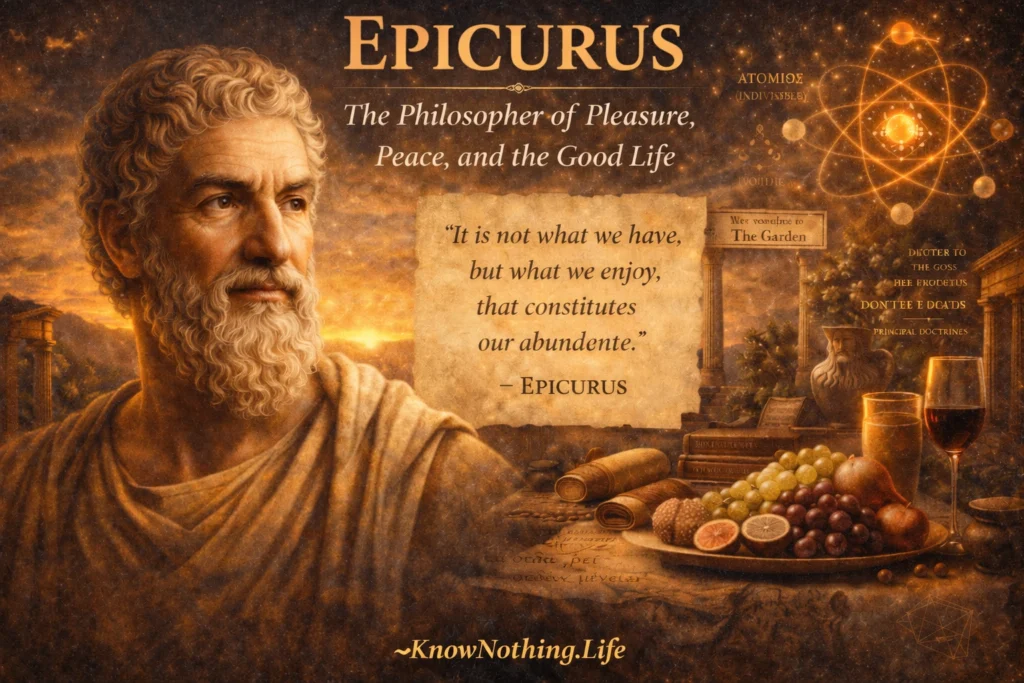
Epicurus emphasized the importance of mental pleasures over physical ones, arguing that the mind’s capacity for reflection and anticipation allows for deeper and more lasting satisfaction. He also highlighted the role of knowledge in achieving happiness, as understanding the nature of the world removes irrational fears. As he succinctly stated, “It is not what we have, but what we enjoy, that constitutes our abundance.” This perspective underscores the importance of perception and attitude in shaping human experience.
Major Works and Intellectual Legacy
Epicurus was a prolific writer, reportedly composing over 300 works, though only a small portion survives today. His most important surviving texts include the Letter to Herodotus, which outlines his natural philosophy; the Letter to Menoeceus, which presents his ethical teachings; and the Principal Doctrines, a collection of concise philosophical statements. These works provide a clear and systematic exposition of his ideas, emphasizing both theoretical understanding and practical application.
His philosophy was later developed and transmitted by followers such as Lucretius, whose poem De Rerum Natura offers a detailed account of Epicurean thought. Through Lucretius and others, Epicureanism influenced Roman intellectual life and persisted as a significant philosophical tradition. Despite periods of decline, its core ideas have continued to resonate, particularly in discussions of happiness, ethics, and the nature of the universe.
In the modern era, Epicurus has been reevaluated as a thinker whose insights align with contemporary understandings of well-being. His emphasis on mental health, emotional balance, and the reduction of unnecessary desires anticipates modern psychological approaches to happiness. By grounding ethics in human experience rather than abstract ideals, he created a philosophy that remains both accessible and relevant.
Final Years and Enduring Influence
Epicurus spent his later years in Athens, continuing to teach and write despite suffering from chronic illness. His personal resilience and commitment to his philosophy are evident in his final writings, in which he maintained a focus on joy and gratitude even in the face of physical pain. According to tradition, he wrote in a letter near the end of his life, “I write this to you on a happy day, which is also the last day of my life,” demonstrating the depth of his commitment to his principles.
He died in 270 BCE, leaving behind a philosophical legacy that would endure for centuries. Although often misunderstood or misrepresented, Epicurus’ ideas have continued to influence thinkers across disciplines, from philosophy to psychology. His rejection of superstition, emphasis on rational inquiry, and focus on human happiness mark him as one of the most practical and humane philosophers of antiquity.
Today, Epicurus is remembered not as an advocate of excess, but as a philosopher of moderation, clarity, and peace. His vision of the good life—centered on friendship, knowledge, and the absence of fear—offers a timeless guide to human flourishing. In a world often driven by ambition and anxiety, his teachings remind us that true happiness lies not in accumulation, but in understanding and simplicity.