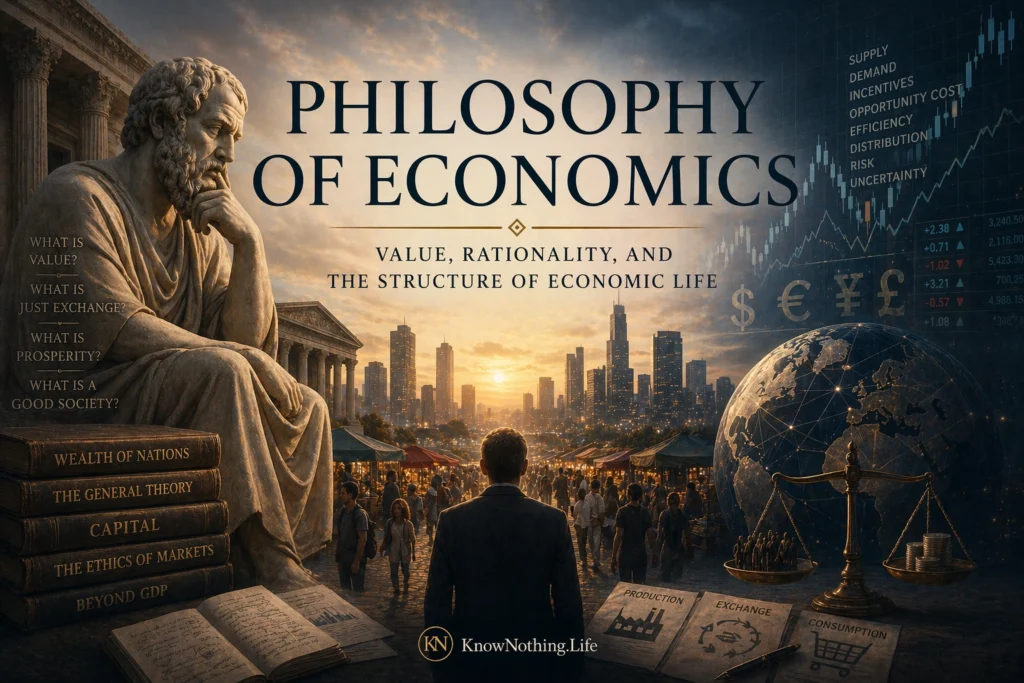
The philosophy of economics examines the foundational concepts, methods, and ethical assumptions underlying economic theory and practice. While economics is often presented as a technical or empirical discipline, it rests on philosophical ideas about human behavior, value, rationality, and social organization. The philosophy of economics seeks to uncover these assumptions, evaluate their coherence, and explore their implications for understanding economic life.
At its core, this field asks what economics is really about. Is it a science that describes objective laws of behavior, or a normative discipline that reflects particular values and goals? How should economic success be measured, and what role should moral considerations play in economic decision-making? By addressing these questions, the philosophy of economics provides a deeper perspective on the systems that shape production, exchange, and distribution in society.
Historical Foundations of Economic Thought
The roots of economic philosophy can be traced to early reflections on wealth, exchange, and social organization. In ancient thought, Aristotle distinguished between natural and unnatural forms of acquisition, emphasizing that economic activity should serve human flourishing rather than the accumulation of wealth for its own sake. This perspective highlights the ethical dimension of economic life, linking it to broader questions of purpose and virtue.
In the modern period, Adam Smith developed a foundational account of market systems, emphasizing the role of self-interest and the “invisible hand” in coordinating economic activity. Smith’s work integrates descriptive and normative elements, suggesting that individual pursuits can lead to collective benefits under certain conditions.
Later thinkers, such as Karl Marx, offered critical perspectives on economic systems, analyzing how capitalism shapes social relations and power dynamics. Marx’s work emphasizes the role of economic structures in determining social outcomes, highlighting issues of inequality and exploitation. These diverse approaches illustrate the philosophical richness of economic thought and its connection to broader social concerns.
The Nature of Value
One of the central questions in the philosophy of economics concerns the nature of value. What makes something valuable, and how should value be measured? Economic theories often distinguish between different types of value, such as use value (the usefulness of a good) and exchange value (its market price). Understanding this distinction is essential for analyzing how markets operate and how resources are allocated.
Philosophers have debated whether value is objective or subjective. Objective theories suggest that value is grounded in factors such as labor or utility, while subjective theories emphasize individual preferences and perceptions. The shift toward subjective value in modern economics reflects a focus on individual choice and market dynamics, but it also raises questions about how preferences are formed and whether they should be taken as given.
The concept of value extends beyond economics into ethical considerations. For example, how should non-market goods, such as environmental resources or social relationships, be valued? These questions highlight the limitations of purely economic measures and the need for broader frameworks that account for diverse forms of value.
Rationality and Decision-Making
Economic theory often assumes that individuals are rational agents who make decisions based on preferences and available information. This model of rationality provides a foundation for analyzing behavior and predicting outcomes. However, the philosophical examination of rationality reveals that this assumption is more complex than it appears.
Philosophers and economists have explored different conceptions of rationality, including instrumental rationality (choosing effective means to achieve goals) and substantive rationality (evaluating the goals themselves). This distinction raises questions about whether economic models adequately capture the richness of human decision-making.
Contemporary research in psychology and behavioral economics has challenged the idea of perfect rationality, showing that individuals are influenced by biases, emotions, and social factors. These findings suggest that economic behavior is not purely rational but shaped by a range of cognitive and contextual influences. The philosophy of economics engages with these insights, seeking to develop more realistic and nuanced models of human behavior.
Markets, Efficiency, and Justice
Markets are central to modern economic systems, providing mechanisms for coordinating production and exchange. Economic theory often emphasizes efficiency as a key criterion for evaluating markets, focusing on how resources can be allocated to maximize overall welfare. However, efficiency is not the only consideration, and its relationship to justice is a central concern in the philosophy of economics.
Philosophers such as John Rawls have explored how economic systems can be evaluated in terms of fairness and equality. Rawls’s theory of justice emphasizes the importance of ensuring that social and economic inequalities benefit the least advantaged members of society. This perspective challenges purely efficiency-based approaches, highlighting the need to consider distributional outcomes.
The tension between efficiency and justice raises important questions about the role of markets in society. While markets can generate wealth and innovation, they can also produce inequalities and externalities that affect well-being. The philosophy of economics examines how these trade-offs can be managed, seeking to balance economic performance with ethical considerations.
Economic Systems and Social Organization
Different economic systems reflect different philosophical assumptions about human nature and social organization. Capitalism, socialism, and mixed economies each embody distinct views about the role of markets, the distribution of resources, and the relationship between individuals and institutions.
Philosophers analyze these systems to understand their strengths and limitations. Capitalism, for example, emphasizes individual freedom and market coordination but may lead to inequality and instability. Socialism prioritizes collective ownership and distribution but may face challenges related to efficiency and innovation. Mixed systems attempt to balance these considerations, integrating elements of both approaches.
The evaluation of economic systems involves both empirical and normative analysis. Philosophers consider not only how systems function but also how they align with values such as freedom, equality, and well-being. This analysis highlights the importance of philosophical reflection in shaping economic policy and practice.
Methodology and the Nature of Economic Science
The philosophy of economics also examines the methods and assumptions of economic science. Economics often uses mathematical models and statistical analysis to study behavior, but these methods involve simplifications and abstractions that may not fully capture real-world complexity.
Philosophers question how these models should be interpreted and evaluated. Are they descriptive tools that approximate reality, or normative frameworks that guide decision-making? The use of assumptions, such as rationality and equilibrium, raises questions about their validity and applicability.
The relationship between theory and evidence is another key issue. Economic predictions are often uncertain, influenced by changing conditions and incomplete information. This challenges the idea of economics as a precise science, suggesting instead that it involves a combination of empirical analysis and philosophical judgment.
Contemporary Issues in the Philosophy of Economics
In the modern world, the philosophy of economics addresses a range of pressing issues, including globalization, inequality, and environmental sustainability. These challenges require integrating economic analysis with ethical and philosophical considerations, reflecting the interconnected nature of contemporary problems.
Globalization, for example, raises questions about fairness and responsibility across national boundaries. Economic policies in one region can have significant impacts on others, highlighting the need for ethical frameworks that account for global interdependence. Similarly, environmental concerns challenge traditional models of growth, emphasizing the need to consider ecological limits.
Technological change also influences economic systems, creating new opportunities and challenges. Automation, digital markets, and data-driven decision-making raise questions about the future of work, privacy, and economic power. The philosophy of economics provides tools for analyzing these developments, ensuring that economic progress aligns with broader human values.
Conclusion
The philosophy of economics offers a comprehensive framework for understanding the principles and practices that shape economic life. By examining concepts such as value, rationality, and justice, it reveals the philosophical foundations underlying economic theory and policy. This analysis highlights the importance of integrating ethical considerations into economic decision-making.
The field underscores that economics is not merely a technical discipline but a human-centered endeavor that reflects values and priorities. Understanding these dimensions is essential for addressing the challenges of modern society, from inequality to sustainability.
Ultimately, the philosophy of economics invites a deeper reflection on how societies organize their resources and pursue well-being. It encourages a critical examination of assumptions and a commitment to aligning economic systems with the broader goals of human flourishing and social justice.