The philosophy of George Berkeley represents one of the most radical reimaginings of reality in the history of Western thought. Best known for his doctrine of immaterialism—the claim that material substance does not exist independently of perception—Berkeley challenged deeply entrenched assumptions about the nature of the world. His work raises a provocative question: what if reality is not composed of matter, but of ideas perceived by minds?
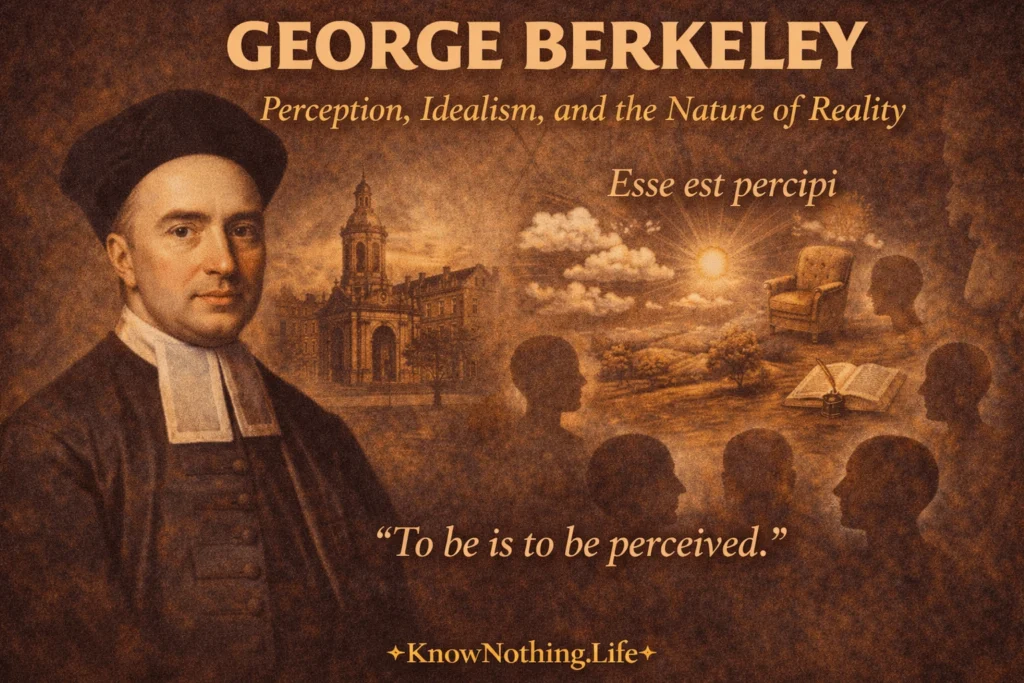
Born in 1685 in Kilkenny, Berkeley developed his philosophy during a period of intellectual transformation influenced by empiricism and scientific progress. While thinkers like John Locke emphasized experience as the source of knowledge, Berkeley pushed this idea further, arguing that existence itself depends on perception. His famous principle, esse est percipi—“to be is to be perceived”—captures the essence of his thought.
Early Life and Education
Berkeley’s early life was shaped by a strong academic environment and religious upbringing. He attended Trinity College Dublin, where he studied classics, philosophy, and theology. His intellectual development was influenced by the empiricist tradition, particularly the work of Locke, yet he quickly began to question its implications.
While Locke maintained that material objects exist independently of perception, Berkeley saw this as an unnecessary and problematic assumption. He argued that if all knowledge comes from sensory experience, then positing an underlying material substance adds nothing to our understanding. Instead, he proposed that reality consists entirely of perceptions and the minds that perceive them.
His early works, including An Essay Towards a New Theory of Vision, demonstrate his interest in perception and the relationship between sensory experience and knowledge. These writings laid the groundwork for his later philosophical system, which would challenge the very notion of material reality.
Immaterialism and the Nature of Reality
Berkeley’s doctrine of immaterialism is most fully developed in A Treatise Concerning the Principles of Human Knowledge. In this work, he argues that what we call “material objects” are simply collections of ideas perceived by the mind. There is no independent material substance underlying these perceptions.
This perspective challenges the distinction between appearance and reality. For Berkeley, there is no hidden layer of material existence beyond what is perceived. The world consists of ideas—colors, shapes, sounds—experienced directly by the mind. To claim that these ideas correspond to an unseen material substance is, in his view, meaningless.
However, Berkeley does not deny the existence of reality. Instead, he redefines it. Objects continue to exist even when not perceived by individual humans because they are perceived by an infinite mind—God. This divine perception ensures the continuity and consistency of the world, providing a foundation for objective reality within his idealist framework.
Perception, Vision, and Knowledge
Berkeley’s interest in perception extends beyond metaphysics into the study of vision and sensory experience. In An Essay Towards a New Theory of Vision, he explores how we perceive distance, size, and spatial relationships. He argues that these perceptions are not inherent in visual experience, but are learned through association and interaction with the world.
This insight challenges the assumption that perception is a passive process. Instead, Berkeley presents it as an active and interpretive activity, shaped by experience and context. His work anticipates later developments in psychology and cognitive science, which emphasize the role of the mind in constructing reality.
By focusing on perception, Berkeley highlights the limitations of human knowledge. If all knowledge is mediated through the senses, then our understanding of the world is inherently tied to the way we perceive it. This perspective encourages a more critical examination of assumptions about reality and knowledge.
God, Reality, and Continuity
A central element of Berkeley’s philosophy is his conception of God as the ultimate perceiver. Since objects exist only as they are perceived, the continued existence of the world depends on a mind that perceives everything at all times. For Berkeley, this role is fulfilled by God.
This theological dimension distinguishes Berkeley’s idealism from later forms of subjective idealism. While individual perception plays a crucial role, it is not the sole determinant of reality. The presence of a divine mind ensures that the world remains stable and coherent, even when not directly observed by humans.
Berkeley’s integration of philosophy and theology reflects his broader intellectual project. He sought to defend religious belief against skepticism and materialism, arguing that his system provides a more consistent and intuitive understanding of reality. By eliminating material substance, he aimed to remove the basis for atheistic interpretations of the world.
Quotes and Key Ideas
Berkeley’s writings include statements that capture the essence of his philosophical vision. Among his most notable quotes:
- “To be is to be perceived.” (Esse est percipi)
- “The ideas of sense are more strong, lively, and distinct than those of the imagination.”
- “All the choir of heaven and furniture of the earth… have not any subsistence without a mind.”
- “We perceive a continuous succession of ideas.”
These statements reflect his emphasis on perception, the nature of ideas, and the role of the mind in constituting reality. They illustrate a philosophy that challenges conventional assumptions and invites deeper reflection.
Berkeley’s key ideas—immaterialism, the dependence of existence on perception, and the role of God as a universal perceiver—have had a lasting impact on philosophy. They continue to be studied and debated as foundational contributions to metaphysics and epistemology.
Later Life and Public Role
In addition to his philosophical work, Berkeley played an active role in religious and public life. He became a bishop in the Church of Ireland, reflecting his commitment to both intellectual and spiritual pursuits. His career combined philosophical inquiry with practical engagement in society.
Berkeley also traveled extensively, including a notable period in the American colonies, where he sought to establish a college in Bermuda. Although this project was ultimately unsuccessful, it demonstrates his ambition to promote education and intellectual development.
His later writings continued to address philosophical and theological issues, reinforcing his commitment to idealism and religious belief. Despite the challenges and controversies he faced, Berkeley remained a dedicated advocate for his ideas.
Legacy and Influence
Berkeley’s philosophy has had a significant and enduring influence on subsequent thinkers. His critique of materialism and emphasis on perception anticipated later developments in idealism, particularly in the work of philosophers such as Immanuel Kant, who grappled with similar questions about the nature of reality and knowledge.
In addition, Berkeley’s ideas have influenced fields beyond philosophy, including psychology and the philosophy of mind. His emphasis on the role of perception in shaping reality resonates with contemporary discussions of consciousness and cognition.
Despite initial skepticism and criticism, Berkeley’s work is now recognized as a major contribution to philosophical thought. His willingness to challenge assumptions and explore alternative frameworks reflects a spirit of inquiry that continues to inspire.
Conclusion
George Berkeley stands as one of the most original and provocative philosophers in the history of Western thought. His doctrine of immaterialism challenges us to reconsider the nature of reality, emphasizing the central role of perception and the mind. By questioning the existence of material substance, he offers a radically different perspective on the world.
His philosophy does not simply deny the material world, but reinterprets it in a way that highlights the importance of experience and perception. Through his integration of metaphysics, epistemology, and theology, Berkeley provides a comprehensive framework for understanding reality. In an age increasingly concerned with the nature of consciousness and perception, Berkeley’s insights remain deeply relevant. His work invites us to reflect on what it means to exist and how we come to know the world around us.