The ontological argument is one of the most distinctive and controversial arguments for the existence of God. Unlike cosmological or teleological arguments, which rely on empirical observations about the world, the ontological argument is purely a priori. It seeks to demonstrate that God’s existence follows necessarily from the very concept of God. In doing so, it raises profound questions about the relationship between thought and reality, logic and existence.
At its core, the ontological argument asks whether existence can be derived from definition alone. Can we, by reflecting on the idea of a perfect being, conclude that such a being must exist? This question has fascinated philosophers for centuries, leading to a rich tradition of debate and refinement. The argument’s enduring appeal lies in its boldness: if successful, it would establish God’s existence without appeal to experience, relying solely on reason.
Anselm’s Original Formulation
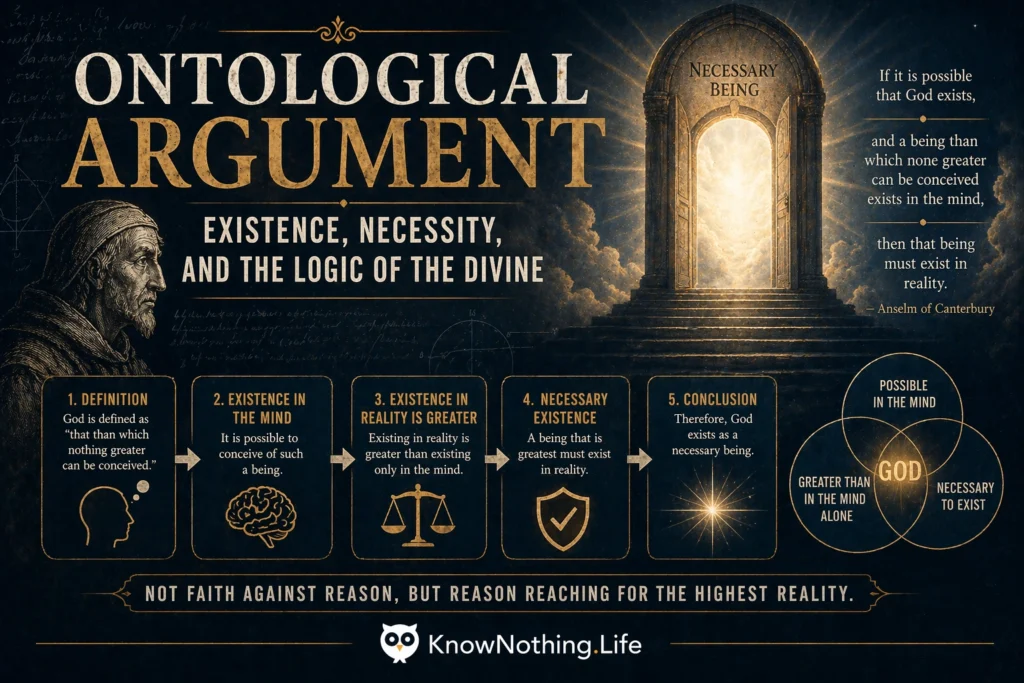
The ontological argument was first systematically articulated by Anselm of Canterbury in the eleventh century. Anselm defined God as “that than which nothing greater can be conceived.” From this definition, he argued that God must exist not only in the mind but also in reality. A being that exists in reality is greater than one that exists only in thought, and therefore a truly greatest conceivable being must exist in reality.
Anselm’s reasoning is elegant but controversial. It relies on the idea that existence is a perfection or a property that adds to the greatness of a being. If God lacked existence, then a greater being—one that does exist—could be conceived, contradicting the definition. Thus, Anselm concluded that God necessarily exists.
This argument sparked immediate debate. One of Anselm’s contemporaries, Gaunilo, objected by proposing a parallel argument for the existence of a “perfect island,” suggesting that the reasoning could be used to prove the existence of anything defined as perfect. Anselm responded by arguing that his argument applies uniquely to a necessary being, not to contingent entities like islands.
Descartes and Rationalist Developments
The ontological argument was later revived and reformulated by René Descartes in the seventeenth century. Descartes argued that existence is an essential property of a supremely perfect being, much like having three angles is essential to a triangle. Just as one cannot conceive of a triangle without three angles, one cannot conceive of God without existence.
Descartes’ version emphasizes the idea that certain truths are self-evident through reason. For him, the existence of God is as clear and distinct as mathematical truths, grounded in the nature of the concept itself. This approach reflects the broader rationalist project of deriving knowledge from reason alone.
However, Descartes’ formulation also inherits the challenges faced by Anselm’s argument. Critics question whether existence can be treated as a property in the same way as other attributes. The analogy with geometry, while compelling, may not hold when applied to questions of existence.
Kant’s Critique
One of the most influential critiques of the ontological argument was offered by Immanuel Kant. Kant argued that existence is not a real predicate—that is, it does not add anything to the concept of a thing. Saying that something exists does not enhance its properties but merely asserts that the concept is instantiated in reality.
According to Kant, the ontological argument fails because it treats existence as if it were a property that could be included in a definition. In reality, existence is not part of a concept but a condition of its instantiation. Thus, one cannot define something into existence, no matter how perfect the concept may be.
Kant’s critique has been highly influential, leading many philosophers to reject traditional forms of the ontological argument. However, it has not ended the debate. Some philosophers argue that Kant’s analysis does not fully address the nuances of the argument, particularly in its more sophisticated forms.
Modal Ontological Arguments
In the twentieth century, the ontological argument was reformulated using modal logic, which deals with concepts of necessity and possibility. Philosophers such as Alvin Plantinga developed modal versions of the argument that aim to avoid some of the criticisms faced by earlier formulations.
The modal ontological argument begins with the premise that it is possible for a maximally great being to exist. A maximally great being is defined as one that possesses all perfections, including necessary existence. If such a being is possible, then it must exist in some possible world. And if it exists in any possible world, it must exist in all possible worlds, including the actual world.
This argument shifts the focus from existence as a property to existence as a necessary condition. By framing the argument in terms of possibility and necessity, it seeks to bypass Kant’s critique. However, it introduces new questions about the nature of possibility and whether the initial premise is justified.
The Role of Necessity
A key concept in the ontological argument is necessity. Unlike contingent beings, which may or may not exist, a necessary being exists in all possible circumstances. The argument seeks to show that God, as a maximally perfect being, must be necessary rather than contingent.
This idea raises important metaphysical questions. What does it mean for something to exist necessarily? And how can we determine whether a being has this property? Philosophers have explored these questions in relation to modal logic, metaphysics, and the philosophy of language.
The notion of necessity also connects the ontological argument to broader debates about the nature of reality. If necessary existence is a coherent concept, it may provide a foundation for understanding why anything exists at all. However, if it is not, then the argument may collapse under its own assumptions.
Strengths and Criticisms
The ontological argument has both strengths and weaknesses. Its primary strength lies in its logical ambition: it attempts to establish a profound conclusion using purely rational means. This makes it unique among arguments for God’s existence and highlights the power of philosophical reasoning.
However, the argument also faces significant criticisms. Many philosophers remain unconvinced that existence can be derived from definition or that the concept of a maximally perfect being is coherent. Others argue that the argument relies on controversial assumptions about possibility and necessity.
Despite these challenges, the ontological argument continues to be a topic of active debate. Its various forms have inspired new developments in logic and metaphysics, demonstrating its enduring influence on philosophical thought.
Conclusion
The ontological argument represents a bold and enduring attempt to prove the existence of God through reason alone. From the original formulation by Anselm of Canterbury to the modal versions developed by Alvin Plantinga, it has evolved in response to criticism and refinement.
While it remains controversial, the argument continues to challenge our understanding of existence, necessity, and the relationship between thought and reality. Whether one accepts or rejects its conclusions, the ontological argument stands as a testament to the depth and creativity of philosophical inquiry.