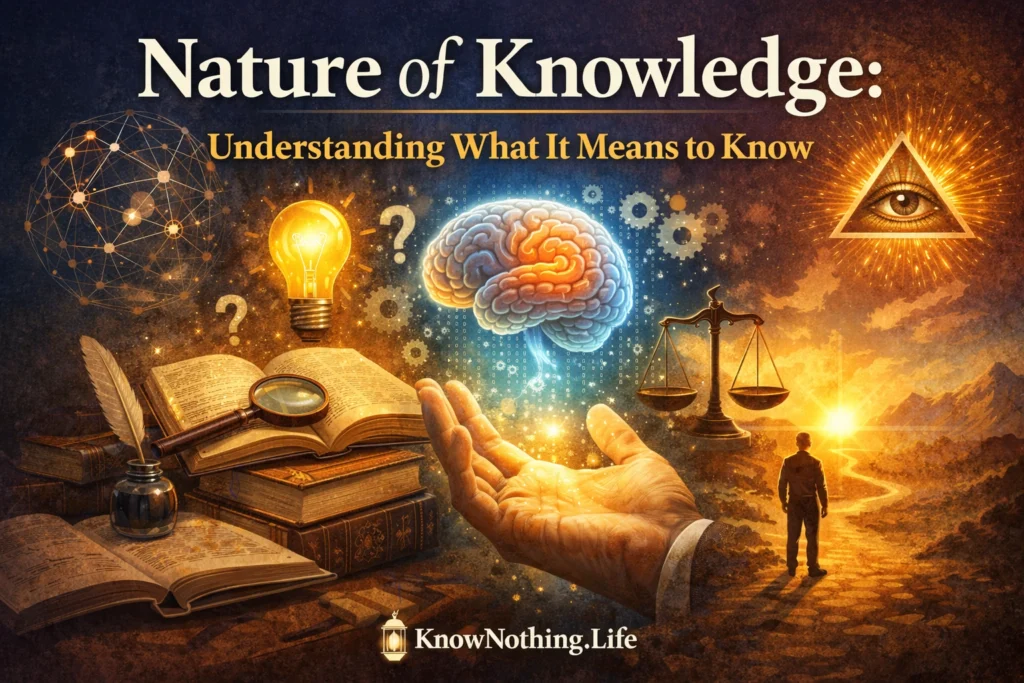
The question of what knowledge is lies at the very heart of philosophy. While epistemology broadly studies how we know, the nature of knowledge focuses more precisely on what knowledge itself consists of—its structure, its defining features, and the conditions under which belief becomes something more than opinion. This inquiry has occupied thinkers for thousands of years, shaping intellectual traditions across science, religion, and philosophy.
From early reflections in ancient Greece to contemporary analytic philosophy, the nature of knowledge has remained both foundational and elusive. At first glance, knowledge seems straightforward: to know something is simply to be certain of it. Yet deeper examination reveals complexities involving truth, justification, belief, and reliability. Philosophers have repeatedly attempted to define knowledge in a way that captures its intuitive meaning while resisting counterexamples that expose hidden weaknesses.
The enduring importance of this topic is reflected in the work of thinkers such as Plato, Aristotle, René Descartes, David Hume, and Edmund Gettier. Each offers a different perspective on what knowledge is and how it should be understood. Together, their ideas reveal that knowledge is not a simple concept but a deeply layered phenomenon that continues to challenge philosophical analysis.
Knowledge as Justified True Belief
One of the most influential attempts to define knowledge originates in Theaetetus, where Plato explores the idea that knowledge consists of justified true belief. According to this account, three conditions must be satisfied: a proposition must be true, an individual must believe it, and there must be sufficient justification supporting that belief. This tripartite model became the standard framework for understanding knowledge for much of philosophical history.
The appeal of this definition lies in its apparent completeness. Truth ensures that knowledge corresponds to reality, belief ensures that the knower accepts the proposition, and justification ensures that the belief is not held arbitrarily. Without any one of these elements, knowledge seems to collapse into something less reliable. A true belief held without justification, for instance, might be correct by accident rather than by understanding.
However, the stability of this model was disrupted in the 20th century by Edmund Gettier. In his paper Is Justified True Belief Knowledge?, Gettier presented scenarios in which individuals possessed beliefs that were justified and true, yet intuitively did not qualify as knowledge because their truth resulted from luck. These examples revealed that justified true belief might be insufficient, forcing philosophers to reconsider the very nature of knowledge and search for additional conditions that eliminate epistemic luck.
The Role of Truth and Belief
At its core, knowledge is intimately tied to truth. A belief cannot count as knowledge if it is false, no matter how convincing or well-supported it may seem. This requirement underscores the objective dimension of knowledge: it must correspond to the way the world actually is. Philosophers such as Aristotle emphasized this connection, famously stating that “to say of what is that it is, and of what is not that it is not, is true.”
Belief, on the other hand, introduces a subjective element. Knowledge requires that the knower actively endorses the proposition in question. One cannot be said to know something without believing it, even if the information is somehow stored or accessible. This distinction highlights the difference between possessing information and genuinely knowing it. Knowledge involves a cognitive commitment, not merely passive awareness.
Yet the relationship between truth and belief is not always straightforward. Individuals often hold beliefs that feel certain but turn out to be false, or conversely, they may doubt truths that are objectively correct. This tension reveals that knowledge is not merely a matter of psychological confidence but requires alignment between internal conviction and external reality. The challenge, then, is to determine how belief can reliably track truth—a problem that lies at the center of epistemological inquiry.
Justification and Epistemic Standards
Justification serves as the bridge between belief and knowledge, providing the reasons or evidence that support a belief’s claim to truth. Without justification, beliefs risk being arbitrary or accidental. Philosophers have long debated what counts as adequate justification and how it should be structured.
In the rationalist tradition, represented by René Descartes, justification is grounded in reason and certainty. In Meditations on First Philosophy, Descartes sought indubitable foundations for knowledge, famously arriving at the conclusion “Cogito, ergo sum” (“I think, therefore I am”). For Descartes, knowledge must be built upon clear and distinct ideas that cannot be doubted.
Empiricists such as David Hume challenged this approach by emphasizing experience as the basis of justification. In An Enquiry Concerning Human Understanding, Hume argued that many of our beliefs—particularly those involving causation—are not rationally justified but arise from habit and repeated observation. His skepticism about induction raised profound questions about whether justification can ever be fully secured.
Modern epistemology has expanded the concept of justification through theories such as foundationalism, coherentism, and reliabilism. Each offers a different account of how beliefs are supported, whether through basic self-evident truths, mutual coherence within a system, or reliable cognitive processes. These competing frameworks reflect the complexity of determining when a belief is truly justified.
Knowledge, Certainty, and Skepticism
The nature of knowledge is closely linked to the problem of certainty. Must knowledge be absolutely certain, or can it accommodate degrees of doubt? This question has driven much of epistemological debate, particularly in response to skepticism.
Skeptical arguments challenge the possibility of knowledge by questioning whether our beliefs can ever be fully justified. René Descartes famously imagined the possibility of an evil demon deceiving our senses, raising doubts about the reliability of perception. Similarly, David Hume argued that our belief in causation lacks rational justification, suggesting that much of what we consider knowledge may rest on uncertain foundations.
Despite these challenges, many philosophers have sought to defend the possibility of knowledge without requiring absolute certainty. Immanuel Kant proposed that knowledge arises from the interaction between sensory experience and the mind’s conceptual framework, offering a middle path between skepticism and dogmatism. Others have argued for fallibilism, the view that knowledge can exist even if it is not infallible.
This shift reflects a more pragmatic understanding of knowledge as something that can be reliable and useful without being immune to error. Rather than demanding perfect certainty, contemporary epistemology often focuses on the conditions under which beliefs are sufficiently justified to count as knowledge.
Contemporary Perspectives on the Nature of Knowledge
In recent decades, philosophers have developed new approaches to understanding knowledge that move beyond traditional definitions. One influential perspective is reliabilism, associated with thinkers like Alvin Goldman, which defines knowledge in terms of the reliability of belief-forming processes. If a belief is produced by a method that generally leads to truth, it may qualify as knowledge even if the individual cannot articulate the justification.
Another approach is virtue epistemology, which emphasizes the intellectual character of the knower. Drawing on ideas from Aristotle, this view sees knowledge as the result of intellectual virtues such as careful reasoning, open-mindedness, and intellectual honesty. Knowledge, in this sense, is not just a property of beliefs but an achievement of a well-functioning cognitive agent.
Social epistemology has further expanded the field by examining how knowledge is shaped by social interactions and institutions. Philosophers like Miranda Fricker have highlighted issues such as epistemic injustice, where individuals are unfairly discredited or excluded as knowers. In her work Epistemic Injustice, Fricker argues that power dynamics can influence whose knowledge is recognized and whose is ignored.
These contemporary developments reflect a broader understanding of knowledge as a dynamic and context-dependent phenomenon. Rather than seeking a single definitive definition, modern epistemology often explores the various ways in which knowledge operates across different domains.
Conclusion
The nature of knowledge remains one of philosophy’s most profound and enduring questions. From the classical definition of justified true belief to contemporary theories emphasizing reliability, virtue, and social context, the concept of knowledge has evolved in response to persistent challenges and new insights.
What emerges from this long tradition is not a simple answer but a richer understanding of knowledge as a complex interplay between truth, belief, and justification. Knowledge is neither purely objective nor entirely subjective; it requires both alignment with reality and engagement by the knower. It is shaped by reason and experience, challenged by skepticism, and refined through ongoing inquiry.
As Plato suggested, “The beginning of knowledge is the definition of terms.” Yet even with centuries of philosophical effort, the definition of knowledge remains open to debate. This enduring uncertainty is not a weakness but a testament to the depth of the subject. By continuing to question what it means to know, epistemology invites us to think more carefully about our beliefs, our reasoning, and our place in the world of truth.