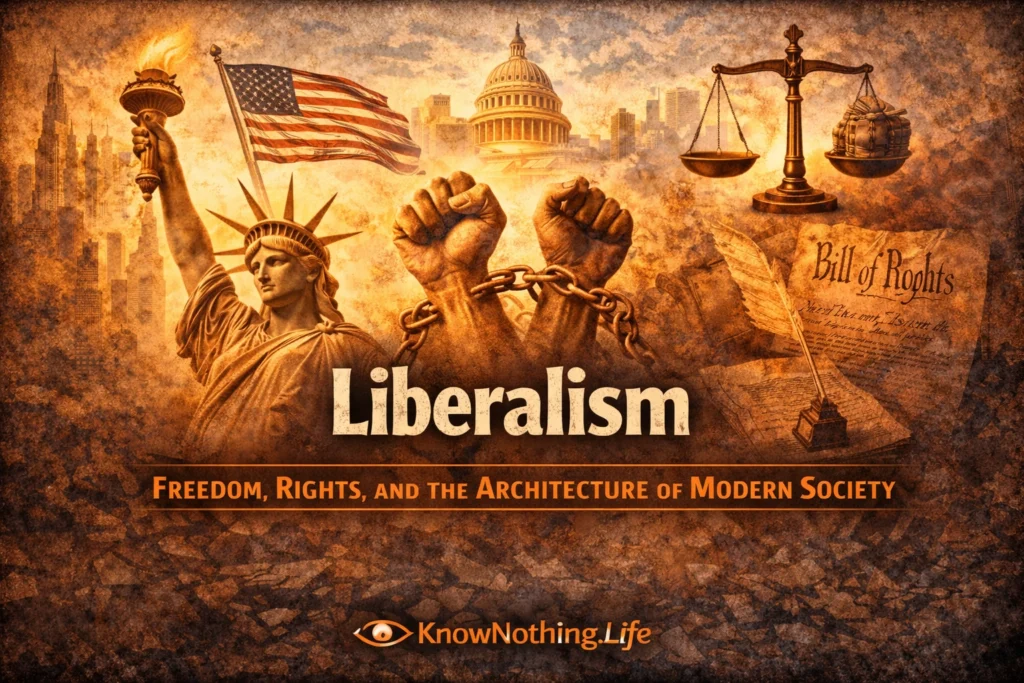
Liberalism is one of the most influential political and moral philosophies in modern history, centered on the protection of individual freedom, the rule of law, and the legitimacy of government grounded in consent. Emerging from the intellectual currents of the Enlightenment, liberalism seeks to secure a social order in which individuals can pursue their own lives according to their values, provided they respect the rights of others. It is both a philosophical doctrine and a practical framework that has shaped constitutional democracies, legal systems, and global norms.
At its core, liberalism rests on the idea that individuals possess inherent moral worth and should not be subordinated to arbitrary authority. This commitment leads to a focus on rights, equality before the law, and limits on state power. However, liberalism is not a monolithic tradition. It encompasses a range of interpretations, from classical liberalism, which emphasizes minimal government and economic freedom, to modern liberalism, which supports a more active role for the state in promoting social justice and equality. Understanding liberalism requires tracing its development and examining the tensions within it.
Foundations in Natural Rights and Enlightenment Thought
The philosophical foundations of liberalism are closely associated with John Locke, whose work Two Treatises of Government articulates a theory of natural rights. Locke argues that individuals possess rights to life, liberty, and property, which exist prior to the formation of government. Political authority is justified only insofar as it protects these rights, and individuals retain the right to resist or overthrow governments that fail in this duty.
Locke’s emphasis on consent and limited government provides a framework for legitimate political authority. He writes, “The end of law is not to abolish or restrain, but to preserve and enlarge freedom,” highlighting the idea that laws can enhance liberty by protecting individuals from arbitrary interference. This perspective marks a departure from earlier views that grounded authority in divine right or tradition, placing the individual at the center of political life.
Other Enlightenment thinkers contribute to the development of liberal ideas. Immanuel Kant, in Groundwork of the Metaphysics of Morals, emphasizes the moral autonomy of individuals and the importance of treating persons as ends in themselves. This ethical foundation reinforces the liberal commitment to human dignity and rights, providing a philosophical basis for the protection of individual freedom.
Classical Liberalism and Economic Freedom
Classical liberalism emphasizes the importance of individual liberty, private property, and free markets. It advocates for limited government intervention in economic affairs, arguing that individuals are best positioned to make decisions about their own lives. This perspective is closely associated with Adam Smith, whose work The Wealth of Nations defends the efficiency and benefits of market exchange.
Smith argues that individuals pursuing their own interests can contribute to the overall wealth of society through the “invisible hand” of the market. This idea supports the liberal belief in economic freedom as a means of promoting prosperity and innovation. However, Smith also recognizes the need for certain public institutions and regulations, suggesting that even classical liberalism allows for a limited role for the state.
The political dimension of classical liberalism is further developed by John Stuart Mill in On Liberty. Mill defends individual freedom against both governmental and social interference, introducing the harm principle as a guideline for limiting liberty. He writes, “Over himself, over his own body and mind, the individual is sovereign.” This statement encapsulates the liberal commitment to personal autonomy and the protection of individual choice.
Modern Liberalism and Social Justice
In the twentieth century, liberalism evolves to address the challenges of industrialization, economic inequality, and social change. Modern liberalism expands the role of the state, arguing that formal equality is insufficient without addressing underlying disparities. This shift reflects the recognition that economic and social conditions can limit individuals’ ability to exercise their freedom.
John Rawls provides a major contribution to modern liberal thought in A Theory of Justice. Rawls argues that a just society must guarantee equal basic liberties while arranging inequalities to benefit the least advantaged. His concept of the original position and the veil of ignorance offers a method for determining fair principles of justice, emphasizing impartiality and fairness.
Rawls’s approach reflects a broader trend in liberalism toward integrating equality and freedom. Rather than viewing these values as opposed, modern liberalism seeks to create conditions in which individuals have genuine opportunities to pursue their goals. This includes support for education, healthcare, and social welfare programs, which are seen as essential for enabling meaningful freedom.
Liberalism, Democracy, and Rights
Liberalism is closely linked to democratic governance, though the two are not identical. Liberalism provides the normative foundation for democracy by emphasizing rights, equality before the law, and the protection of minorities. Democratic institutions, in turn, offer mechanisms for expressing and implementing these principles through participation and representation.
The relationship between liberalism and democracy is explored by thinkers such as Alexis de Tocqueville in Democracy in America. Tocqueville observes that democracy promotes equality but also poses risks to liberty, particularly through the potential tyranny of the majority. His analysis highlights the need for institutional safeguards to protect individual rights within democratic systems.
Human rights frameworks represent a global extension of liberal principles, emphasizing the universality of certain rights regardless of cultural or political context. These frameworks reflect the liberal commitment to protecting individuals from injustice and ensuring basic freedoms. However, they also raise questions about cultural diversity and the limits of universal norms, illustrating the ongoing challenges faced by liberal thought.
Critiques of Liberalism
Despite its influence, liberalism has been subject to significant criticism from various perspectives. Karl Marx critiques liberalism for focusing on formal equality while ignoring economic inequalities that limit real freedom. In works such as Capital, Marx argues that liberal rights can mask underlying power structures, allowing inequality to persist under the guise of freedom.
Communitarian thinkers also challenge liberalism’s emphasis on individual autonomy, arguing that it overlooks the importance of community and social relationships. They contend that individuals are shaped by their social contexts and that a purely individualistic framework cannot fully account for moral and political life. This critique highlights the tension between individual rights and collective values.
More recent critiques focus on issues such as globalization, environmental sustainability, and technological change. These challenges raise questions about whether liberalism can adapt to new conditions and address problems that extend beyond traditional political boundaries. The ongoing debate reflects the dynamic nature of liberalism as a philosophical tradition.
The Enduring Influence of Liberalism
Liberalism remains a central force in shaping modern political and social life. Its principles of individual freedom, equality before the law, and limited government continue to inform institutions and policies around the world. Even critics often engage with liberal ideas, reflecting their pervasive influence.
At the same time, liberalism is not static. It evolves in response to new challenges, incorporating insights from different perspectives and adapting to changing conditions. This flexibility has allowed it to remain relevant, even as it faces ongoing criticism and debate.
Ultimately, liberalism is defined by its commitment to human dignity and the protection of individual autonomy. It provides a framework for balancing freedom and order, offering a vision of society in which individuals can pursue their goals while respecting the rights of others. Its enduring significance lies in its ability to inspire reflection on the principles that should guide political life and the structures that best embody those principles.