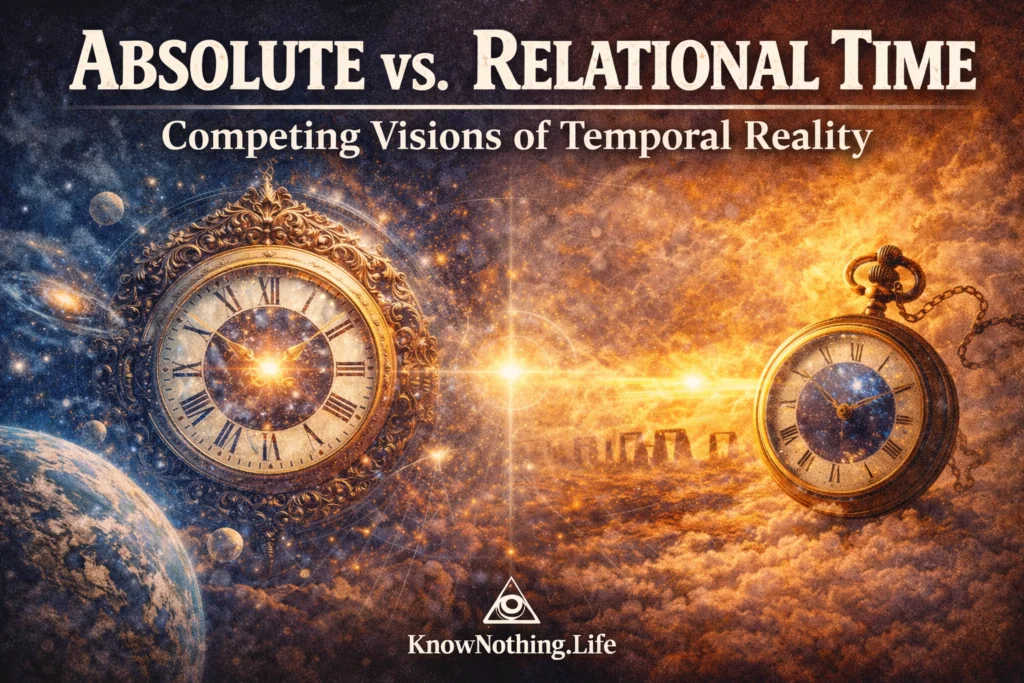
The nature of time has long occupied philosophers and scientists alike, raising fundamental questions about how reality is structured and experienced. Among the most influential debates is the distinction between absolute and relational time. Is time an independent, objective entity that flows uniformly regardless of events, or is it nothing more than a system of relations between changing things? This question touches on metaphysics, physics, and human perception, shaping how we understand motion, causality, and existence.
At first glance, time appears to be a constant backdrop—a steady progression from past to present to future. Yet closer examination reveals that this intuitive view may be misleading. Philosophers have proposed radically different accounts of time, each with profound implications. The debate between absolute and relational time is not merely theoretical; it has influenced the development of modern physics and continues to inform contemporary discussions about the nature of reality.
Newton and the Concept of Absolute Time
The most famous defender of absolute time is Isaac Newton, whose formulation in Philosophiæ Naturalis Principia Mathematica established a foundational framework for classical physics. Newton described absolute time as something that exists independently of the material world, flowing uniformly without relation to anything external. He wrote, “Absolute, true, and mathematical time, of itself, and from its own nature, flows equably without relation to anything external.”
In Newton’s view, time is like an invisible container in which events occur. It provides a fixed, universal standard against which motion and change can be measured. This conception allows for objective descriptions of physical processes, making it possible to compare events across different locations and conditions. Absolute time ensures that the universe operates within a consistent temporal framework.
Philosophically, however, this raises significant questions. If time exists independently of events, what kind of entity is it? Does it have substance, or is it a purely abstract dimension? Critics of Newton’s view argue that absolute time introduces unnecessary metaphysical commitments, positing the existence of something that cannot be directly observed.
Leibniz and the Relational Theory of Time
In opposition to Newton, Gottfried Wilhelm Leibniz developed a relational theory of time. For Leibniz, time does not exist independently but is a system of relations among events. He argued that time is the order of succession—an arrangement of events in terms of earlier and later.
Leibniz rejected the idea of empty time, asserting that time without events is meaningless. He wrote, “I hold that time, like place, is something purely relative.” According to this view, if there were no changes or events, there would be no time. Time is not a container but a way of describing the relationships between occurrences.
This relational perspective aligns with Leibniz’s broader philosophical principles, particularly his principle of sufficient reason, which states that nothing happens without a reason. He argued that absolute time would violate this principle, as it would allow for differences—such as events occurring at different times—without any corresponding reason. By grounding time in relations, Leibniz sought to avoid such metaphysical difficulties.
Kant: Time as a Form of Intuition
The debate between absolute and relational time took a new turn with Immanuel Kant, who proposed that time is neither an independent entity nor merely a relation among objects. In Critique of Pure Reason, Kant argued that time is a form of intuition—a fundamental structure of the human mind that organizes experience.
For Kant, time is not something we derive from observing the world; rather, it is the framework through which we perceive any sequence of events. He wrote, “Time is not something which subsists of itself… but a subjective condition under which alone all intuitions can take place.” This means that time is real as a feature of human perception but does not necessarily reflect the ultimate nature of reality.
Kant’s view shifts the debate from the external world to the structure of cognition. It suggests that the disagreement between Newton and Leibniz may arise from different assumptions about the nature of experience. By locating time within the mind, Kant provides a synthesis that preserves elements of both positions while introducing a new dimension to the discussion.
Einstein and the Relativity of Time
The development of modern physics, particularly the work of Albert Einstein, transformed the debate over time. In his theory of relativity, Einstein demonstrated that time is not absolute but relative to the observer’s frame of reference. Time can pass at different rates depending on factors such as velocity and gravitational fields.
Einstein’s findings challenge the Newtonian notion of a universal, uniform time. Instead, they support a relational understanding in which time is intertwined with space and dependent on physical conditions. The concept of spacetime—a four-dimensional continuum—replaces the idea of separate, independent dimensions of space and time.
Philosophically, relativity raises profound questions about the nature of temporal reality. If time is not the same for all observers, can it still be considered a fundamental feature of the universe? Does the relativity of time imply that the flow of time is an illusion? These questions continue to be explored in both physics and philosophy, demonstrating the enduring significance of the debate.
The Nature of Temporal Passage
A central issue in the discussion of time is whether it truly “flows” or whether this perception is a feature of human consciousness. The concept of temporal passage is closely linked to the distinction between absolute and relational time. Absolute time suggests a real, objective flow, while relational theories often interpret flow as a description of changing relations.
J. M. E. McTaggart famously argued that time is unreal in his essay The Unreality of Time. He distinguished between the A-series (past, present, future) and the B-series (earlier than, later than). McTaggart claimed that the A-series, which gives rise to the sense of flow, is contradictory, leading to the conclusion that time itself is an illusion.
Others have defended the reality of temporal passage, emphasizing its central role in human experience. The feeling of time moving forward, of events becoming past and new ones emerging, is deeply embedded in consciousness. Whether this reflects an objective feature of the universe or a subjective phenomenon remains an open question.
Contemporary Perspectives and Ongoing Debates
In contemporary philosophy, the debate between absolute and relational time continues to evolve. Some philosophers defend a form of substantivalism, akin to Newton’s view, arguing that time is a real entity. Others support relationalism, emphasizing the dependence of time on events and relations.
Modern discussions often incorporate insights from physics, particularly quantum mechanics and cosmology. These fields raise new questions about the nature of time, such as whether time has a beginning, whether it is continuous or discrete, and how it relates to the structure of the universe.
Philosophers also explore the implications of time for other areas of inquiry, including causality, free will, and personal identity. The nature of time influences how we understand the relationship between past, present, and future, shaping our conception of reality as a whole.
Conclusion
The debate between absolute and relational time represents one of the most profound inquiries into the nature of reality. From the absolute framework of Isaac Newton to the relational perspective of Gottfried Wilhelm Leibniz, and the transformative insights of Albert Einstein, it has shaped both philosophy and science.
Each perspective offers a different way of understanding time—whether as an independent dimension, a system of relations, or a structure of human perception. These views are not merely theoretical but have practical implications for how we interpret the universe and our place within it.
Ultimately, the question of time remains open. It invites ongoing exploration, challenging assumptions and expanding understanding. As our knowledge deepens, the nature of time continues to reveal new complexities, ensuring that this debate remains central to the pursuit of truth.