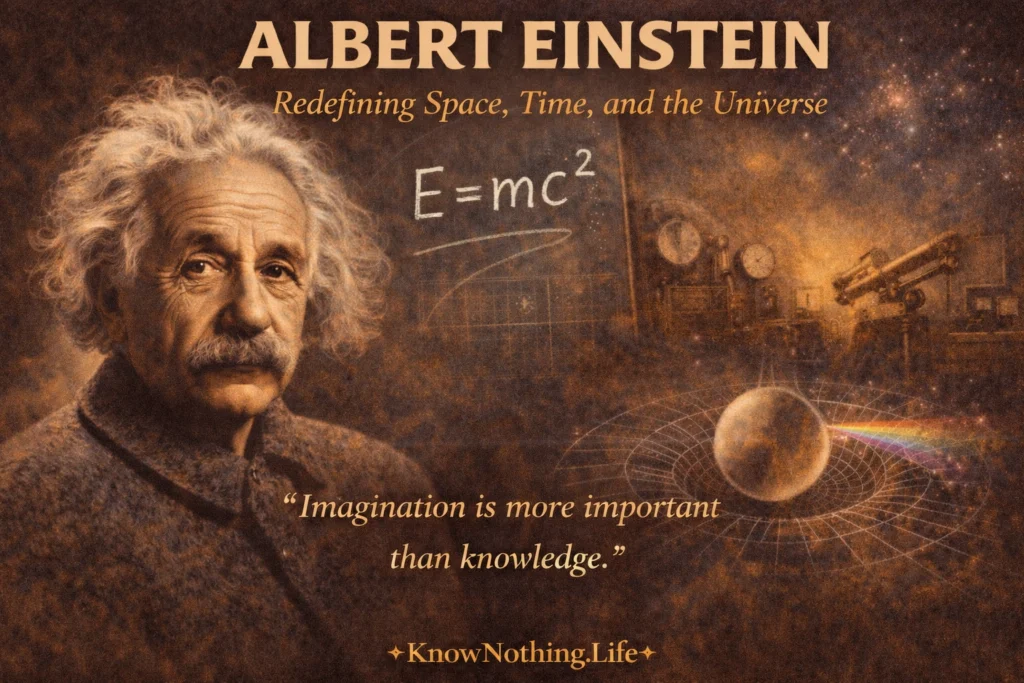
The name Albert Einstein has become synonymous with genius, yet his significance extends far beyond intellectual reputation. Einstein fundamentally reshaped humanity’s understanding of space, time, energy, and gravity, altering the very framework through which reality is interpreted. His work did not merely refine existing theories—it overturned them, introducing concepts that challenged intuition and redefined the limits of scientific thought.
Born in 1879 in Ulm, Einstein came of age during a period of rapid technological and scientific advancement. Classical physics, built upon the foundations of Newton, appeared to explain the natural world with remarkable precision. Yet inconsistencies remained, particularly in the behavior of light and electromagnetism. Einstein’s insights addressed these gaps, leading to a new understanding of the universe that continues to shape modern science.
Early Life and Education
Einstein’s early life was marked by curiosity and independence rather than conventional academic success. As a child, he displayed a deep fascination with natural phenomena, particularly the behavior of light and magnetism. However, his unconventional thinking often clashed with rigid educational systems, leading to the misconception that he was an underperforming student.
He later attended the Swiss Federal Polytechnic in Zurich, where he studied physics and mathematics. Despite his intellectual abilities, Einstein struggled to secure an academic position after graduation. Instead, he took a job at the Swiss Patent Office in Bern, a role that provided both stability and the freedom to pursue his own ideas. This period of relative isolation proved to be extraordinarily productive.
In 1905, often referred to as his “annus mirabilis” or miracle year, Einstein published a series of papers that would revolutionize physics. These works addressed the photoelectric effect, Brownian motion, and the nature of space and time, establishing him as one of the leading thinkers of his generation.
Special Relativity
Einstein’s theory of special relativity, introduced in 1905, transformed the understanding of space and time. Prior to this, these concepts were considered absolute and independent. Einstein demonstrated that they are relative, depending on the observer’s frame of reference.
One of the most famous consequences of this theory is the equation E = mc², which expresses the equivalence of mass and energy. This relationship revealed that matter can be converted into energy, a concept that would later have profound implications for both science and technology. Special relativity also introduced the idea that the speed of light is constant, regardless of the observer’s motion.
This theory challenged deeply held assumptions about reality, showing that measurements of time and space are not fixed, but vary depending on motion. It marked a departure from classical physics and opened the door to a new understanding of the universe.
General Relativity
Einstein’s work reached a new level of depth with the development of general relativity, published in 1915. This theory extends the principles of relativity to include gravity, describing it not as a force, but as a curvature of spacetime caused by mass and energy.
According to general relativity, massive objects like planets and stars distort the fabric of spacetime, influencing the motion of other objects. This framework provides a more accurate description of gravitational phenomena than Newton’s theory, particularly in extreme conditions such as near black holes.
The predictions of general relativity have been confirmed through numerous experiments, including the bending of light by gravity and the detection of gravitational waves. These discoveries highlight the enduring relevance of Einstein’s work and its capacity to explain complex aspects of the universe.
Contributions to Quantum Theory
Although Einstein is best known for relativity, his contributions to quantum theory are equally significant. His explanation of the photoelectric effect demonstrated that light can behave as both a wave and a particle, introducing the concept of photons. This work earned him the Nobel Prize in Physics in 1921.
Despite his role in advancing quantum theory, Einstein remained skeptical of its implications. He famously resisted the idea that the universe operates according to probabilistic principles, expressing this view in the statement: “God does not play dice with the universe.” His debates with other physicists, particularly Niels Bohr, reflect ongoing tensions within the interpretation of quantum mechanics.
Einstein’s engagement with quantum theory illustrates his commitment to understanding the fundamental nature of reality, even when it challenged his own philosophical inclinations. His work in this area continues to influence modern physics.
Works and Scientific Writings
Einstein’s contributions are preserved in a series of groundbreaking papers rather than traditional books. His 1905 papers on relativity and quantum theory remain among the most influential scientific works ever published. Later writings expanded on these ideas, particularly in the development of general relativity.
He also authored more accessible works, such as Relativity: The Special and the General Theory, which aimed to explain complex concepts to a broader audience. This effort reflects his belief that scientific knowledge should be shared and understood beyond academic circles. Einstein’s writings demonstrate a balance between technical precision and conceptual clarity. His ability to communicate complex ideas has contributed to the widespread impact of his work.
Quotes and Key Ideas
Einstein’s words have become as famous as his equations, capturing both his intellectual insights and philosophical reflections. Among his most notable quotes:
- “Imagination is more important than knowledge.”
- “Life is like riding a bicycle. To keep your balance, you must keep moving.”
- “The important thing is not to stop questioning.”
- “God does not play dice with the universe.”
These statements reflect his emphasis on curiosity, creativity, and the pursuit of understanding. They reveal a thinker who valued not only knowledge, but the process of discovery itself.
Einstein’s key ideas—relativity, the equivalence of mass and energy, and the dual nature of light—have fundamentally shaped modern science. They continue to influence research in physics, cosmology, and technology.
Later Life and Global Influence
In his later years, Einstein became a global figure, recognized not only for his scientific achievements but also for his humanitarian views. He emigrated to the United States in 1933, fleeing the rise of Nazi Germany, and joined the Institute for Advanced Study in Princeton.
Einstein was an outspoken advocate for peace, civil rights, and international cooperation. His involvement in political and social issues reflects a broader vision of science as a tool for improving human life. At the same time, he grappled with the ethical implications of scientific discovery, particularly in relation to nuclear weapons.
He continued to work on unified field theories, seeking to reconcile gravity and electromagnetism into a single framework. Although he did not achieve this goal, his efforts reflect a lifelong commitment to understanding the fundamental structure of the universe.
Legacy and Influence
Einstein’s influence extends far beyond physics, shaping the way we think about reality, knowledge, and the limits of human understanding. His theories have become integral to technologies such as GPS systems, which rely on relativistic corrections to function accurately. In popular culture, Einstein represents the archetype of the genius scientist, yet his true legacy lies in his ability to question assumptions and explore new possibilities.
His work demonstrates that even the most established ideas can be reexamined and transformed. Einstein’s impact continues to be felt in contemporary science, where his theories serve as both foundation and inspiration. His contributions have opened new avenues of inquiry, from cosmology to quantum physics.
Conclusion
Albert Einstein stands as one of the most transformative figures in the history of science. Through his theories of relativity and his contributions to quantum mechanics, he redefined the fundamental principles governing the universe. His work challenges us to reconsider our understanding of space, time, and reality itself. Beyond his scientific achievements, Einstein’s legacy is characterized by curiosity, creativity, and a commitment to questioning the unknown.
He demonstrated that progress depends not only on knowledge, but on the willingness to explore new ideas and challenge established beliefs. In a world shaped by scientific discovery, Einstein’s insights continue to guide our understanding of the cosmos. His life and work serve as a testament to the power of human imagination and the enduring quest for knowledge.