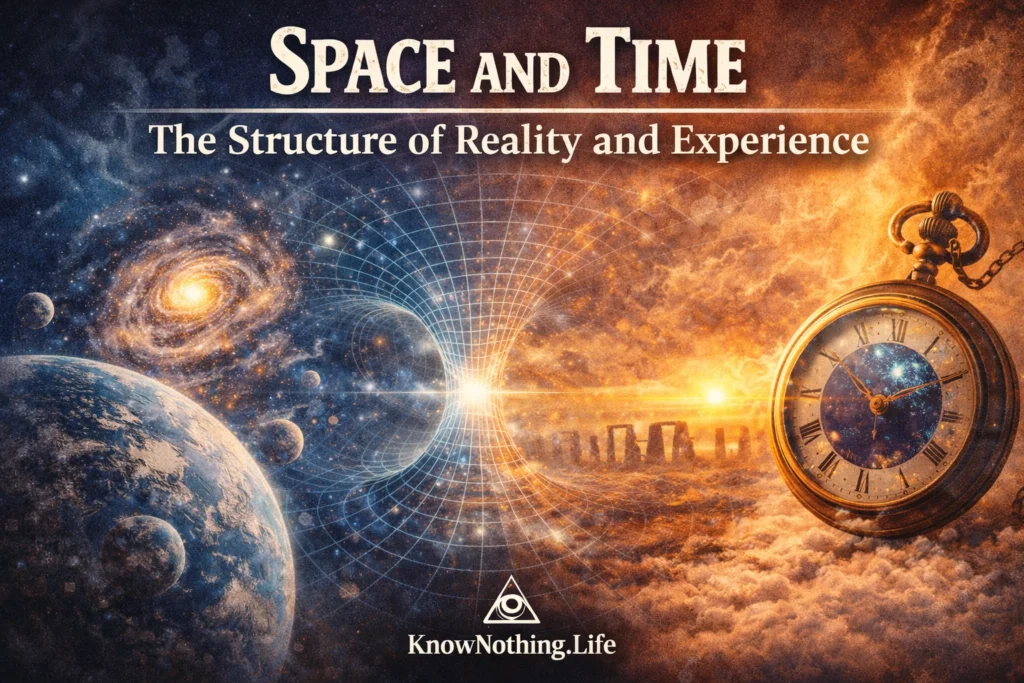
Space and time are the fundamental dimensions through which reality is experienced, yet their true nature has long been a subject of philosophical debate. Are space and time independent features of the universe, existing whether or not anything occupies them? Or are they frameworks imposed by the human mind to organize perception? These questions lie at the intersection of metaphysics, physics, and epistemology, shaping how we understand existence itself.
While everyday intuition treats space as a container and time as a flowing sequence, philosophical inquiry reveals deeper complexities. From ancient thinkers to modern scientists, the nature of space and time has been reinterpreted repeatedly, reflecting shifts in both conceptual and empirical understanding. The study of space and time is not merely theoretical—it influences how we think about causality, motion, identity, and the structure of the universe.
Ancient Foundations: Space, Change, and Motion
Early philosophical discussions of space and time were closely tied to questions of motion and change. Aristotle, in his work Physics, defined time as “the number of motion with respect to before and after.” For Aristotle, time does not exist independently but is a measure of change. Without motion, there would be no time, as there would be nothing to count or compare.
Similarly, Aristotle’s conception of space, or “place,” was relational rather than absolute. He argued that space is defined by the positions of objects relative to one another, rather than as an independent container. This view emphasizes the interconnectedness of objects and their environment, suggesting that space cannot be understood apart from the things within it.
In contrast, earlier thinkers such as Parmenides challenged the reality of change altogether, implying that time itself might be illusory. These early debates established the foundational tension between viewing space and time as real, independent entities and seeing them as dependent on change and perception.
Absolute vs. Relational Space and Time
The nature of space and time became a central issue in early modern philosophy, particularly in the debate between Isaac Newton and Gottfried Wilhelm Leibniz. Newton argued for an absolute conception, in which space and time exist independently of objects and events. In his Principia Mathematica, he described absolute space as “without relation to anything external” and absolute time as flowing uniformly, regardless of what occurs within it.
Newton’s framework provided a stable foundation for classical physics, allowing motion to be measured against a fixed background. However, it raised philosophical questions about the nature of this independent framework. If space and time exist without objects, what kind of entities are they?
Leibniz offered a contrasting relational view, arguing that space and time are not substances but systems of relations among objects. According to Leibniz, space is the order of coexisting things, and time is the order of successive events. He rejected the idea of empty space or time, asserting that they have no existence apart from the relations they describe. This debate between absolutism and relationalism remains central to the philosophy of space and time.
Kant: Space and Time as Forms of Intuition
Immanuel Kant transformed the debate by proposing that space and time are not features of the external world but forms of human intuition. In Critique of Pure Reason, Kant argued that space and time are the conditions under which we perceive anything at all. They are not derived from experience but make experience possible.
For Kant, space and time are a priori structures of the mind. They shape how phenomena appear to us, organizing sensory data into coherent experiences. This means that while space and time are real as aspects of human perception, they do not necessarily reflect the ultimate nature of reality. The “things-in-themselves” (noumena) remain beyond our direct knowledge.
Kant’s view bridges the gap between absolutism and relationalism by relocating space and time within the subject rather than the object. It also introduces a profound limitation: our understanding of space and time may be fundamentally constrained by the structure of human cognition. This insight continues to influence both philosophy and science.
Einstein and the Relativity of Space-Time
The 20th century brought a revolutionary shift in the understanding of space and time through the work of Albert Einstein. In his theory of relativity, Einstein demonstrated that space and time are not separate, absolute entities but interconnected dimensions forming a single continuum known as spacetime.
Einstein’s equations showed that measurements of time and space depend on the observer’s frame of reference. Time can slow down, and lengths can contract, depending on relative motion and gravitational fields. This overturned the Newtonian view of fixed, universal space and time, revealing a dynamic and flexible structure.
Philosophically, relativity has profound implications. It suggests that temporal order and spatial distance are not absolute but relative to perspective. This challenges intuitive notions of simultaneity and raises questions about the nature of reality. If different observers experience time differently, what does it mean for events to occur “at the same time”?
The Nature of Time: Flow or Illusion?
One of the most debated aspects of time is whether it truly “flows” or whether this perception is an illusion. Some philosophers and physicists support the “block universe” theory, which aligns with relativity. According to this view, past, present, and future all exist equally within spacetime, and the flow of time is a subjective experience.
This perspective has been explored by thinkers such as J. M. E. McTaggart, who argued in his essay The Unreality of Time that time is ultimately unreal. McTaggart distinguished between two ways of ordering events: the A-series (past, present, future) and the B-series (earlier than, later than). He concluded that the A-series is contradictory, leading to the conclusion that time itself is an illusion.
Others defend the reality of temporal flow, emphasizing the importance of change and becoming. This debate reflects a deeper question about whether time is an objective feature of the universe or a feature of human experience. The answer has implications for everything from physics to personal identity.
Space, Time, and Human Experience
Beyond abstract theory, space and time shape how humans experience and interpret the world. They provide the framework for perception, action, and memory. Without spatial organization, objects would lack position and relation; without temporal order, events would lack sequence and meaning.
Psychologically, the perception of time is not uniform. Moments of intense emotion may seem to slow time, while routine experiences may pass quickly. This variability suggests that time is not only a physical dimension but also a subjective phenomenon. Similarly, the experience of space can be influenced by perspective, context, and scale.
These insights highlight the dual nature of space and time as both objective structures and subjective experiences. They are at once features of the universe and constructs through which humans interpret reality. This duality underscores the complexity of the concepts and their central role in both philosophy and science.
Conclusion
The study of space and time reveals the depth and complexity of reality. From the relational ideas of Aristotle to the absolute framework of Isaac Newton, the transcendental philosophy of Immanuel Kant, and the revolutionary insights of Albert Einstein, our understanding has evolved dramatically.
These developments show that space and time are not simple, self-evident concepts but deeply intricate structures that shape both the universe and human experience. Whether they are fundamental features of reality or frameworks of perception remains an open question, one that continues to inspire philosophical and scientific inquiry.
Ultimately, the exploration of space and time invites a reconsideration of what it means to exist. It challenges assumptions, expands understanding, and reveals the profound interconnectedness of reality. As knowledge advances, so too does the mystery, ensuring that the study of space and time remains one of the most compelling pursuits in human thought.