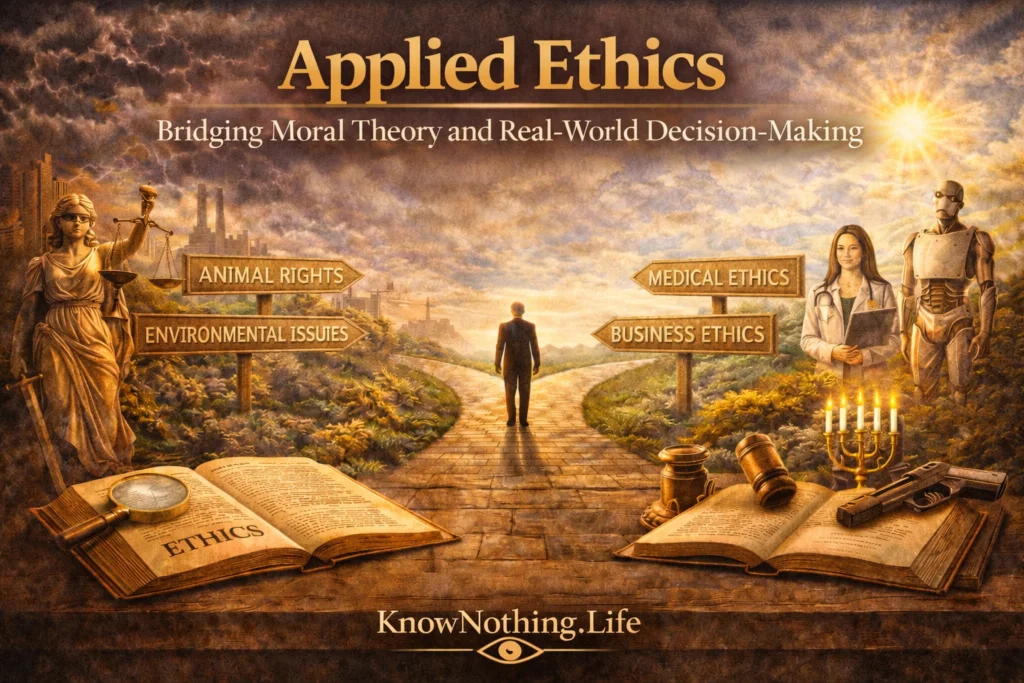
Applied ethics is the branch of moral philosophy that takes abstract ethical principles and brings them into direct engagement with real-world issues. While normative ethics asks what principles should guide behavior, and metaethics examines the nature of moral language and truth, applied ethics asks a more immediate question: How should we act in specific situations? It is concerned with translating theory into practice, addressing concrete dilemmas in areas such as medicine, business, law, technology, and the environment.
The rise of applied ethics in the 20th century reflects a growing recognition that philosophical inquiry must grapple with the complexities of modern life. Advances in science and technology, global interconnectedness, and shifting social norms have created new ethical challenges that demand careful analysis. From decisions about life-sustaining treatment to debates over artificial intelligence and climate change, applied ethics provides a framework for navigating issues where the stakes are often high and the answers are far from clear.
At its best, applied ethics does not simply impose theoretical models onto real-world problems. Instead, it fosters a dynamic interaction between theory and practice, where ethical principles are refined through experience and practical considerations are informed by philosophical reflection. This reciprocal relationship ensures that ethics remains both intellectually rigorous and socially relevant.
Historical Development and Philosophical Foundations
Although ethical reflection on practical issues has existed for centuries, applied ethics as a distinct field gained prominence in the latter half of the 20th century. This development was driven in part by rapid technological advances and social changes that raised new moral questions. Issues such as medical experimentation, environmental degradation, and corporate responsibility highlighted the need for systematic ethical analysis beyond traditional philosophical debates.
Philosophers such as John Stuart Mill laid important groundwork for applied ethics through their emphasis on consequences and social well-being. In Utilitarianism, Mill argued that ethical decisions should aim to maximize happiness, a principle that has been widely applied in policy-making and public health. Similarly, deontological frameworks derived from Immanuel Kant have influenced discussions about rights, duties, and the moral limits of action, particularly in legal and medical contexts.
In the late 20th century, applied ethics expanded significantly with contributions from philosophers such as Peter Singer, whose work Practical Ethics addressed issues ranging from animal welfare to global poverty. Singer’s argument that “if we can prevent something bad without sacrificing anything of comparable significance, we ought to do it” exemplifies the practical orientation of applied ethics. His work demonstrates how philosophical reasoning can be used to challenge existing practices and promote ethical reform.
Bioethics: Life, Health, and Medical Decision-Making
Bioethics is one of the most prominent areas of applied ethics, focusing on moral questions related to medicine, healthcare, and biological research. It addresses issues such as patient autonomy, informed consent, end-of-life decisions, and the allocation of medical resources. These dilemmas often involve conflicting values, requiring careful balancing of individual rights and collective well-being.
The principle of autonomy, influenced by Kantian ethics, emphasizes the right of individuals to make decisions about their own bodies and medical treatment. This has led to practices such as informed consent, where patients must be fully informed about the risks and benefits of medical procedures before agreeing to them. At the same time, utilitarian considerations may come into play when resources are limited, raising questions about how to prioritize care in a way that maximizes overall benefit.
Philosophers such as Tom Beauchamp and James Childress have developed influential frameworks for bioethics, particularly in their work Principles of Biomedical Ethics. They identify four key principles—autonomy, beneficence, nonmaleficence, and justice—that guide ethical decision-making in healthcare. These principles provide a structured approach to navigating complex medical dilemmas while respecting both individual and societal concerns.
Environmental Ethics: Responsibility Beyond Humanity
Environmental ethics extends moral consideration beyond human beings to include animals, ecosystems, and the natural world. It challenges traditional anthropocentric views that prioritize human interests above all else, advocating for a broader understanding of moral responsibility. As environmental crises such as climate change and biodiversity loss intensify, this field has become increasingly important.
One of the key debates in environmental ethics concerns the intrinsic value of nature. Should the environment be protected solely for its usefulness to humans, or does it possess value in its own right? Aldo Leopold, in A Sand County Almanac, argued for a “land ethic” that recognizes the interconnectedness of all living things. “A thing is right,” he wrote, “when it tends to preserve the integrity, stability, and beauty of the biotic community.” This perspective shifts the focus from individual interests to ecological harmony.
Contemporary philosophers have built on these ideas to address global environmental challenges. Peter Singer has argued for extending moral consideration to non-human animals based on their capacity to suffer, while others emphasize the rights of future generations. Environmental ethics thus highlights the need for long-term thinking and collective responsibility in addressing issues that transcend individual and national boundaries.
Business and Professional Ethics
Applied ethics also plays a crucial role in business and professional contexts, where decisions often have significant economic and social consequences. Business ethics examines issues such as corporate responsibility, fair trade, labor practices, and the ethical implications of profit-driven decision-making. It seeks to balance the interests of stakeholders, including employees, customers, shareholders, and the broader community.
The tension between profit and ethical responsibility is a central concern in this field. While businesses are often driven by the goal of maximizing profit, ethical considerations may require limiting certain practices or prioritizing social good. Philosophers have debated whether corporations have moral obligations beyond legal compliance, with many arguing that ethical conduct is essential for long-term sustainability and public trust.
Professional ethics extends these considerations to specific fields such as law, journalism, and engineering. Codes of conduct and ethical guidelines are designed to ensure integrity, accountability, and respect for others. These frameworks reflect a recognition that professional roles carry special responsibilities, requiring individuals to uphold standards that go beyond personal interest.
Technology and Emerging Ethical Challenges
The rapid development of technology has introduced new ethical challenges that require innovative approaches. Issues such as artificial intelligence, data privacy, and genetic engineering raise questions about autonomy, accountability, and the limits of human intervention. Applied ethics provides a framework for addressing these challenges, helping to ensure that technological progress aligns with human values.
Artificial intelligence, for example, raises concerns about decision-making, bias, and responsibility. If an autonomous system causes harm, who is accountable—the developer, the user, or the system itself? These questions highlight the need for ethical guidelines that can adapt to evolving technologies. Philosophers and ethicists are increasingly involved in shaping policies and standards to address these issues.
Similarly, advances in biotechnology, such as gene editing, present ethical dilemmas about the boundaries of human enhancement and the potential consequences for future generations. These developments underscore the importance of foresight and ethical reflection in guiding innovation. As Hans Jonas argued in The Imperative of Responsibility, modern technology demands a new ethical framework that considers the long-term impact of human actions.
Conclusion
Applied ethics represents the vital intersection of philosophical theory and practical life, addressing the moral challenges that arise in an increasingly complex world. By engaging with real-world issues, it demonstrates the relevance and necessity of ethical reasoning beyond academic discourse. Through fields such as bioethics, environmental ethics, business ethics, and technology ethics, it provides tools for navigating dilemmas where the stakes are often profound.
The contributions of thinkers such as John Stuart Mill, Immanuel Kant, Peter Singer, and Hans Jonas highlight the diverse approaches that inform applied ethics. Each offers insights that help illuminate different aspects of moral decision-making, from consequences and duties to responsibility and care.
Ultimately, applied ethics is not about providing definitive answers, but about fostering thoughtful and informed engagement with the moral dimensions of human life. It challenges individuals and societies to reflect on their values, consider the impact of their actions, and strive toward decisions that promote well-being, justice, and sustainability. In doing so, it reaffirms the enduring importance of ethics as a guide to living responsibly in a complex and interconnected world.