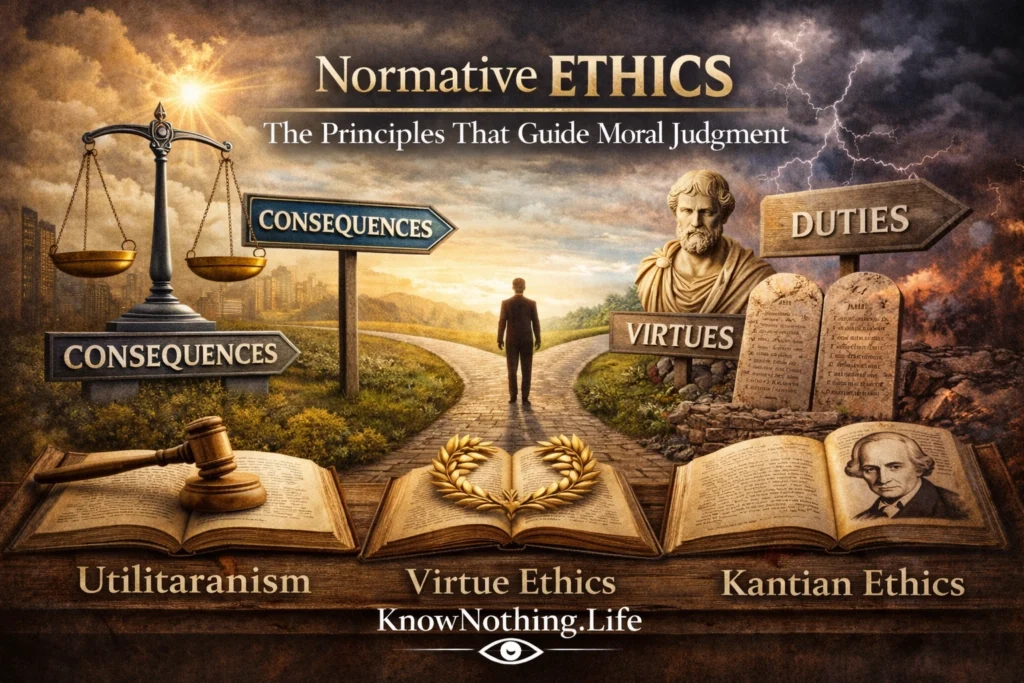
Normative ethics is the branch of moral philosophy concerned with establishing standards for what actions are right or wrong, good or bad, and just or unjust. Unlike descriptive ethics, which examines how people actually behave, or metaethics, which investigates the nature of moral language and truth, normative ethics seeks to answer a more practical and pressing question: What ought we to do? It provides the frameworks and principles that guide human conduct, shaping everything from personal decisions to legal systems and global policies.
At its core, normative ethics is about justification. It does not merely assert that certain actions are right or wrong; it aims to explain why they are so. This involves constructing coherent systems of reasoning that can be applied across situations, offering consistency and moral clarity. As Immanuel Kant argued in Groundwork of the Metaphysics of Morals, morality must be grounded in rational principles that hold universally, not in subjective preferences or contingent outcomes. This ambition—to provide universally valid guidance—distinguishes normative ethics from other areas of inquiry.
Yet, the search for universal principles is not without tension. Human life is complex, and moral dilemmas often resist simple solutions. Normative ethics must therefore balance abstraction with practical relevance, offering guidance that is both philosophically rigorous and applicable to real-world contexts. It is this dual demand—clarity and applicability—that has driven centuries of philosophical debate and continues to animate ethical inquiry today.
The Foundations of Normative Ethical Theory
The development of normative ethics has been shaped by a series of foundational questions: What is the ultimate source of moral value? Are moral truths objective or constructed? Should morality be based on reason, emotion, or social convention? These questions have led to diverse answers, each giving rise to distinct ethical systems that attempt to capture the essence of moral judgment.
In ancient philosophy, Aristotle offered one of the earliest systematic accounts of normative ethics in Nicomachean Ethics. He rejected the idea that morality could be reduced to rigid rules, instead emphasizing the cultivation of virtues that enable individuals to achieve eudaimonia, or flourishing. “We are what we repeatedly do,” Aristotle suggested, implying that ethical excellence is not an isolated act but a habitual state. His framework grounded morality in human nature and social life, presenting ethics as a practical discipline oriented toward living well.
The Enlightenment introduced a shift toward rationalism and universality. Immanuel Kant argued that moral principles must be derived from reason alone, independent of empirical circumstances. His categorical imperative provided a formal test for moral action: only those maxims that can be universalized without contradiction are morally permissible.
In contrast, David Hume challenged the primacy of reason, asserting that moral judgments are rooted in sentiment. “Reason is, and ought only to be the slave of the passions,” he wrote, highlighting the emotional dimension of ethical life. These contrasting perspectives—rationalist and sentimentalist—continue to influence contemporary debates about the foundations of morality.
Deontological Ethics: Duty and Moral Law
Deontological ethics focuses on the idea that certain actions are intrinsically right or wrong, regardless of their consequences. The most influential proponent of this approach is Immanuel Kant, whose work in Groundwork of the Metaphysics of Morals and Critique of Practical Reason established a rigorous framework for duty-based ethics. According to Kant, moral obligations arise from rational principles that bind all individuals equally, reflecting the inherent dignity of persons as rational agents.
Central to Kant’s theory is the categorical imperative, which requires individuals to act only according to maxims that can be universally applied. This principle eliminates actions based on self-interest or contingent outcomes, insisting instead on consistency and impartiality. Kant also introduced the idea that individuals must be treated as ends in themselves, never merely as means. This formulation has had a lasting impact on human rights discourse, emphasizing respect for autonomy and moral worth.
However, deontological ethics faces challenges when duties conflict or when rigid adherence to rules leads to counterintuitive outcomes. Critics argue that an exclusive focus on duty can neglect the importance of consequences and context. Nevertheless, deontology remains a cornerstone of normative ethics, offering a powerful account of moral obligation grounded in reason and universal law.
Consequentialism: Outcomes and Moral Value
Consequentialism evaluates actions based on their outcomes, asserting that the right action is the one that produces the best overall results. The most prominent form of consequentialism is utilitarianism, developed by Jeremy Bentham and refined by John Stuart Mill. In Utilitarianism, Mill articulated the principle of utility: actions are right in proportion as they tend to promote happiness and wrong as they tend to produce the opposite.
Bentham’s approach emphasized quantitative measurement, proposing that pleasures and pains could be calculated to determine the moral value of actions. Mill, however, introduced a qualitative distinction between higher and lower pleasures, arguing that intellectual and moral pleasures are superior to purely physical ones. “It is better to be a human being dissatisfied than a pig satisfied,” Mill famously wrote, highlighting the importance of human dignity and intellectual development.
Consequentialism’s strength lies in its flexibility and practical orientation. It allows for context-sensitive decision-making and emphasizes the importance of outcomes in ethical evaluation. Yet, it also raises concerns about justice and individual rights. If maximizing overall happiness justifies harming a minority, does consequentialism adequately protect individuals? These tensions continue to fuel debates within normative ethics, prompting refinements and alternative formulations.
Virtue Ethics: Character and Moral Excellence
Virtue ethics shifts the focus from actions and consequences to the character of the moral agent. Rooted in the philosophy of Aristotle, this approach emphasizes the development of virtues—traits such as courage, honesty, and compassion—that enable individuals to live flourishing lives. In Nicomachean Ethics, Aristotle argued that virtue lies in finding the mean between extremes, guided by practical wisdom.
Modern philosophers have revived and expanded virtue ethics, including Alasdair MacIntyre, whose work After Virtue critiques the fragmentation of modern moral discourse. MacIntyre argues that virtues are embedded in social practices and traditions, suggesting that moral understanding cannot be divorced from historical and cultural contexts. This perspective reintroduces a communal dimension to ethics, emphasizing the role of shared values and narratives.
Virtue ethics offers a holistic account of morality, integrating emotion, reason, and social life. It addresses aspects of ethical experience that rule-based and outcome-based theories may overlook, such as moral development and personal integrity. However, critics question whether it provides sufficient guidance in specific situations, particularly when virtues conflict. Despite these challenges, virtue ethics remains a vital component of normative theory, enriching our understanding of moral life.
Contemporary Approaches and Moral Pluralism
In modern philosophy, many thinkers have moved beyond single-theory frameworks, recognizing that no one approach fully captures the complexity of moral life. This has led to the development of pluralistic theories that integrate elements of deontology, consequentialism, and virtue ethics. For example, W. D. Ross proposed a theory of prima facie duties in The Right and the Good, arguing that individuals have multiple moral obligations that must be balanced through judgment and experience.
Similarly, John Rawls introduced a contractarian approach in A Theory of Justice, emphasizing fairness and equality. His concept of the “veil of ignorance” provides a method for determining just principles by imagining a position of impartiality. Rawls’s work reflects a broader trend toward procedural ethics, where the focus is on fair methods of decision-making rather than fixed outcomes or rules.
Contemporary normative ethics also engages with issues of global justice, environmental responsibility, and technological change. Philosophers like Peter Singer have extended ethical concern to non-human animals and distant populations, challenging traditional boundaries of moral obligation. These developments highlight the evolving nature of normative ethics, as it responds to new challenges and expands its scope.
Conclusion
Normative ethics represents humanity’s ongoing effort to articulate the principles that should guide moral judgment and action. Through its major traditions—deontology, consequentialism, and virtue ethics—it offers diverse perspectives on what it means to act rightly and live well. Each framework captures important aspects of moral experience, yet none provides a complete account on its own.
The enduring value of normative ethics lies not in delivering final answers, but in fostering critical reflection and informed decision-making. It equips individuals with the tools to navigate moral complexity, question assumptions, and strive for coherence in their beliefs and actions. As John Stuart Mill observed, “A person who has not read both sides of the argument knows little of that.” This spirit of open inquiry remains central to ethical philosophy.
In a world marked by rapid change and increasing interconnection, the need for thoughtful ethical guidance is greater than ever. Normative ethics continues to evolve, drawing on its rich history while addressing contemporary challenges. It remains a vital discipline—not only for philosophers, but for anyone seeking to understand what it means to act with integrity, responsibility, and purpose.