Metaethics is the branch of moral philosophy that steps back from questions about what we ought to do and instead asks deeper, more abstract questions about the nature of morality itself. Rather than prescribing actions or evaluating behavior, metaethics investigates the meaning of moral language, the status of moral truths, and the foundations of ethical knowledge. It asks: Are moral claims objectively true or merely expressions of opinion? What does it mean to call something “good” or “wrong”? And how, if at all, can moral knowledge be justified?
This level of inquiry distinguishes metaethics from normative ethics and applied ethics. While those fields focus on guiding behavior and resolving practical dilemmas, metaethics seeks to understand the underlying structure of moral reasoning. It is concerned not with which actions are right, but with what rightness itself consists in. As such, metaethics operates at a higher level of abstraction, often intersecting with philosophy of language, metaphysics, and epistemology.
The importance of metaethics lies in its ability to clarify the assumptions that underpin ethical theories. Without a clear understanding of what moral claims mean or whether they can be true, debates in normative ethics risk becoming confused or superficial. By examining the foundations of moral thought, metaethics provides the conceptual tools needed to engage in ethical inquiry with greater precision and depth.
The Origins and Development of Metaethical Thought
Although metaethics emerged as a distinct field in the 20th century, its roots can be traced to earlier philosophical traditions that questioned the nature of moral values and judgments. David Hume played a pivotal role in shaping metaethical inquiry by challenging the idea that moral judgments are derived from reason alone. In A Treatise of Human Nature, Hume argued that moral distinctions arise from sentiment rather than rational deduction, famously asserting that “reason is, and ought only to be the slave of the passions.” This insight laid the groundwork for later debates about the role of emotion in moral judgment.
Another foundational figure is G. E. Moore, whose work Principia Ethica introduced the concept of the “naturalistic fallacy.” Moore argued that moral properties such as “goodness” cannot be reduced to natural properties like pleasure or desire. He maintained that “good” is a simple, indefinable quality, known through intuition rather than empirical observation. This position, known as ethical non-naturalism, became a central point of reference in metaethical discussions.
The development of analytic philosophy in the early 20th century further transformed metaethics. Philosophers began to focus on the language of ethics, examining how moral statements function and what they express. A. J. Ayer, in Language, Truth and Logic, argued that moral statements are not factual claims but expressions of emotion, a view known as emotivism. According to Ayer, saying “murder is wrong” is equivalent to expressing disapproval rather than stating a truth. This shift toward linguistic analysis marked a significant turning point in the study of metaethics.
Moral Realism and Anti-Realism
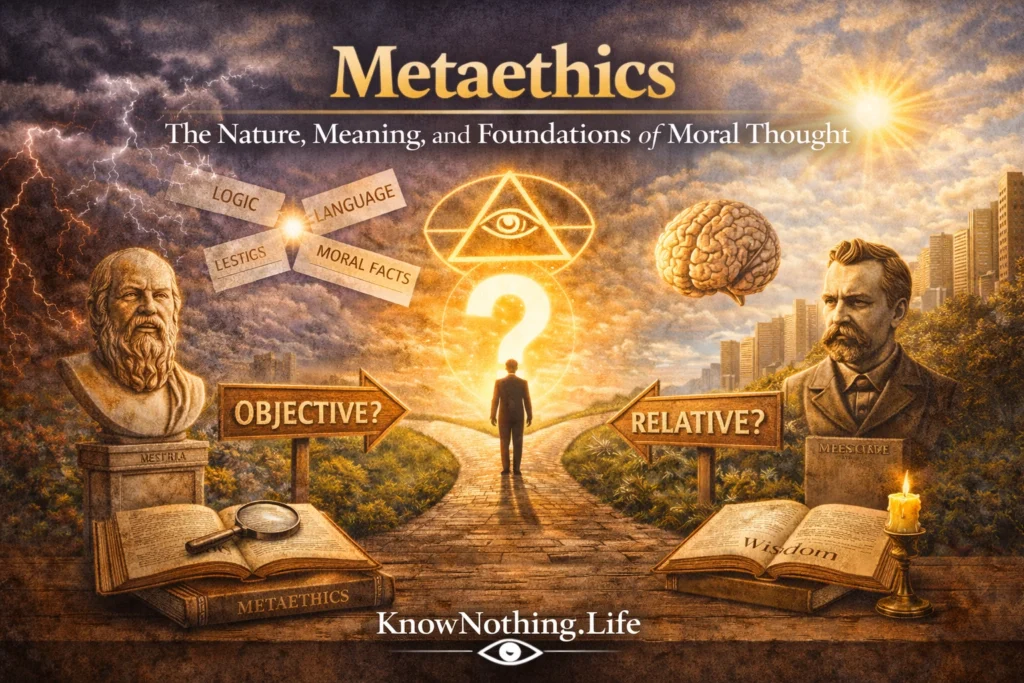
One of the central debates in metaethics concerns the status of moral truths: are there objective moral facts, or are moral claims fundamentally subjective or constructed? This question divides philosophers into two broad camps: moral realists and moral anti-realists.
Moral realism holds that moral statements can be true or false in a way that is independent of individual beliefs or cultural practices. Realists argue that there are objective moral facts, much like scientific facts, that can be discovered and justified. Thomas Nagel, for example, has defended the idea that moral truths are accessible through reason and that ethical objectivity is essential for meaningful moral discourse. This perspective supports the intuition that certain actions, such as cruelty or injustice, are wrong regardless of context or opinion.
In contrast, moral anti-realism denies the existence of objective moral facts. This broad category includes several distinct positions, such as subjectivism, relativism, and error theory. J. L. Mackie, in Ethics: Inventing Right and Wrong, argued that while moral language appears to refer to objective values, such values do not actually exist. He famously described moral judgments as “systematically false,” suggesting that our moral discourse is based on a fundamental error.
These competing views reflect deeper disagreements about the nature of reality and human understanding. While realism offers a robust foundation for moral claims, anti-realism highlights the complexities and contingencies of moral experience. The tension between these perspectives continues to drive metaethical inquiry, shaping debates about objectivity, truth, and the possibility of moral knowledge.
Cognitivism and Non-Cognitivism
Another key distinction in metaethics concerns the function of moral language: do moral statements express beliefs that can be true or false, or do they serve a different purpose altogether? This question divides philosophers into cognitivists and non-cognitivists.
Cognitivism holds that moral statements are propositions that can be evaluated for truth or falsity. According to this view, when someone says “lying is wrong,” they are making a claim about the world that can, in principle, be true or false. This position is compatible with both realism and certain forms of anti-realism, as it focuses on the structure of moral language rather than the existence of moral facts.
Non-cognitivism, on the other hand, argues that moral statements do not express beliefs but rather emotions, attitudes, or prescriptions. A. J. Ayer’s emotivism is a prominent example, interpreting moral statements as expressions of approval or disapproval. Similarly, R. M. Hare, in The Language of Morals, developed prescriptivism, which views moral statements as commands or recommendations rather than factual claims.
This debate has significant implications for how we understand moral disagreement. If moral statements are truth-apt, then disagreements can be resolved through evidence and argument. If they are expressions of attitude, however, disagreement may reflect differences in perspective that cannot be objectively adjudicated. This raises questions about the nature of moral discourse and the possibility of rational moral debate.
Moral Epistemology: Can We Know Moral Truths?
Metaethics also explores the question of moral knowledge: if moral truths exist, how can we know them? This area, known as moral epistemology, examines the sources and justification of ethical beliefs. Philosophers have proposed various accounts, including rational intuition, empirical observation, and social construction.
Some thinkers, such as G. E. Moore, argue that moral truths are known through intuition—a direct, non-inferential form of knowledge. Others, influenced by David Hume, emphasize the role of emotion and sentiment in shaping moral judgments. These differing views reflect broader debates about the nature of knowledge and the relationship between reason and experience.
Contemporary philosophers have developed more nuanced approaches, integrating insights from psychology, neuroscience, and social theory. Christine Korsgaard, for example, has argued that moral obligations arise from the structure of practical reason and the need for self-constitution. Her work bridges metaethics and normative ethics, suggesting that understanding the foundations of morality can inform practical decision-making.
The question of moral knowledge remains one of the most challenging and contested areas in philosophy. It touches on fundamental issues about human cognition, cultural diversity, and the limits of rational inquiry. Whether moral truths are discovered, constructed, or felt, the search for ethical understanding continues to shape both philosophical theory and everyday life.
Conclusion
Metaethics represents a profound and essential dimension of moral philosophy, addressing questions that lie beneath the surface of ethical inquiry. By examining the meaning, truth, and justification of moral claims, it provides the conceptual foundation for understanding morality itself. Through debates about realism and anti-realism, cognitivism and non-cognitivism, and the nature of moral knowledge, metaethics reveals the complexity and depth of ethical thought.
The contributions of philosophers such as David Hume, G. E. Moore, A. J. Ayer, and J. L. Mackie have shaped the field, offering diverse perspectives on the nature of morality. Their work continues to influence contemporary discussions, highlighting the enduring relevance of metaethical inquiry.
Ultimately, metaethics challenges us to reflect not only on what we believe, but on what those beliefs mean and how they can be justified. It invites us to question the foundations of our moral convictions and to engage in a deeper exploration of the principles that guide human life. In doing so, it underscores the importance of philosophy as a tool for understanding both ourselves and the world we inhabit.