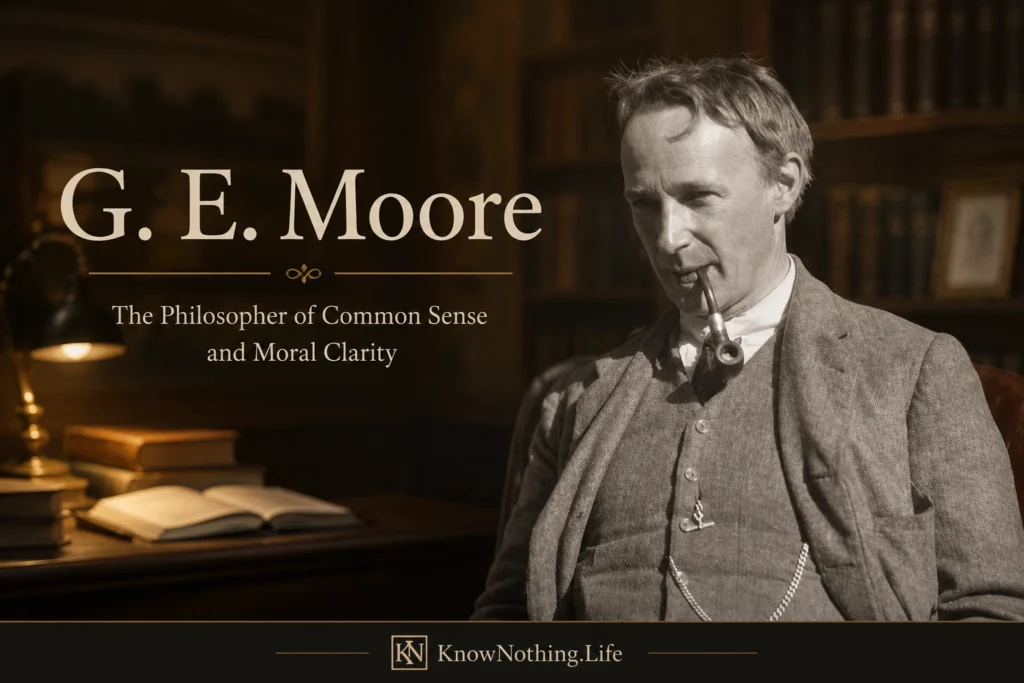
George Edward Moore was born on November 4, 1873, in South London, and became one of the most influential British philosophers of the twentieth century. He disliked the names George Edward and is usually remembered simply as G. E. Moore. His intellectual life became closely tied to Trinity College, Cambridge, where he studied Classics before turning seriously to philosophy. Cambridge at the end of the nineteenth century was still shaped by British Idealism, a philosophical movement influenced by Hegel and concerned with the unity of reality, mind, and experience.
Moore’s importance begins with his rebellion against that atmosphere. Alongside Bertrand Russell, and later in a different relation to Ludwig Wittgenstein, Moore helped make Cambridge a center of analytic philosophy. His style was not grand, rhetorical, or system-building. He was suspicious of sweeping metaphysical claims and preferred slow, careful examination of what propositions mean and what ordinary people are entitled to believe. That method gave his work a distinctive force: Moore made philosophy seem less like a performance of speculative brilliance and more like an exercise in intellectual honesty.
Russell, Idealism, and the Birth of Analysis
Moore became friends with Bertrand Russell while still a student, and the two helped move each other away from the idealist philosophy then dominant in Cambridge. Moore’s early essays attacked the idea that reality is dependent on mind or experience. In “The Nature of Judgment” and “The Refutation of Idealism,” he argued for a sharp distinction between acts of consciousness and the objects of which we are conscious. This may sound technical, but it mattered deeply. If the object of thought is not the same as the act of thinking, then philosophy can begin to recover realism about truth, objects, and the external world.
“The Refutation of Idealism,” published in 1903, is one of Moore’s most famous early works. Its central target was the idealist slogan “esse is percipi,” or “to be is to be perceived.” Moore argued that idealists confuse the sensation of something with the thing sensed. When we experience yellow, for example, there is the act or experience and there is the quality yellow. These are not identical. His argument helped clear space for the realist and analytic movements that would dominate much English-language philosophy in the twentieth century.
Principia Ethica and the Meaning of Good
In 1903, Moore published Principia Ethica, one of the most influential books in modern moral philosophy. Its central claim was that “good” is a simple, indefinable, non-natural property. Moore argued that philosophers had repeatedly committed what he called the naturalistic fallacy: they tried to define goodness in terms of some natural property such as pleasure, desire, survival, evolution, or social approval. Moore thought this was a mistake. Goodness could not be reduced to any of these things.
His famous open-question argument was designed to show why. If someone says “good means pleasant,” it still remains an open and meaningful question whether what is pleasant is actually good. If the two terms were truly identical in meaning, the question would be closed or trivial. Moore wrote that “good does not, by definition, mean anything that is natural,” and that it is “always an open question whether anything that is natural is good.” This argument shaped twentieth-century metaethics, even among philosophers who later rejected Moore’s own non-naturalism.
The Ideal: Art, Love, and Intrinsic Value
Moore’s ethics was not only a negative attack on naturalistic definitions. Principia Ethica also developed a theory of intrinsic value. Moore believed that some states of affairs are good in themselves, not merely as means to something else. He famously gave special importance to personal affection and aesthetic appreciation. In the final chapter of Principia Ethica, he suggested that by far the most valuable things we know or can imagine are certain states of consciousness involving “the pleasures of human intercourse and the enjoyment of beautiful objects.”
This vision made Moore unexpectedly important for the Bloomsbury Group, whose members included Lytton Strachey, Leonard Woolf, Maynard Keynes, Virginia Woolf, and others. Moore’s ideal of truthful friendship, aesthetic experience, and intrinsic value resonated deeply with their cultural rebellion against Victorian convention. Yet Moore himself was not a bohemian stylist. He was cautious, exacting, and morally serious. His influence on Bloomsbury came not from flamboyance but from an ethical atmosphere: the belief that honest relations between persons and the love of beauty mattered more than status, conformity, or social performance.
Philosophical Method and the Search for Clarity
Moore’s philosophical method was one of his greatest legacies. He did not try to explain everything through one comprehensive theory. Instead, he analyzed particular propositions, distinctions, and puzzles with extreme care. His questions often sounded plain: What exactly are we saying? What follows from it? What is being confused with what? What do we know before philosophy tries to unsettle us? This attention to clarity helped define analytic philosophy as a discipline of argument, precision, and conceptual scrutiny.
His works such as Philosophical Studies, Some Main Problems of Philosophy, and later essays show this method in action. Moore’s prose can seem repetitive because he was determined not to move faster than the argument allowed. But the repetition has a purpose. He wanted to prevent philosophy from being carried away by verbal momentum. For Moore, the danger was not only false belief but false depth: the impression that a sentence is profound because it is obscure. His intellectual virtue was patience.
Common Sense and the External World
Moore’s later work became famous for its defense of common sense. In “A Defence of Common Sense,” published in 1925, he listed propositions he claimed to know with certainty: that he had a body, that the Earth had existed before his birth, that other human beings existed, and that he had had experiences in the past. He did not pretend these were exciting discoveries. Their ordinariness was the point. Any philosophy that implies we do not know such things must carry a very heavy burden of proof.
This was Moore’s answer to radical skepticism and certain forms of idealism. He did not claim to have solved every puzzle about perception, knowledge, or the external world. He claimed that we are more certain of many ordinary truths than we are of the philosophical arguments used to deny them. This reversal was powerful. Instead of letting skeptical theory overrule common belief, Moore asked whether the theory was less credible than the beliefs it tried to overthrow.
“Here Is One Hand”
Moore’s most famous moment came in “Proof of an External World,” delivered as a lecture in 1939. He held up one hand and said, “Here is one hand,” then held up the other and said, “and here is another.” From that, he concluded that at least two external objects exist, and therefore an external world exists. The argument has often been mocked as too simple, but Moore was making a serious point. A proof can be valid if its premises are known and its conclusion follows.
The deeper issue is whether Moore really knew the premises more securely than the skeptic knew the skeptical argument. Moore thought he did. He was not offering a psychological comfort but a philosophical challenge. If a skeptical argument implies that we do not know we have hands, perhaps the rational response is not to give up our hands but to doubt the argument. Moore’s proof remains famous because it stages a confrontation between ordinary certainty and philosophical doubt in the plainest possible form.
Later Career, Influence, and Personality
Moore returned to Cambridge as a lecturer in 1911, became editor of Mind in 1921, and was appointed professor at Cambridge in 1925. He retired from his professorship in 1939, the same year Wittgenstein succeeded him, and he continued as editor of Mind until 1944. His long Cambridge career placed him at the center of British philosophy during a remarkable period. Russell, Wittgenstein, Frank Ramsey, and others made Cambridge one of the most important philosophical settings in the world.
Moore was admired not only for his arguments but for his character. Friends and students often described his honesty, seriousness, and almost Socratic refusal to pretend he understood what he did not. This personal quality mattered because Moore’s philosophy was inseparable from his temperament. He distrusted performance, exaggeration, and fashionable obscurity. He wanted to know what was true, and he wanted to say it as plainly as possible.
Death and Lasting Legacy
G. E. Moore died on October 24, 1958. By then, some of his specific doctrines had been criticized or abandoned, including parts of his ethical non-naturalism and his sense-data theory. Yet his influence survived those revisions. He helped found analytic philosophy, reshaped metaethics, challenged idealism, defended common sense realism, and gave later philosophers a model of careful conceptual analysis. Even when philosophers disagreed with him, they often inherited his standards of clarity.
Moore’s lasting importance lies in his disciplined refusal to be impressed by confusion. He did not make philosophy smaller by demanding clarity; he made its difficulties more exact. His work asks us to distinguish the thing known from the act of knowing, the good from what is merely natural, and genuine doubt from philosophical theater. In an age still tempted by grand claims and verbal fog, Moore remains essential because he reminds us that philosophy begins with a simple but demanding virtue: saying exactly what we mean.