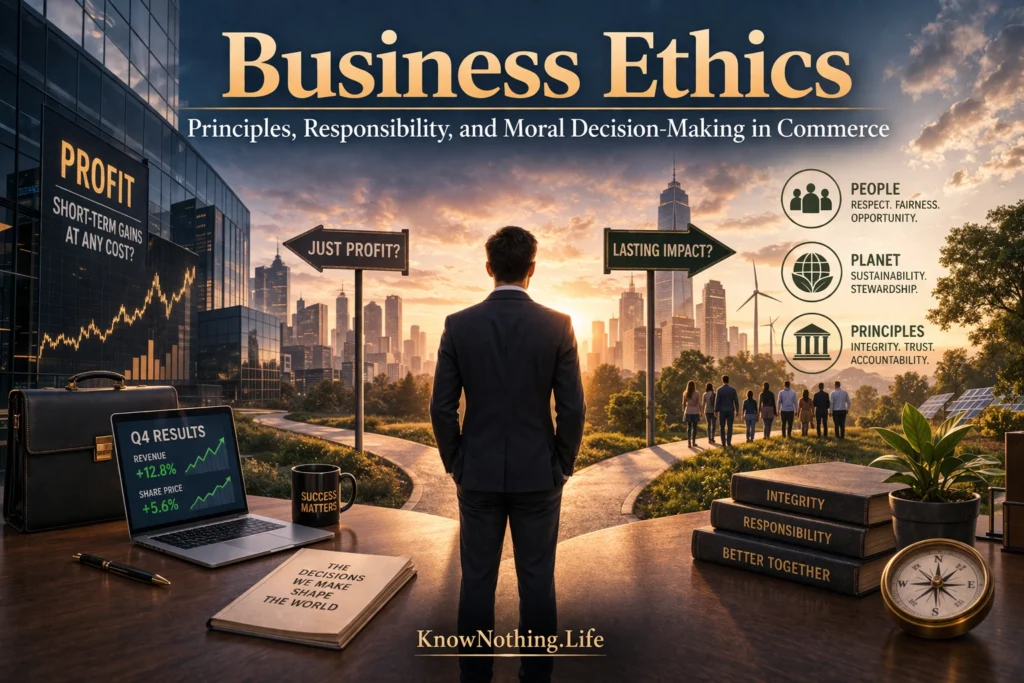
Business ethics is the field of applied ethics that examines the moral principles guiding behavior in commercial contexts. It addresses how individuals and organizations ought to act when making decisions that affect stakeholders, markets, and society at large. While business is often associated with profit and competition, business ethics asks whether success can—or should—be pursued without regard for fairness, responsibility, and the broader social good.
At its core, business ethics grapples with a fundamental tension: the pursuit of profit versus the obligation to act ethically. Companies operate within complex systems involving employees, customers, investors, and communities, each with competing interests. Ethical decision-making in business requires balancing these interests while maintaining integrity and accountability. As Adam Smith observed in The Theory of Moral Sentiments, economic activity is not divorced from moral considerations; sympathy and moral judgment play a central role in human interactions, even in markets.
In an increasingly globalized and technologically driven economy, the importance of business ethics has grown significantly. Issues such as corporate governance, environmental sustainability, labor practices, and data privacy highlight the need for ethical frameworks that extend beyond legal compliance. Business ethics thus serves as both a guide for responsible conduct and a critical lens for evaluating the impact of commerce on society.
Historical Foundations and Philosophical Background
The roots of business ethics can be traced to broader philosophical traditions that explore the relationship between economic activity and moral responsibility. Aristotle, in Nicomachean Ethics and Politics, distinguished between natural forms of exchange aimed at meeting human needs and excessive accumulation driven by greed. He viewed economic activity as part of a larger ethical framework oriented toward the common good, emphasizing moderation and justice.
In the modern era, Adam Smith offered a more complex view of markets and morality. While often associated with the idea of the “invisible hand,” Smith did not advocate unrestrained self-interest. In The Theory of Moral Sentiments, he argued that human behavior is guided by sympathy and a desire for mutual approval, suggesting that ethical considerations are integral to economic life. This dual perspective—combining self-interest with moral restraint—remains central to debates in business ethics.
The formal development of business ethics as a distinct field occurred in the 20th century, particularly in response to corporate scandals and increasing awareness of the social impact of business practices. Philosophers such as Milton Friedman and R. Edward Freeman offered contrasting views on corporate responsibility. Friedman argued in Capitalism and Freedom that the primary responsibility of business is to increase profits within the bounds of the law, famously stating that “the social responsibility of business is to increase its profits.” Freeman, in contrast, developed stakeholder theory, which emphasizes the obligations of businesses to all parties affected by their actions, not just shareholders.
Core Principles of Business Ethics
Business ethics encompasses a range of principles that guide decision-making and behavior within organizations. One of the most fundamental is honesty, which underpins trust in commercial relationships. Transparent communication, accurate reporting, and truthful marketing are essential for maintaining credibility and fostering long-term success. Without trust, markets cannot function effectively.
Fairness is another key principle, involving the equitable treatment of stakeholders and the avoidance of exploitation. This includes fair wages, nondiscriminatory practices, and just dealings with suppliers and customers. Fairness also extends to competition, where ethical businesses avoid practices such as price-fixing, insider trading, and deceptive advertising. These principles ensure that competition remains both vigorous and just.
Accountability and responsibility are equally central. Businesses must take responsibility for the consequences of their actions, including unintended harms. This involves not only complying with laws and regulations but also proactively addressing ethical concerns. Corporate social responsibility (CSR) initiatives reflect this broader commitment, encouraging companies to consider their environmental and social impact alongside financial performance.
Stakeholder Theory and Corporate Responsibility
One of the most influential developments in business ethics is stakeholder theory, articulated by R. Edward Freeman in Strategic Management: A Stakeholder Approach. This framework challenges the traditional view that businesses exist solely to serve shareholders. Instead, it argues that companies have ethical obligations to all stakeholders, including employees, customers, suppliers, communities, and the environment.
Stakeholder theory emphasizes the interconnectedness of business relationships and the importance of balancing competing interests. Decisions that benefit one group at the expense of others may lead to long-term harm, undermining trust and sustainability. By considering the needs and perspectives of all stakeholders, businesses can make more informed and ethical decisions that contribute to overall well-being.
This approach also aligns with broader trends toward corporate responsibility and sustainability. Companies are increasingly expected to address issues such as climate change, social inequality, and ethical supply chains. These expectations reflect a shift in public attitudes, where businesses are seen not just as economic entities but as social actors with moral responsibilities.
Ethical Challenges in Modern Business
Contemporary business environments present a wide range of ethical challenges that require careful consideration. Globalization has expanded the reach of corporations, raising questions about labor standards, cultural differences, and regulatory disparities. Companies operating in multiple countries must navigate complex ethical landscapes, balancing local practices with universal principles.
Technological advancements have introduced new ethical concerns, particularly in areas such as data privacy and artificial intelligence. The collection and use of personal data raise questions about consent, security, and surveillance. Businesses must ensure that technological innovation does not come at the expense of individual rights and societal trust.
Environmental sustainability is another critical issue. As awareness of climate change and ecological degradation grows, businesses face increasing pressure to adopt sustainable practices. This includes reducing emissions, minimizing waste, and investing in renewable resources. Ethical decision-making in this context requires balancing short-term costs with long-term benefits, reflecting a broader commitment to future generations.
Critiques and Ongoing Debates
Business ethics is not without controversy, and debates continue about the extent and nature of corporate responsibility. Critics of stakeholder theory argue that expanding the scope of business obligations can dilute accountability and create conflicts of interest. They contend that businesses are not equipped to address complex social issues and should focus on their core economic functions.
On the other hand, proponents of ethical business practices argue that ignoring social and environmental concerns can lead to significant risks, including reputational damage and regulatory intervention. Ethical behavior is increasingly seen as a strategic advantage, enhancing trust and fostering long-term success. This perspective challenges the notion that ethics and profitability are inherently opposed.
Philosophical debates also persist about the role of moral principles in business decision-making. Should businesses prioritize outcomes, as in utilitarian approaches, or adhere to duties and rights, as in deontological frameworks? These questions highlight the complexity of applying ethical theory in practical contexts, where multiple considerations must be balanced.
Conclusion
Business ethics provides a critical framework for understanding the moral dimensions of commerce, guiding individuals and organizations in navigating complex decisions. By integrating principles such as honesty, fairness, and responsibility, it ensures that economic activity contributes to both individual success and societal well-being.
The contributions of thinkers such as Adam Smith, Milton Friedman, and R. Edward Freeman illustrate the diversity of perspectives within the field, reflecting ongoing debates about the purpose and responsibilities of business. These discussions continue to shape the evolution of business ethics in response to changing economic and social conditions.
Ultimately, business ethics is not merely an academic discipline but a practical necessity. In a world where business decisions have far-reaching consequences, ethical reflection is essential for building trust, promoting justice, and ensuring sustainable success. By embracing ethical principles, businesses can play a vital role in creating a more equitable and responsible global economy.