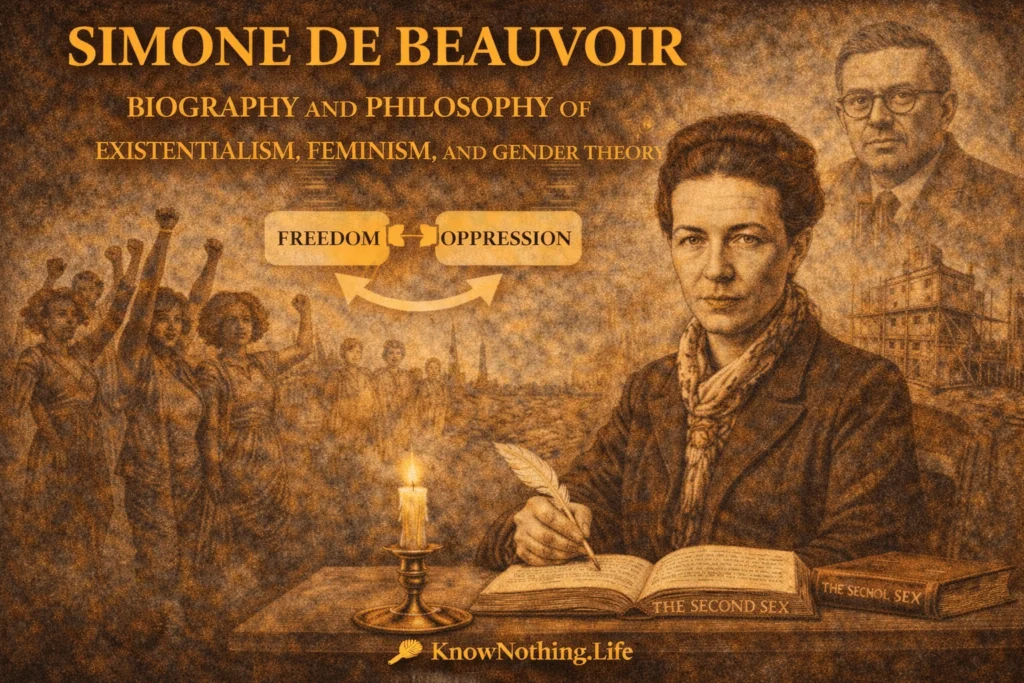
Few thinkers have reshaped modern philosophy and social thought as profoundly as Simone de Beauvoir. A central figure in existentialism and one of the most influential feminist philosophers of the 20th century, Beauvoir explored what it means to live freely in a world shaped by social constraints, inequality, and ambiguity. Her work bridges philosophy, literature, and political theory, offering a deeply human account of freedom, identity, and responsibility.
Beauvoir’s philosophy is grounded in the belief that existence precedes essence—that human beings are not born with predetermined purposes but must create meaning through their choices. Yet she went further than many of her contemporaries by examining how social structures limit this freedom, particularly for women. Her writing remains essential because it confronts a central tension of modern life: how can individuals be free when their circumstances are shaped by forces beyond their control?
Early Life and Intellectual Formation
Simone de Beauvoir was born in 1908 in Paris into a bourgeois family that valued education and cultural refinement. From an early age, she demonstrated exceptional intellectual ability and a fierce independence of thought. Her upbringing, while privileged in some respects, was also marked by contradictions—traditional expectations coexisted with her growing rejection of religious and social conventions.
Beauvoir pursued her studies at the Sorbonne, where she excelled in philosophy and formed relationships that would shape her intellectual trajectory. Among these was her lifelong partnership with Jean-Paul Sartre, with whom she developed and refined existentialist ideas. Their relationship, unconventional in both personal and intellectual terms, reflected Beauvoir’s commitment to freedom and authenticity.
Her early philosophical development was influenced by thinkers such as Georg Wilhelm Friedrich Hegel and Søren Kierkegaard, whose ideas about selfhood, freedom, and contradiction informed her work. Yet Beauvoir’s approach remained distinct, shaped by her focus on lived experience and the social realities that define human existence.
Existentialism and the Ethics of Ambiguity
Beauvoir’s philosophical contributions are closely tied to existentialism, yet she developed her own distinctive interpretation of its principles. In The Ethics of Ambiguity, she explores the moral implications of existential freedom, arguing that human life is inherently ambiguous. We are both free and constrained, capable of shaping our lives yet limited by circumstances beyond our control.
This ambiguity, Beauvoir contends, is not a problem to be solved but a condition to be embraced. Ethical living requires acknowledging both our freedom and our limitations, recognizing that our choices affect not only ourselves but others. She rejects both absolute determinism and naive notions of complete autonomy, proposing instead a nuanced understanding of human agency.
Beauvoir’s ethical framework emphasizes responsibility and engagement. Freedom is not merely the ability to choose, but the obligation to act in ways that respect and promote the freedom of others. This relational conception of ethics distinguishes her work from more individualistic interpretations of existentialism.
The Second Sex and Feminist Philosophy
Beauvoir’s most influential and groundbreaking work, The Second Sex, fundamentally transformed the understanding of gender and inequality. In this monumental text, she examines the historical, social, and psychological forces that have shaped women’s status in society. Her famous assertion, “One is not born, but rather becomes, a woman,” encapsulates her argument that gender is not a fixed biological destiny but a social construction.
Through a detailed analysis of myths, literature, and lived experience, Beauvoir demonstrates how women have been defined as the “Other” in relation to men. This dynamic, rooted in historical power structures, limits women’s freedom and reinforces patterns of inequality. By exposing these mechanisms, Beauvoir challenges readers to reconsider assumptions about gender and identity.
The impact of The Second Sex extends far beyond philosophy, influencing feminist movements around the world. It provided a theoretical foundation for critiques of patriarchy and inspired generations of thinkers and activists to pursue greater equality and autonomy.
Freedom, Oppression, and Social Conditions
Central to Beauvoir’s philosophy is the tension between individual freedom and social constraint. While existentialism emphasizes the capacity for self-determination, Beauvoir recognized that not all individuals have equal opportunities to exercise this freedom. Social conditions—such as gender, class, and race—shape the possibilities available to individuals, often limiting their ability to act freely.
Beauvoir argued that oppression arises when certain groups are denied the ability to transcend their circumstances and define themselves. This condition is not merely external but internalized, as individuals come to accept the limitations imposed upon them. Overcoming oppression, therefore, requires both social change and personal transformation.
Her analysis highlights the importance of solidarity and collective action in the pursuit of freedom. While individual choices are significant, they must be understood within a broader social context. Beauvoir’s work underscores the interconnectedness of human lives, emphasizing that true freedom cannot exist in isolation.
Literature, Experience, and Philosophical Expression
In addition to her philosophical writings, Beauvoir was a prolific novelist and memoirist, using literature as a means of exploring existential themes. Works such as She Came to Stay and The Mandarins examine the complexities of relationships, identity, and moral choice, bringing philosophical ideas to life through narrative.
Her autobiographical works, including Memoirs of a Dutiful Daughter, offer a deeply personal account of her intellectual and emotional development. Through these writings, Beauvoir demonstrates how philosophy is not merely an abstract discipline but a way of engaging with the world and understanding one’s place within it.
By combining philosophy and literature, Beauvoir expanded the scope of existentialism, making it accessible and relevant to a wider audience. Her ability to articulate complex ideas through lived experience remains one of her most distinctive and enduring contributions.
Relationship with Sartre and Intellectual Collaboration
Beauvoir’s relationship with Sartre is often discussed as a defining aspect of her life, yet it is important to recognize her intellectual independence. While they shared ideas and influenced each other’s work, Beauvoir developed her own philosophical perspective, particularly in her focus on ethics and social conditions.
Their partnership was based on a commitment to freedom and honesty, rejecting traditional notions of exclusivity and permanence. This approach, while controversial, reflected their philosophical beliefs about authenticity and choice. Beauvoir’s writings often explore the challenges and contradictions inherent in such a relationship, offering a nuanced perspective on love and commitment.
Despite the close association between the two thinkers, Beauvoir’s work stands on its own as a significant and original contribution to philosophy. Her emphasis on lived experience and social context distinguishes her from Sartre and highlights the unique scope of her thought.
Legacy and Influence
Simone de Beauvoir’s influence extends across philosophy, feminism, literature, and political theory. Her work laid the foundation for modern feminist thought, shaping debates about gender, identity, and equality. Thinkers such as Judith Butler have built upon her insights, developing new approaches to understanding the social construction of identity.
Beyond feminism, Beauvoir’s exploration of freedom and ethics continues to resonate in contemporary philosophy. Her emphasis on ambiguity and responsibility offers a framework for addressing complex moral and social issues, reflecting the challenges of modern life.
Beauvoir’s legacy is also evident in her impact on cultural and intellectual movements. Her writing inspires readers to question assumptions, challenge injustice, and engage with the world in meaningful ways. As both a philosopher and a public intellectual, she remains a powerful voice in ongoing discussions about human freedom and dignity.
Final Thoughts
Simone de Beauvoir stands as one of the most important and influential thinkers of the 20th century. Her philosophy, grounded in existentialism yet expanded through a focus on social realities, offers a compelling vision of human freedom and responsibility. By confronting the complexities of identity, oppression, and ethical choice, she challenges us to think deeply about what it means to live authentically.
Her famous assertion that “one is not born, but rather becomes” captures the essence of her thought, reminding us that identity is not fixed but shaped through experience and action. Beauvoir’s work continues to inspire those who seek to understand and transform the conditions of human existence, ensuring her place as a central figure in the history of philosophy.