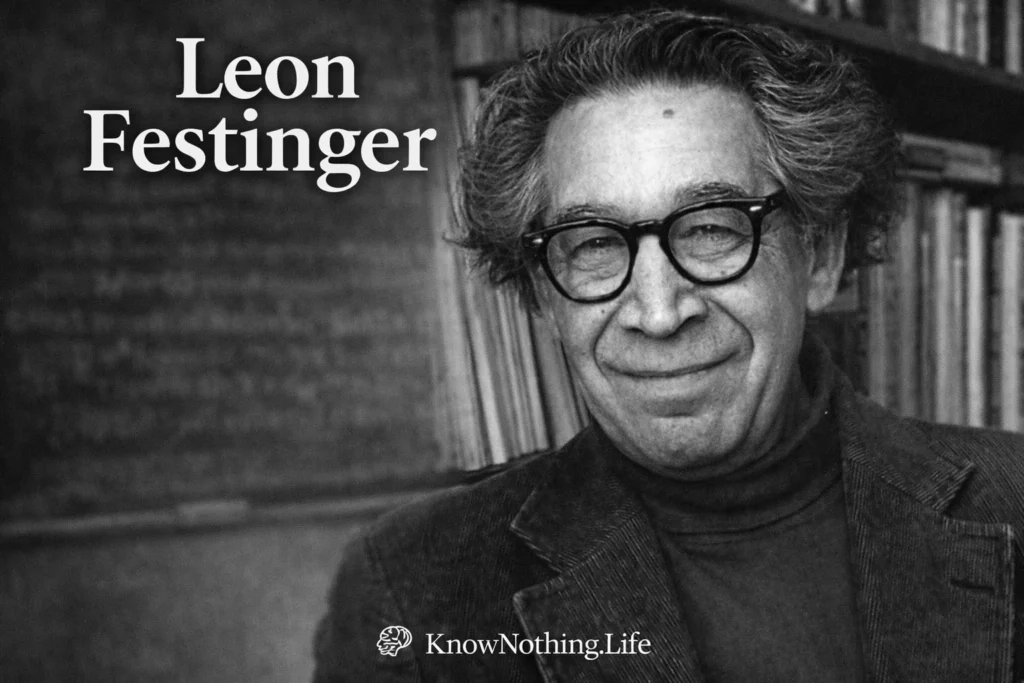
Few psychologists have explained the hidden tension behind human belief and decision-making as profoundly as Leon Festinger. Best known for developing the theory of cognitive dissonance, Festinger fundamentally changed psychology by demonstrating that people possess a powerful internal drive for psychological consistency. When beliefs, actions, attitudes, or decisions conflict with one another, the mind experiences discomfort, often motivating individuals to rationalize, justify, or alter their perceptions in order to restore internal balance. His work revealed that human beings do not simply seek truth or logic; they frequently seek consistency, even when maintaining that consistency requires self-deception.
Festinger’s ideas transformed modern psychology by bridging cognition and social behavior. His research helped explain why people defend false beliefs, remain loyal to failing decisions, justify harmful actions, and resist contradictory evidence even when facts appear overwhelming. Beyond cognitive dissonance, Festinger made foundational contributions to social comparison theory and group behavior research, helping establish modern social psychology as a rigorous scientific discipline. His work remains central not only to psychology but to economics, political science, marketing, behavioral science, and understanding why human beings so often struggle when reality challenges deeply held beliefs.
Early Life and Intellectual Formation
Leon Festinger was born on May 8, 1919, in Brooklyn, New York, to Russian-Jewish immigrant parents. Raised in an intellectually curious environment during a period of rapid social and economic change in the United States, Festinger developed an early fascination with understanding human behavior and the hidden forces that influence decision-making. Unlike many psychologists of his generation who initially entered philosophy or medicine, Festinger was drawn strongly toward science and mathematics, interests that would later shape his unusually analytical approach to psychological research.
He attended the City College of New York, where he studied psychology while building a strong foundation in statistical reasoning and scientific methodology. He later pursued graduate studies at the University of Iowa under renowned psychologist Kurt Lewin, one of the most influential thinkers in twentieth-century social psychology. Lewin’s work emphasized that behavior emerges from the interaction between individuals and their surrounding environments, an idea that deeply shaped Festinger’s intellectual development.
Under Lewin’s mentorship, Festinger learned to view human behavior not simply as isolated personal choices but as responses shaped by dynamic psychological and social forces. This systems-oriented perspective became central to his later theories. He increasingly recognized that people constantly navigate invisible pressures involving beliefs, relationships, identity, and the desire for internal psychological stability.
Social Comparison Theory
Before developing cognitive dissonance theory, Festinger first made a major contribution through social comparison theory, introduced in 1954. The theory proposed that people evaluate their own beliefs, abilities, and personal worth not in isolation but by comparing themselves to others. Human beings, Festinger argued, possess a natural drive to assess themselves, and in the absence of objective standards, other people become the primary reference point.
This insight helped explain a wide range of human behaviors involving competition, self-esteem, insecurity, ambition, and identity formation. People compare intelligence, success, appearance, morality, status, and social belonging in ways that profoundly shape emotional well-being. Upward comparisons often generate feelings of inadequacy or motivation, while downward comparisons can temporarily enhance self-confidence.
Social comparison theory became foundational to understanding modern social life and has become even more relevant in the digital era. Social media platforms amplify precisely the psychological mechanisms Festinger identified decades earlier, constantly exposing individuals to curated images of other people’s success, attractiveness, and achievement. Long before the internet existed, Festinger recognized that much of identity is constructed relationally through comparison with others.
The Birth of Cognitive Dissonance Theory
Festinger’s most revolutionary contribution arrived in 1957 with the publication of A Theory of Cognitive Dissonance, one of the most influential books in the history of psychology. At the center of the theory was a simple but profound idea: when individuals hold conflicting beliefs or behave in ways inconsistent with their values, they experience psychological discomfort known as cognitive dissonance.
This discomfort motivates people to restore internal consistency. However, rather than changing behavior rationally, individuals often alter their beliefs instead. People justify bad decisions, reinterpret facts, minimize contradictions, and construct rationalizations that protect psychological comfort. The mind resists contradiction because inconsistency creates emotional tension.
Festinger famously summarized this principle through a deceptively simple observation: “A man with conviction is a hard man to change.” He argued that once beliefs become psychologically integrated into identity, contradictory evidence often strengthens commitment rather than weakening it. The mind seeks coherence as powerfully as it seeks accuracy, and sometimes coherence wins.
The Famous $1 Experiment
One of Festinger’s most famous experiments involved a deceptively simple task that became one of psychology’s classic demonstrations of cognitive dissonance. Participants were asked to perform extremely dull repetitive tasks for an extended period. After completing the task, researchers instructed participants to tell another person that the experiment had actually been enjoyable.
Some participants were paid twenty dollars for lying, while others were paid only one dollar. Conventional reasoning suggested participants receiving more money would report greater satisfaction because they had stronger incentive. The results showed the opposite. Those paid only one dollar later convinced themselves the task had genuinely been interesting.
Festinger explained that participants paid twenty dollars possessed sufficient external justification for lying. Those paid only one dollar lacked adequate justification, creating internal psychological tension. To resolve that discomfort, they unconsciously changed their own attitude toward the task itself. The experiment demonstrated a powerful principle: when behavior conflicts with belief and external justification is weak, people often modify beliefs rather than confront contradiction.
Belief, Rationalization, and Failed Prophecy
Festinger became deeply interested in how people respond when reality directly disproves deeply held beliefs. This led to one of his most fascinating research projects involving a religious group convinced the world would soon end through catastrophic destruction while extraterrestrials would rescue true believers. Festinger and his colleagues secretly observed the group while waiting to see what would happen when the prophecy failed.
When the predicted apocalypse never occurred, logic suggested group members would abandon their beliefs. Instead, many became even more committed. They concluded their faith had somehow prevented the disaster, transforming contradiction into confirmation. Rather than dissolving belief, failed prophecy intensified commitment.
These findings became the basis for Festinger’s influential book When Prophecy Fails (1956). The study demonstrated that deeply invested individuals often reinterpret contradictory evidence in ways that preserve identity and belief systems. This principle remains enormously relevant in understanding cults, political extremism, conspiracy thinking, financial decision-making, and ideological polarization.
Major Works and Intellectual Contributions
Festinger’s most important intellectual contributions came through several groundbreaking books that transformed social psychology. When Prophecy Fails explored how belief systems survive direct contradiction and introduced the psychological mechanisms underlying belief persistence. The work became one of the earliest systematic studies of ideological commitment and rationalization.
His landmark book A Theory of Cognitive Dissonance formalized the theory that would define his career. The book provided one of psychology’s most elegant explanations for self-justification, attitude change, hypocrisy, and irrational decision-making. Few psychological theories have had broader influence across disciplines.
Later in his career, Festinger increasingly turned toward visual perception, archaeology, and evolutionary questions surrounding human cognition. Unlike many psychologists who remained narrowly focused within one specialty, he constantly pursued broader questions about how the human mind organizes reality itself.
Criticism and Scientific Debate
Although cognitive dissonance theory became enormously influential, it also attracted criticism. Some researchers argued alternative explanations such as self-perception theory could explain many findings without requiring internal psychological discomfort. Proposed by psychologist Daryl Bem, self-perception theory suggested individuals infer their own attitudes by observing their own behavior rather than resolving internal tension.
Others argued cognitive dissonance is difficult to measure directly because internal psychological discomfort cannot always be observed objectively. Researchers debated whether dissonance represents emotional tension, cognitive conflict, or broader identity defense mechanisms.
Despite these debates, decades of research have consistently confirmed Festinger’s central insight that inconsistency between beliefs and behavior motivates psychological adjustment. Modern neuroscience studies have even identified measurable brain activity associated with cognitive conflict, strengthening the empirical foundation of his theory.
Legacy and Lasting Influence
Leon Festinger permanently transformed psychology by revealing how deeply the human mind resists contradiction. His theories helped explain why people defend poor decisions, rationalize unethical behavior, maintain ideological loyalty despite evidence, and frequently prioritize psychological comfort over objective truth. His work fundamentally changed how scientists understand persuasion, belief formation, decision-making, and self-deception.
His influence extends far beyond psychology into behavioral economics, political science, marketing, negotiation theory, consumer behavior, organizational leadership, and modern media studies. Discussions surrounding misinformation, conspiracy theories, tribal politics, brand loyalty, and online polarization frequently depend on principles Festinger first identified decades earlier.
Festinger once observed, “People seek consistency among their cognitions.” While deceptively simple, this insight revealed one of the deepest organizing principles of human behavior. The mind often works not as a truth-seeking machine but as a consistency-preserving system attempting to protect psychological stability.
Final Thoughts
To study Leon Festinger is to understand one of psychology’s most revealing truths: human beings are not always rational creatures pursuing objective reality. More often, people work tirelessly to preserve internal consistency between beliefs, identity, and behavior, even when doing so distorts truth itself.
His work remains profoundly relevant because modern society constantly confronts individuals with conflicting information, ideological polarization, and endless opportunities for self-justification. Festinger revealed that changing minds is far more difficult than presenting facts alone because beliefs are woven deeply into psychological identity. In explaining why contradiction creates discomfort, he uncovered one of the most powerful forces governing human thought and gave psychology one of its most enduring theories about the hidden architecture of belief itself.