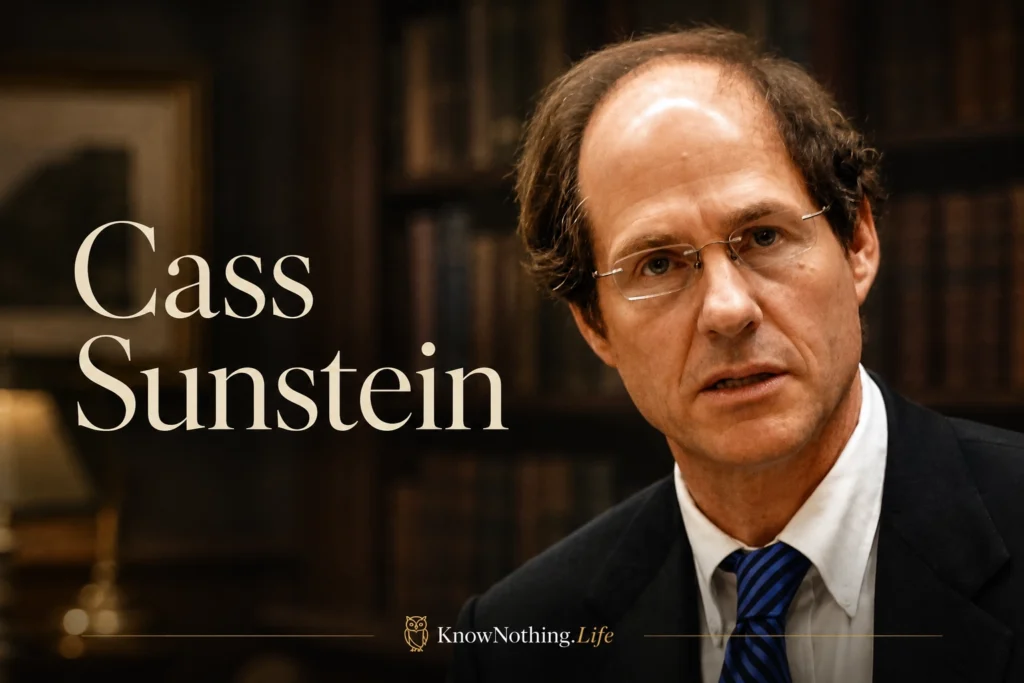
Cass R. Sunstein was born in 1954 and became one of the most influential legal scholars, political theorists, and public-policy thinkers of the modern era. His work reaches across constitutional law, administrative law, behavioral economics, risk regulation, free speech, democratic theory, animal welfare, technology, and the psychology of decision-making. Few contemporary scholars have written across so many fields while also shaping real government practice. Sunstein’s central concern has been how institutions can respect freedom while helping people and societies make better choices.
Sunstein studied at Harvard, earning his undergraduate degree and law degree before clerking for Justice Benjamin Kaplan of the Massachusetts Supreme Judicial Court and Justice Thurgood Marshall of the United States Supreme Court. Those early experiences placed him close to constitutional argument, judicial reasoning, civil rights, and the practical machinery of American law. He later joined the University of Chicago Law School, where he became one of the most productive and cited legal academics in the United States. His career developed in the space between theory and practice: how constitutional ideals survive inside large, imperfect, modern institutions.
Constitutional Law and the Administrative State
Sunstein’s early major works, including After the Rights Revolution and The Partial Constitution, helped establish him as a leading interpreter of constitutional law in the age of regulation. He rejected the idea that constitutional law can be understood only through courts, negative rights, and limits on government. Modern freedom, he argued, is also shaped by regulatory agencies, economic conditions, environmental protections, workplace rules, public health systems, information policy, and the state’s capacity to prevent harm.
This made Sunstein a major theorist of the administrative state. He did not treat bureaucracy as automatically hostile to liberty, but neither did he romanticize it. Large agencies can protect people from pollution, unsafe workplaces, financial deception, discrimination, food hazards, and predatory practices. They can also become inefficient, captured, arbitrary, or burdensome. Sunstein’s recurring question has been how democracies can use regulation intelligently while keeping it accountable, evidence-based, and respectful of human dignity. As he later summarized his own project, he has sought to promote “freedom, dignity, equality, self-government, the rule of law” under contemporary conditions.
Risk, Fear, and Cost-Benefit Analysis
Sunstein’s work on risk regulation became another defining part of his intellectual legacy. In books such as Risk and Reason, The Cost-Benefit State, Laws of Fear, and The Cost-Benefit Revolution, he argued that public policy should not be governed simply by fear, vivid anecdotes, or worst-case imagination. People often misjudge risks because some dangers are emotionally available while others remain invisible. Terrorism, nuclear accidents, pandemics, climate change, food safety, and environmental threats all require serious attention, but public law must ask how likely harms are, how severe they are, and what tradeoffs different policies create.
This position made Sunstein both influential and controversial. Critics worried that cost-benefit analysis can reduce human life, justice, and environmental values to numbers. Sunstein’s reply was that refusing to measure costs and benefits does not avoid moral choices; it often hides them. Agencies must decide where to allocate resources, which risks to reduce first, and how to protect people most effectively. In his view, careful analysis can discipline government by forcing officials to consider consequences for all citizens, including those who are otherwise unseen. Good regulation is not just strong regulation; it is regulation that actually improves lives.
Nudge and Libertarian Paternalism
Sunstein became widely known outside legal academia through Nudge: Improving Decisions About Health, Wealth, and Happiness, written with behavioral economist Richard H. Thaler and published in 2008. The book introduced a broad public to “choice architecture,” the idea that the way options are presented can powerfully shape decisions. Retirement savings defaults, cafeteria layouts, organ donation forms, energy-use reports, school lunch design, and disclosure labels all affect behavior even when choices remain formally open. As Nudge puts it, “A choice architect has the responsibility for organizing the context in which people make decisions.”
The political idea behind Nudge is often called libertarian paternalism. It tries to preserve freedom of choice while arranging environments so that people are more likely to choose options that improve their own welfare. A default enrollment rule for retirement savings does not force anyone to save, but it recognizes that inertia is powerful. A clear disclosure form does not command a decision, but it helps people understand what they are choosing. Sunstein and Thaler’s point was that there is “no such thing as a neutral design.” If choice environments influence people anyway, public and private institutions should design them transparently, ethically, and for human benefit.
Public Service and Simpler Government
Sunstein’s ideas entered government directly when he served from 2009 to 2012 as Administrator of the White House Office of Information and Regulatory Affairs in the Obama administration. OIRA reviews major federal regulations, making the role central to the practical relationship between law, science, economics, and public administration. Sunstein’s time there reflected his long-standing interest in smarter regulation: reducing unnecessary burdens, improving disclosure, using evidence, and designing rules that work in the real world rather than merely appearing strong on paper.
His book Simpler: The Future of Government grew partly out of that experience. It argued for government that is more user-friendly, less confusing, and less wasteful. In later work, Sunstein developed the concept of “sludge,” meaning the paperwork, waiting times, complicated forms, and administrative burdens that prevent people from accessing benefits, exercising rights, or completing ordinary tasks. Sludge is the dark twin of the nudge. Where a nudge helps people move toward a beneficial choice, sludge blocks people through friction. Sunstein’s interest in sludge shows the humane side of his regulatory thought: freedom can be burdened not only by coercion, but by complexity.
Democracy, Free Speech, and the Digital Public Sphere
Sunstein has also been one of the major thinkers on democracy in the age of digital filtering. In Republic.com, Republic.com 2.0, and #Republic, he warned that personalized media can weaken democratic life by allowing people to avoid opposing views and retreat into echo chambers. The danger is not only censorship. It is self-sorting, fragmentation, polarization, and the disappearance of shared public experiences. In one of his sharpest formulations, he wrote, “Unplanned, unanticipated encounters are central to democracy itself.”
This argument made Sunstein a key voice in debates about free speech and the internet. He does not argue that government should force citizens to consume unwanted ideas. Instead, he argues that a healthy democracy needs spaces where people encounter topics and perspectives they did not select in advance. Free speech is not only the absence of censorship; it is also the presence of a public sphere capable of producing surprise, correction, common knowledge, and mutual understanding. In a world of algorithmic personalization, that argument has become more important, not less.
Noise, Judgment, and Recent Work
In 2021, Sunstein coauthored Noise: A Flaw in Human Judgment with Daniel Kahneman and Olivier Sibony. The book shifted attention from bias to variability. Bias means judgments lean in a predictable direction; noise means similar cases receive different judgments for no good reason. In courts, medicine, hiring, insurance, forecasting, and performance review, noise can produce unfairness even when no one intends discrimination. The lesson fits Sunstein’s broader work: institutions should be designed to reduce predictable human error.
Sunstein’s later books include The Ethics of Influence, On Freedom, Conformity, How Change Happens, Too Much Information, Sludge, This Is Not Normal, and Look Again, coauthored with Tali Sharot. These works continue his interest in how people notice, decide, conform, change, and respond to institutions. They also show a scholar increasingly focused on attention, habit, misinformation, and the hidden obstacles that shape everyday life. Sunstein’s subject is not only law in books, but law as experienced by human beings with limited time, limited attention, and imperfect judgment.
Legacy and Lasting Importance
Sunstein is currently Robert Walmsley University Professor at Harvard and founder and director of Harvard Law School’s Program on Behavioral Economics and Public Policy. He received the Holberg Prize in 2018, and his scholarship has been recognized for reshaping several academic fields while also affecting public policy. His work stands out because it refuses the divide between abstract theory and practical reform. He writes about constitutional ideals, but also about forms, defaults, warnings, risk estimates, internet feeds, and the small design choices that quietly govern modern life.
Cass Sunstein’s lasting importance lies in his insistence that freedom is not protected by slogans alone. It depends on institutions, information, design, accountability, and the reduction of avoidable burdens. His work has shown that law must take human psychology seriously, and that democratic government must be judged not only by its intentions, but by its effects. Whether writing about constitutional democracy, nudges, risk, speech, or sludge, Sunstein returns to the same basic question: how can societies help people live better while preserving their freedom to choose?