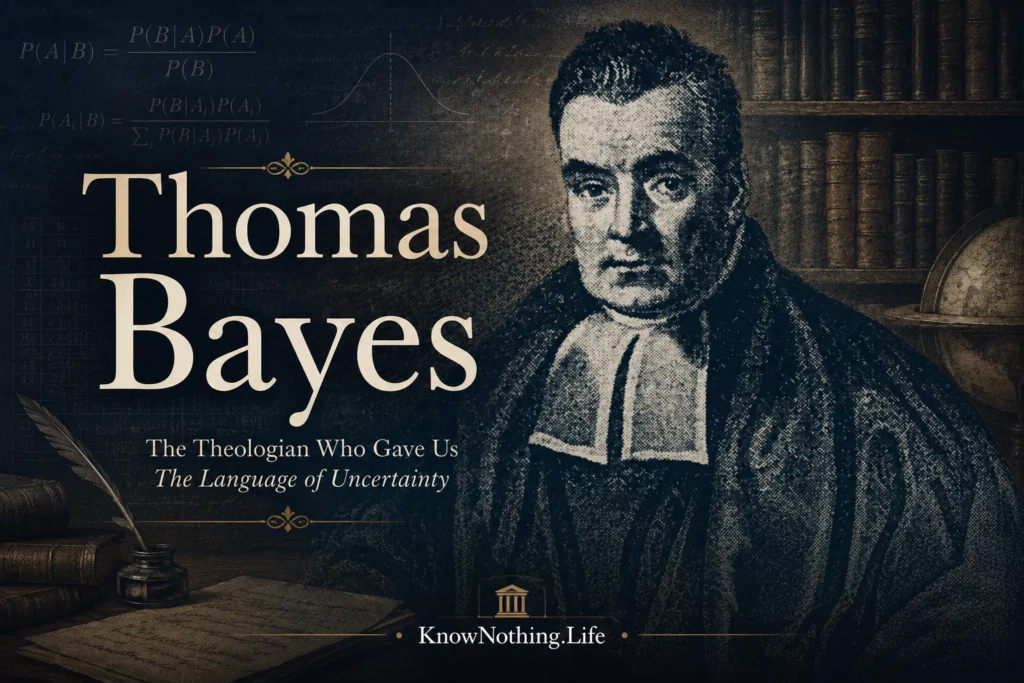
Thomas Bayes was born in 1701 or 1702, in or near London, into a prominent English Nonconformist family. His father, Joshua Bayes, was a Presbyterian minister and respected dissenting theologian at a time when Nonconformists lived outside the full privileges of the established Church of England. That religious background shaped Thomas Bayes’s life more deeply than many modern readers realize. He was not a university professor, public celebrity, or professional statistician. He was a minister, a private scholar, and a quiet mathematical thinker whose most famous work appeared only after his death.
Bayes was educated privately and later studied logic and theology at the University of Edinburgh, a natural destination for a young Nonconformist who could not easily follow the usual Anglican paths through Oxford or Cambridge. After returning to England, he assisted his father in London before becoming minister of the Presbyterian meeting house at Mount Sion in Tunbridge Wells, Kent. He lived much of his adult life there in relative privacy. The contrast between his quiet provincial life and his immense later influence is one of the striking features of his biography.
A Minister With Mathematical Interests
Bayes published very little during his lifetime. The two works known to have appeared while he was alive were Divine Benevolence, published in 1731, and An Introduction to the Doctrine of Fluxions, published anonymously in 1736. The first was a theological work whose full title announced its argument: An Attempt to Prove That the Principal End of the Divine Providence and Government is the Happiness of His Creatures. This title alone shows the moral structure of Bayes’s thought. He was interested in providence, order, happiness, and rational justification.
His second known publication entered a mathematical controversy. George Berkeley had attacked the logical foundations of Newton’s calculus in The Analyst, criticizing the use of fluxions and infinitesimals. Bayes’s Introduction to the Doctrine of Fluxions defended Newtonian mathematics and showed that he was not merely an amateur with casual interests. He understood the technical issues well enough to produce what later commentators have regarded as one of the stronger replies to Berkeley. This work helped establish Bayes’s reputation among mathematically informed readers.
Fellow of the Royal Society
In 1742, Bayes was elected a Fellow of the Royal Society. The exact reasons for his election are still discussed by historians, partly because he had not published many mathematical works. His supporters described him as “well skilled in Geometry and all parts of Mathematical and Philosophical Learning,” suggesting that his reputation rested on private work, personal networks, and unpublished mathematical ability as much as on printed books. For an eighteenth-century minister outside the main universities, election to the Royal Society was a major honor.
Bayes’s membership connected him to the learned world of mathematics, natural philosophy, and probability, even though he remained a relatively obscure figure. He did not become a public scientific personality like Isaac Newton, Abraham de Moivre, or later Pierre-Simon Laplace. Instead, Bayes worked quietly, apparently leaving behind manuscripts and notes that might have disappeared without the intervention of his friend Richard Price. His life reminds us that some of the most consequential ideas in intellectual history begin not in fame, but in private inquiry.
The Problem of Inverse Probability
Bayes is remembered because of one paper: “An Essay towards Solving a Problem in the Doctrine of Chances.” The essay was found among his papers after his death and was edited, introduced, and sent to the Royal Society by Richard Price. It was read to the Society in 1763 and published in the Philosophical Transactions. The problem Bayes addressed concerned what later became known as inverse probability: how to reason from observed events back to the probability of the underlying cause or chance that produced them.
Bayes framed the problem with elegant directness: given how often an unknown event has happened and failed, find the chance that its probability lies between two named degrees. In simpler language, if we observe outcomes, how should we update our estimate of the hidden probability behind them? That question now sits at the center of statistics, scientific inference, medical testing, machine learning, artificial intelligence, philosophy of science, and everyday reasoning under uncertainty. Bayes was asking how experience should change rational belief.
Bayes’s Theorem and the Logic of Updating
The mathematical result now called Bayes’s theorem gives a way to update probabilities when new evidence arrives. It relates the probability of a hypothesis after evidence to the prior probability of the hypothesis and the likelihood of the evidence if the hypothesis were true. In modern terms, it explains how prior belief, evidence, and updated belief fit together. Bayes himself did not present the theorem in today’s notation, but his essay supplied the breakthrough pattern of reasoning.
One of the most important lines in the essay is Bayes’s simple clarification: “By chance, I mean the same as probability.” The sentence may look plain, but it reflects the eighteenth-century effort to make uncertainty mathematically precise. Bayes was not simply gambling with numbers. He was trying to show how rational confidence can be measured when certainty is unavailable. The deeper philosophical idea is that evidence should not merely confirm or disconfirm in a vague way. It should change belief according to a disciplined structure.
Richard Price and Posthumous Fame
Richard Price played a decisive role in Bayes’s legacy. Without Price, the manuscript might never have become famous. Price edited the essay, added an introduction, supplied explanations and applications, and framed Bayes’s work as important not only for mathematics but also for natural theology. Price believed that Bayes’s reasoning could help show how recurring order in nature supports belief in stable causes rather than mere chance. Whether or not one accepts Price’s theological framing, it shows how probability, religion, and natural philosophy were intertwined in the eighteenth century.
This also creates an important historical caution. Bayesian reasoning today is often associated with secular statistics, data science, machine learning, and rational decision theory. But Bayes’s original world was not the modern world of computers and algorithms. It was a world of dissenting religion, Newtonian science, natural theology, and debates about divine order. His theorem survived because it could travel beyond that setting. It began as a problem in the doctrine of chances and became a general logic of learning from evidence.
Later Influence and Bayesian Thinking
Bayes’s paper was not immediately dominant. Pierre-Simon Laplace later developed related methods independently and did much to advance inverse probability. Over the nineteenth and twentieth centuries, Bayesian reasoning went through cycles of influence, criticism, rejection, and revival. Frequentist approaches became dominant in many areas of statistics, especially in the twentieth century, but Bayesian methods continued to develop in probability theory, decision theory, philosophy, and scientific inference.
The modern revival of Bayesian thinking has been enormous. Bayesian methods now appear in medical diagnosis, spam filtering, weather prediction, genetics, artificial intelligence, cognitive science, risk analysis, and legal reasoning. The basic idea is intuitive but powerful: begin with a prior probability, consider the likelihood of new evidence, and update rationally. This does not make people omniscient. It gives them a framework for becoming less wrong as evidence accumulates. In that sense, Bayes’s legacy is not only a formula; it is a discipline of intellectual humility.
Major Works and Lasting Legacy
Thomas Bayes died suddenly in Tunbridge Wells in 1761. His known works are few: Divine Benevolence, An Introduction to the Doctrine of Fluxions, and the posthumously published “Essay towards Solving a Problem in the Doctrine of Chances.” Yet those few works reveal a mind concerned with providence, mathematics, reason, evidence, and uncertainty. He did not live to see his name become attached to one of the most important ideas in statistics and philosophy.
Bayes’s lasting importance lies in the way his work changed the meaning of evidence. Before Bayes, probability theory had already studied games of chance and forward prediction. Bayes helped open the reverse question: how should observed facts change our estimate of hidden causes? That question now shapes science and technology at the deepest levels. Thomas Bayes remains one of history’s quiet revolutionaries: a Presbyterian minister whose private mathematical problem became a universal method for learning from experience.