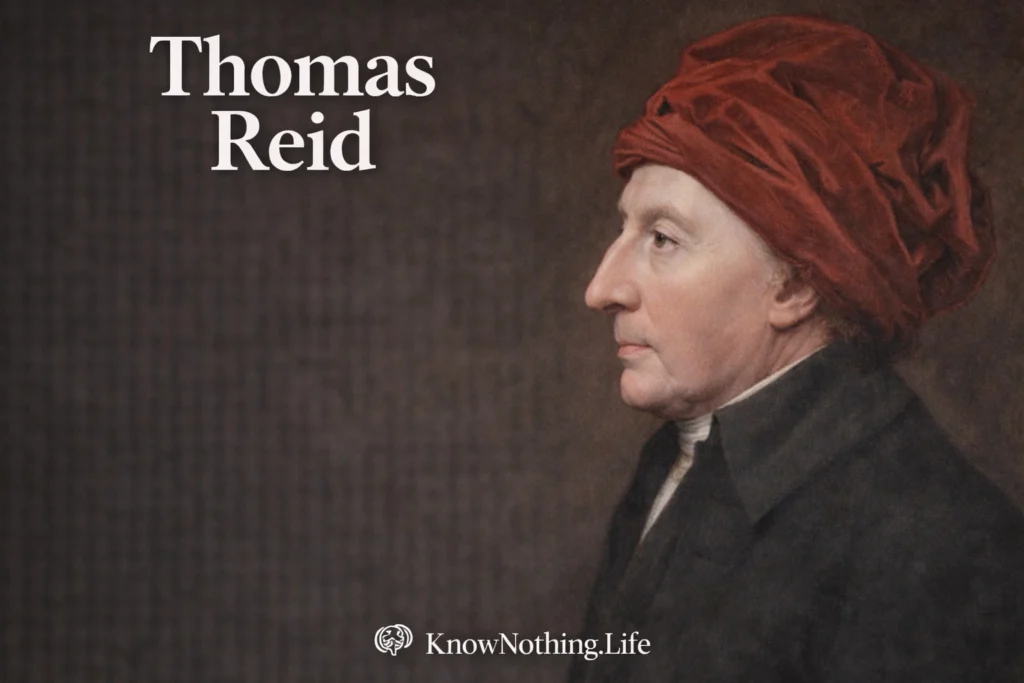
Thomas Reid was born on April 26, 1710, in Strachan, Kincardineshire, Scotland, and became one of the central figures of the Scottish Enlightenment. He is best known as the founder of Scottish Common Sense philosophy, a movement that defended ordinary human judgment against the skeptical conclusions of philosophers such as David Hume. Reid was not a crude anti-intellectual who rejected philosophy. He was a careful and systematic thinker who believed philosophy loses its way when it tries to prove away the basic convictions that make reasoning possible in the first place.
Reid studied at Marischal College, Aberdeen, graduating in 1726, and later served as librarian there. His early training combined classical education, mathematics, theology, and natural philosophy. In 1737, he became minister of New Machar, near Aberdeen, where he remained for many years before entering academic life. That background shaped his philosophical temperament. Reid was deeply religious, scientifically minded, and practical. He admired Newtonian method and believed the study of the mind should begin with careful observation rather than wild speculation.
Aberdeen, Hume, and the Birth of Common Sense Philosophy
Reid’s philosophical turning point came through his encounter with David Hume’s skeptical philosophy. Hume had argued that many beliefs people take for granted—belief in causation, the continued existence of the self, and the external world—could not be rationally justified in the way philosophers expected. Reid took Hume seriously, perhaps more seriously than many of Hume’s admirers. He saw that Hume had exposed deep weaknesses in the “way of ideas,” the theory that the mind directly knows only its own ideas, impressions, or perceptions.
Reid’s response was not to dismiss skepticism as foolish. Instead, he argued that skepticism was the natural result of bad philosophical assumptions. If we begin by saying that the mind directly knows only internal images or ideas, then we will struggle to prove that an external world exists beyond those ideas. Reid’s solution was to reject the starting point. In An Inquiry into the Human Mind on the Principles of Common Sense, published in 1764, he argued that perception gives us direct awareness of the world. The mind is not trapped behind a screen of ideas. We are naturally constituted to perceive objects, trust memory, believe testimony, and reason from experience.
The Principles of Common Sense
Reid’s phrase “common sense” has often been misunderstood. He did not mean popular opinion, laziness, or whatever most people happen to believe. By common sense, he meant the first principles built into human rational life—beliefs we cannot help trusting and must trust in order to think, act, speak, or inquire at all. These principles include belief in an external world, belief in personal identity, belief in the reliability of memory, belief that other minds exist, and belief that nature operates with enough regularity to make experience useful.
In one of his clearest definitions, Reid wrote that if there are principles “which the constitution of our nature leads us to believe,” and which we must take for granted in ordinary life, “these are what we call the principles of common sense.” His point was not that these principles are proved by argument. Rather, they are the ground on which argument stands. Philosophy may examine them, clarify them, and defend them, but it cannot replace them with something more basic. Reid’s famous warning was that philosophy cut off from common sense destroys itself: philosophy “has no other root but the principles of common sense.”
Perception and Direct Realism
Reid’s theory of perception was one of his most important contributions. Against Locke, Berkeley, and Hume, he rejected the idea that the immediate objects of perception are mental representations. When a person sees a tree, touches a table, or hears a voice, Reid argued, the person is not directly aware of an inner idea and only indirectly aware of the external object. The person perceives the object itself, though perception also involves sensations, signs, and learned interpretation. This view made Reid a major defender of direct realism.
His analysis was subtle because he did not deny that sensations occur. He denied that sensations are the objects we ordinarily perceive. A sensation may be the occasion by which the mind is led to perceive a quality in the world, but it is not the same thing as perceiving the object. This allowed Reid to explain why perception can be biologically and psychologically complex without collapsing into skepticism. His work on perception later influenced debates in epistemology, philosophy of mind, and cognitive science because he treated the mind as active, reliable, and naturally directed toward reality.
Memory, Personal Identity, and Testimony
Reid also made important contributions to memory and personal identity. He criticized John Locke’s theory that personal identity consists in memory, arguing that memory presupposes identity rather than creating it. If I remember doing something yesterday, that memory already presents the action as mine. Memory cannot be the foundation of personal identity if it depends on the very identity it is supposed to explain. Reid’s famous “brave officer” objection to Locke showed that memory-based theories can produce contradictions when memory connections are partial across a lifetime.
He also defended the importance of testimony. Human beings are naturally disposed to trust others and to speak truthfully, at least as a basic starting point. Without some original trust in testimony, language, education, history, law, and ordinary communication would collapse. Reid did not claim people are always honest or that testimony never needs checking. He argued that trust is not irrational merely because it comes before proof. Like perception and memory, testimony is one of the natural sources of knowledge that human life depends on.
Active Powers, Free Will, and Moral Agency
In Essays on the Active Powers of Man, published in 1788, Reid turned from perception and knowledge to action, freedom, and morality. He defended an agent-causal view of free will, arguing that persons are not merely passive links in a chain of events. Human beings possess active powers: capacities to deliberate, choose, exert effort, and bring about actions. Reid believed moral responsibility requires genuine agency. If every human action were simply the unavoidable effect of prior causes outside the agent’s control, praise and blame would lose their deepest meaning.
Reid’s moral philosophy also reflected his common sense method. He believed human beings possess moral judgment as part of their rational constitution. We naturally recognize duties, obligations, virtues, and wrongs, even if moral education and reflection refine that recognition. His ethics was neither pure sentimentalism nor cold rationalism. It treated moral life as rooted in human nature, conscience, responsibility, and our capacity to act for reasons. In this way, Reid’s philosophy defended both knowledge and agency against theories that reduced the human person to impressions, impulses, or mechanisms.
Major Works and Later Career
Reid’s major works include “An Essay on Quantity,” An Inquiry into the Human Mind on the Principles of Common Sense, Essays on the Intellectual Powers of Man, and Essays on the Active Powers of Man. The Inquiry focused especially on perception and the senses. Essays on the Intellectual Powers expanded the system to memory, conception, judgment, reasoning, taste, and first principles. Essays on the Active Powers addressed will, action, liberty, morality, and responsibility. Together, these works formed one of the most important philosophical systems of the eighteenth century.
After publishing the Inquiry, Reid succeeded Adam Smith as professor of moral philosophy at the University of Glasgow in 1764. He resigned from teaching in 1781 so he could devote more time to writing. In Glasgow, Reid became an influential teacher and an important figure in the Scottish Enlightenment, connected to a world of philosophers, scientists, economists, theologians, and reformers. He was less flamboyant than Hume and less famous than Smith, but his influence was deep, especially in epistemology, education, theology, and later American philosophy.
Legacy and Lasting Importance
Thomas Reid died on October 7, 1796, in Glasgow. His reputation rose and fell over the centuries, but modern philosophy has increasingly recognized his importance. Reid anticipated many later debates about direct realism, external-world skepticism, testimony, memory, personal identity, moral agency, and epistemic first principles. He influenced Scottish Common Sense philosophy, nineteenth-century American thought, and later philosophers such as G. E. Moore and Roderick Chisholm, who shared his resistance to radical skepticism.
Reid’s lasting importance lies in his defense of the ordinary conditions of reason. He did not argue that common sense solves every problem. He argued that without some trust in our natural faculties, no problem can even be meaningfully raised. His philosophy remains powerful because it asks a question every age must confront: when clever arguments deny the world we live in, should we distrust the world—or the arguments? Reid’s answer was clear. Philosophy must not abolish human nature in the name of reason. It must begin from the powers by which human beings already know, act, remember, trust, and live.