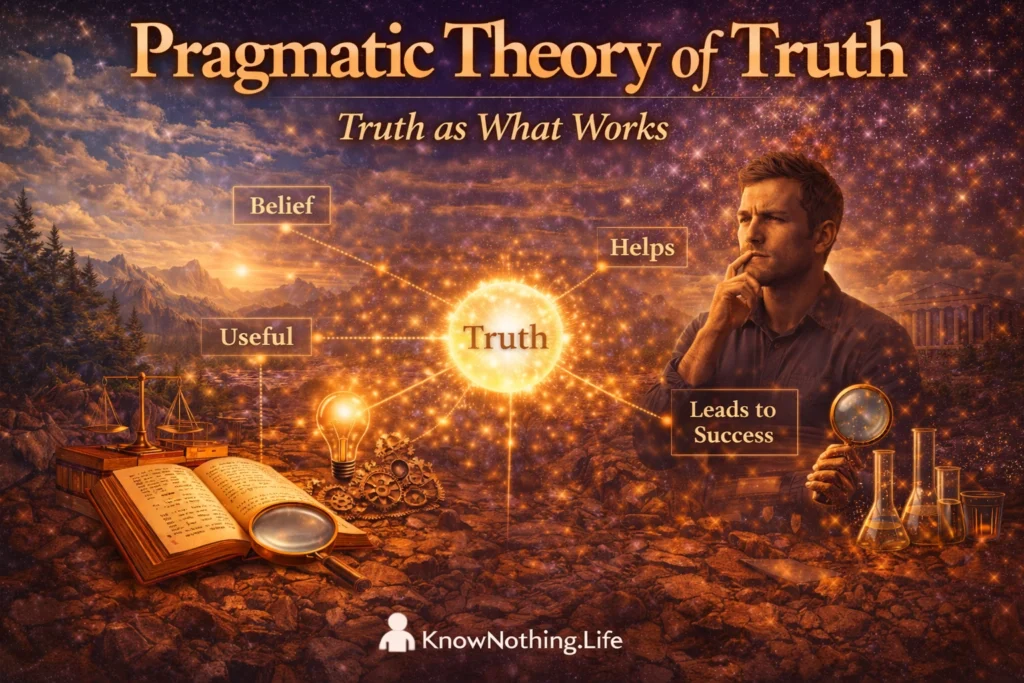
The pragmatic theory of truth offers a distinctive and influential alternative to traditional accounts of truth. Rather than defining truth as correspondence with reality or coherence within a system of beliefs, pragmatism ties truth to practical consequences. According to this view, a statement is true if it proves useful, effective, or successful in guiding action and inquiry. Truth is not a static property but something that emerges through experience and application.
This approach developed in the late 19th and early 20th centuries through the work of American philosophers such as Charles Sanders Peirce, William James, and John Dewey. Each contributed to shaping pragmatism as both a theory of truth and a broader philosophical method. Their work reflects a shift away from abstract metaphysical debates toward a focus on how ideas function in practice.
At its core, the pragmatic theory challenges the assumption that truth must be understood in purely theoretical terms. Instead, it emphasizes the role of human activity, inquiry, and problem-solving. Truth, from a pragmatic perspective, is not something we discover in isolation but something we develop and refine through interaction with the world.
Peirce and the Foundations of Pragmatism
The origins of the pragmatic theory of truth can be traced to Charles Sanders Peirce, whose work laid the foundation for the movement. In essays such as How to Make Our Ideas Clear, Peirce introduces the pragmatic maxim, which states that the meaning of a concept lies in its practical effects.
Peirce’s account of truth is closely tied to the process of scientific inquiry. He argues that truth is what would ultimately be agreed upon by an ideal community of investigators over the long run. This view emphasizes the importance of inquiry as a dynamic and collective process. Truth is not determined by individual opinion but by the convergence of evidence and reasoning over time.
For Peirce, truth is objective in the sense that it is independent of any single person’s beliefs, yet it is also grounded in practice. As inquiry progresses, false beliefs are gradually eliminated, and more accurate understandings emerge. This long-term perspective distinguishes Peirce’s pragmatism from more immediate or subjective interpretations of truth.
William James and Truth as Utility
William James popularized and expanded pragmatism, offering a more accessible and psychologically oriented account of truth. In works such as Pragmatism, James argues that truth is what works in practice—what proves useful in guiding action and satisfying human needs.
James famously states, “Truth happens to an idea. It becomes true, is made true by events.” This statement captures the dynamic nature of truth in pragmatism. Rather than being a fixed property, truth is something that develops through experience. A belief is true if it successfully helps us navigate the world and achieve our goals.
This emphasis on utility has led to both admiration and criticism. Supporters argue that it reflects the practical nature of human knowledge, while critics contend that it risks reducing truth to mere usefulness. James responds to this criticism by emphasizing that usefulness must be understood in a broad and rigorous sense, encompassing long-term consequences and consistency with experience.
Dewey and Truth as Inquiry
John Dewey further developed pragmatism by integrating it with a comprehensive theory of inquiry. In works such as Logic: The Theory of Inquiry, Dewey argues that truth is not a static property but a function of successful inquiry.
For Dewey, knowledge arises from the process of solving problems and resolving uncertainties. Truth is what emerges when inquiry leads to stable and reliable conclusions. This process-oriented view emphasizes experimentation, testing, and revision, aligning closely with the methods of modern science.
Dewey’s pragmatism highlights the social and contextual dimensions of truth. Inquiry is not an isolated activity but a collaborative process influenced by cultural and historical factors. Truth, therefore, is not absolute but evolves as our methods of inquiry and understanding improve. This perspective underscores the adaptability and openness of pragmatism.
Pragmatism vs. Correspondence and Coherence
The pragmatic theory of truth is often contrasted with correspondence and coherence theories. While correspondence theory defines truth as alignment with reality, and coherence theory defines it as consistency within a system of beliefs, pragmatism focuses on practical outcomes.
Pragmatists argue that both correspondence and coherence theories overlook the role of human activity in determining truth. They contend that truth cannot be understood independently of its effects on action and inquiry. By emphasizing practical consequences, pragmatism provides a more dynamic and flexible account of truth.
However, this difference also raises questions about whether pragmatism adequately captures the objective dimension of truth. Critics argue that a belief could be useful without being true, suggesting that pragmatism may conflate truth with utility. Pragmatists respond by emphasizing that usefulness must be evaluated in the context of ongoing inquiry and long-term success, rather than immediate convenience.
Critiques and Challenges
Despite its influence, the pragmatic theory of truth faces several significant criticisms. One major concern is that it appears to relativize truth, making it dependent on human needs and interests. If truth is what works, then different beliefs might be considered true in different contexts, raising questions about objectivity.
Another criticism is that pragmatism may fail to distinguish between short-term usefulness and long-term truth. A belief might be useful in the short term but ultimately false. This challenge highlights the need for a more precise account of what counts as “working” in the pragmatic sense.
Additionally, critics argue that pragmatism does not fully address the relationship between belief and reality. While it emphasizes practical consequences, it may not provide a clear explanation of how beliefs correspond to the world. These critiques have led to ongoing debates about the strengths and limitations of the pragmatic approach.
Contemporary Relevance of Pragmatic Truth
In contemporary philosophy, pragmatism continues to play an important role, particularly in discussions of science, language, and social knowledge. Its emphasis on inquiry and practical consequences aligns with modern approaches that view knowledge as dynamic and context-dependent.
Pragmatism has also influenced fields such as education, politics, and ethics, where the focus on practical outcomes is especially relevant. The idea that truth emerges through experience and action resonates with interdisciplinary approaches that integrate philosophy with empirical research.
Moreover, pragmatism has contributed to debates about pluralism and relativism, offering a framework for understanding how different perspectives can coexist while still being evaluated in terms of their practical consequences. This flexibility makes pragmatism a valuable tool for navigating complex and evolving domains of knowledge.
Conclusion
The pragmatic theory of truth offers a compelling and innovative account of what it means for a belief to be true. By emphasizing practical consequences, inquiry, and human activity, it shifts the focus from abstract definitions to the lived experience of knowledge.
From the foundational insights of Charles Sanders Peirce to the influential interpretations of William James and John Dewey, pragmatism has reshaped the philosophical landscape. Its dynamic and flexible approach reflects the complexity of truth in a changing world.
As James suggests, truth is not something we simply discover but something we actively create and refine through experience. This perspective highlights the ongoing nature of inquiry and the importance of adaptability in the pursuit of knowledge. While challenges remain, the pragmatic theory continues to offer valuable insights into the nature of truth and its role in human life.