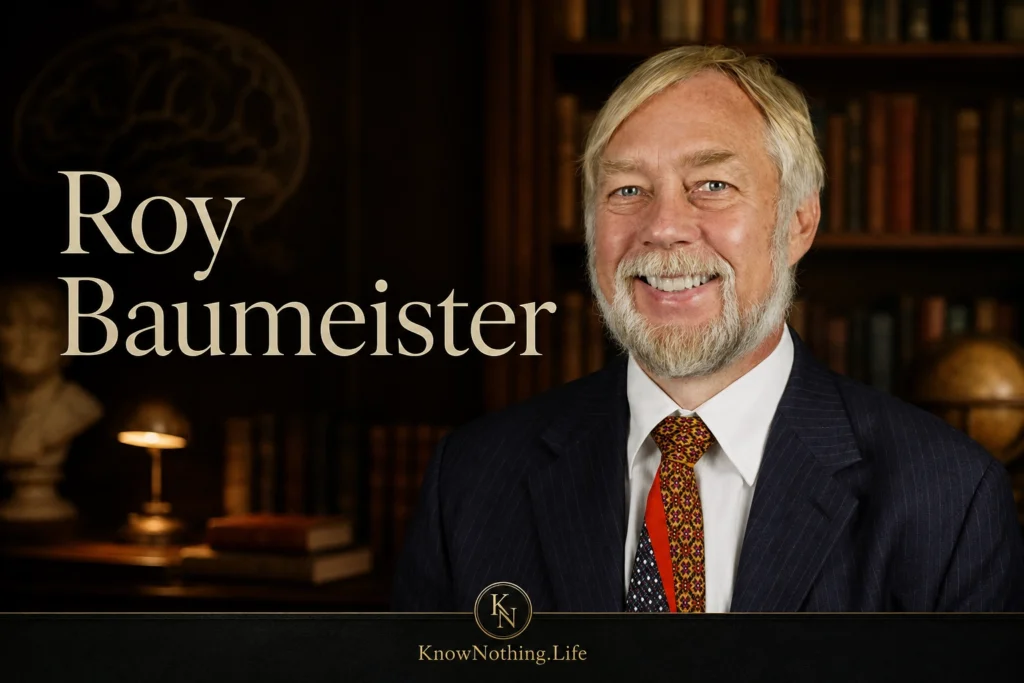
Roy F. Baumeister was born on May 16, 1953, in Cleveland, Ohio, and became one of the most influential social psychologists of the late twentieth and early twenty-first centuries. His work is unusually broad, ranging across the self, identity, self-control, belonging, rejection, aggression, sexuality, meaning, free will, and the darker patterns of human behavior. Unlike psychologists who built their careers around one narrow experimental question, Baumeister developed a large theory of human nature in which the self is both a personal experience and a social instrument.
Baumeister studied at Princeton University, where he earned his PhD in experimental social psychology, and later completed a postdoctoral fellowship in sociology at the University of California, Berkeley. That combination of psychology and sociology shaped his career. He was interested not only in what happens inside the individual mind, but also in how culture, relationships, norms, and social expectations shape the self. His mature work would repeatedly return to one central question: how do human beings regulate themselves well enough to live in groups, pursue goals, make meaning, and avoid self-destruction?
The Self as a Social Project
Baumeister’s early work focused on identity and the self, especially in books such as Identity: Cultural Change and the Struggle for Self and later The Self Explained: Why and How We Become Who We Are. He rejected the idea that the self is simply a hidden inner essence waiting to be discovered. For him, the self is partly constructed through social roles, cultural meanings, personal stories, choices, failures, and relationships. Human beings do not merely have selves; they work on them, defend them, explain them, and sometimes try to escape them.
This emphasis made Baumeister one of the major psychologists of selfhood after the cognitive revolution. He studied self-presentation, self-esteem, self-defeating behavior, guilt, identity, and the pressure of self-awareness. In Escaping the Self, he explored destructive behaviors such as addiction, masochism, and suicide as attempts to flee from painful self-consciousness. This was one of his most unsettling insights: the self is not only a source of dignity and agency, but also a burden. People sometimes harm themselves not because they want pain, but because they want relief from the demands of being someone.
Meaning, Culture, and the Human Animal
In Meanings of Life, published in 1991, Baumeister examined the psychological structure of meaning. He argued that people need more than pleasure or survival. They need purpose, value, efficacy, and self-worth. A meaningful life gives people reasons to act, standards for judgment, a sense that their actions matter, and some way of seeing themselves as worthy. This framework helped move the study of meaning from abstract philosophy into empirical psychology without losing the seriousness of the question.
Baumeister developed this broader view in The Cultural Animal: Human Nature, Meaning, and Social Life. The title captures one of his central ideas: human beings are biological creatures whose distinctiveness lies in culture. People use language, rules, morality, institutions, money, reputation, religion, and long-term planning to live in ways no other animal does. Culture expands human possibility, but it also increases self-control demands. A cultural animal must restrain impulses, follow norms, plan for the future, cooperate with strangers, and shape behavior around meanings that are not immediately visible.
The Need to Belong
One of Baumeister’s most influential articles, written with Mark Leary in 1995, was “The Need to Belong: Desire for Interpersonal Attachments as a Fundamental Human Motivation.” The title itself became a classic phrase in social psychology. Baumeister and Leary argued that human beings have a deep need to form and maintain strong, stable relationships. Belonging is not a luxury added after survival. It is part of the architecture of human motivation.
This theory helped explain why rejection, exclusion, loneliness, and social disconnection can be so psychologically powerful. People organize much of life around acceptance: families, friendships, romantic bonds, groups, communities, and reputations. When belonging is threatened, behavior changes. Rejection can produce emotional pain, aggression, numbness, withdrawal, or desperate attempts at reconnection. Baumeister’s work showed that much of the self is relational. To be a person is partly to be someone who matters to others.
Self-Control and Willpower
Baumeister became especially famous for his research on self-control and willpower. With colleagues including Dianne Tice, Mark Muraven, Kathleen Vohs, and others, he developed the strength model of self-control and the concept of ego depletion. The basic idea was that self-control depends on a limited resource: after people exert self-control in one task, they may have less capacity available for a later task. This model made willpower a central topic in modern psychology.
His popular book Willpower: Rediscovering the Greatest Human Strength, co-written with John Tierney, brought this research to a wide audience. One of its widely quoted lessons is, “Improving willpower is the surest way to a better life.” The point was practical as well as theoretical. Self-control helps people study, work, save money, resist temptation, regulate emotion, maintain relationships, and pursue long-term goals. Baumeister did not treat willpower as a vague moral slogan. He treated it as a psychological capacity that can fail, recover, and in some cases be strengthened.
Self-Esteem and Its Discontents
Baumeister also became known for challenging the self-esteem movement. During the late twentieth century, many educators and psychologists assumed that raising self-esteem would improve achievement, morality, happiness, and social adjustment. Baumeister’s reviews of the evidence were far more skeptical. He argued that high self-esteem does not automatically produce success and that inflated self-regard can sometimes be linked to aggression, entitlement, or defensiveness when the ego is threatened.
This critique did not mean he favored humiliation or low self-worth. Rather, he argued that self-control, realistic achievement, and social responsibility matter more than simply feeling good about oneself. The line often associated with this view is: “Self-esteem does not lead to success in life. Self-discipline and self-control do.” Whether phrased in popular or technical form, the message was clear. Feeling valuable is not the same as building the habits and abilities that make a valuable life possible.
Evil, Negativity, and Human Cruelty
Baumeister’s book Evil: Inside Human Violence and Cruelty examined one of psychology’s hardest topics: why people harm others. He rejected the simple view that evil is always committed by monsters who love suffering for its own sake. Much cruelty, he argued, emerges from threatened egotism, idealism, revenge, instrumental gain, obedience, or the ordinary human tendency to see one’s own motives as justified. The book was disturbing because it made cruelty psychologically intelligible without excusing it.
With Ellen Bratslavsky, Catrin Finkenauer, and Kathleen Vohs, Baumeister also published the influential article “Bad Is Stronger Than Good.” That phrase became one of his most memorable contributions. Negative experiences often affect people more powerfully than positive ones: bad feedback can outweigh praise, losses can loom larger than gains, rejection can cut deeper than acceptance, and trauma can persist longer than ordinary pleasure. This work helped explain why human minds are so sensitive to threat, failure, conflict, and loss.
Free Will, Prospection, and Later Work
In later years, Baumeister turned increasingly toward free will, agency, and the future-oriented nature of human thought. In Homo Prospectus, written with Martin Seligman, Peter Railton, and Chandra Sripada, he argued that human beings are not merely driven by the past. They imagine futures, compare possibilities, plan actions, and organize behavior around what might happen. This focus on prospection connected his work on meaning, self-control, and culture. The self is not only a record of the past; it is a manager of possible futures.
His more recent work includes The Power of Bad, again with John Tierney, and The Science of Free Will. These books continue his effort to connect academic psychology with everyday human problems. Why do negative events dominate attention? How can people resist temptation? What does freedom mean if behavior has causes? How can people become better agents? Baumeister’s answers are not always uncontroversial, but they are consistently ambitious.
Debate, Replication, and Scientific Legacy
Baumeister’s work on ego depletion has been one of the most debated areas of modern social psychology. Some replication efforts raised serious questions about the size and reliability of ego depletion effects, while Baumeister and collaborators argued that the theory needed refinement rather than abandonment. In a 2024 review, he and coauthors described ego depletion theory as a model of limited willpower that has been revised to emphasize conservation, decision-making, planning, initiative, fatigue, and recovery.
This debate is now part of Baumeister’s legacy. His importance does not depend on every early formulation remaining unchanged. Scientific influence often means creating the framework that later researchers test, criticize, revise, and extend. Baumeister’s broader contribution is unmistakable: he made self-control, belonging, meaning, and the self central to social psychology. He asked large questions and forced the field to connect experiments with ordinary life.
Legacy and Lasting Importance
Roy Baumeister has held major appointments and affiliations at institutions including Case Western Reserve University, Florida State University, the University of Queensland, Constructor University Bremen, and others. He has served as president of the International Positive Psychology Association and has authored or coauthored hundreds of publications and dozens of books. His major works include Identity, Meanings of Life, Escaping the Self, Evil, The Cultural Animal, Willpower, Homo Prospectus, The Power of Bad, The Self Explained, and The Science of Free Will.
Baumeister remains essential because he studies the human being as a self-regulating, meaning-making, socially dependent creature. His work explains why people need belonging, why self-control matters, why self-esteem can mislead, why bad events strike so deeply, and why culture makes human life both richer and more difficult. At the center of his psychology is a demanding idea: human nature is not just impulse or reason, not just biology or culture, but the ongoing struggle to become a self that can live with others.