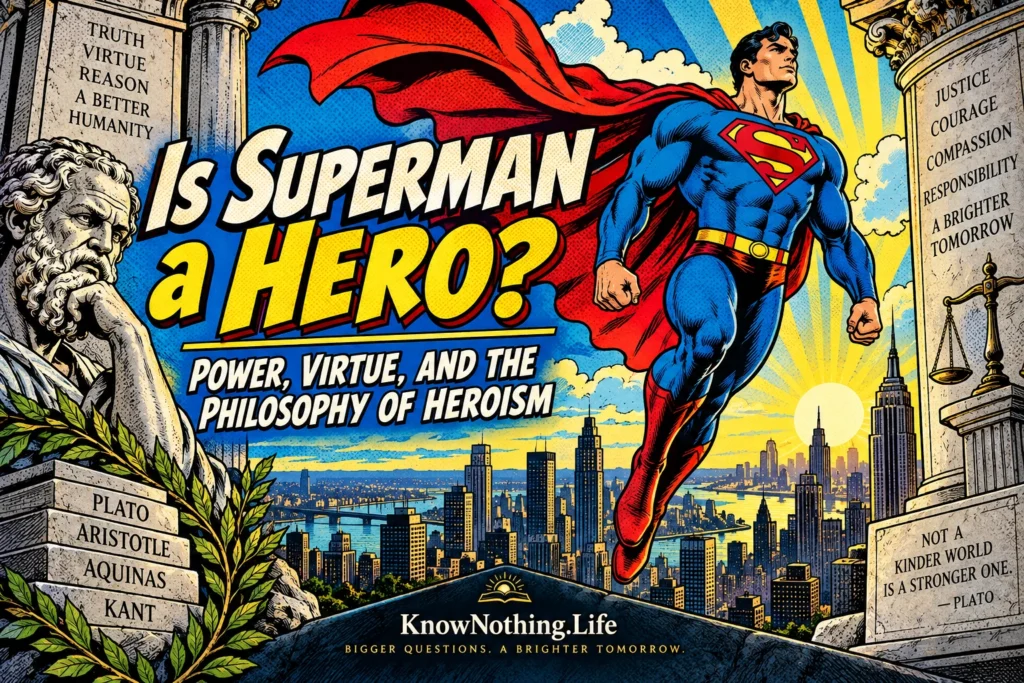
Superman is so closely associated with heroism that calling him a hero can seem almost redundant. Jerry Siegel and Joe Shuster’s character debuted in Action Comics #1 in 1938 and became one of the figures that established the modern superhero genre. DC describes him as fighting for “truth, justice and a better tomorrow,” while the Smithsonian credits his appearance with helping give birth to the superhero form itself. But Superman creates a philosophical problem precisely because he appears to embody heroism so perfectly: if a man can lift buildings, survive bullets, fly faster than aircraft, and hear cries for help from miles away, is rescuing someone actually courageous?
The question becomes more interesting when heroism is separated from mere effectiveness. A firefighter who enters a burning building may be heroic partly because the building can kill them. If Superman enters the same building knowing the flames cannot hurt him, he saves the same people while risking much less. Yet Superman’s greatest stories repeatedly suggest that his heroism lies somewhere other than raw danger. The philosophical case for Superman as a hero rests on what he chooses to do with power he did not earn, why he chooses it, how he restrains himself, and what he is willing to sacrifice for people who can offer him almost nothing in return.
What Makes Someone a Hero?
Psychologists have struggled with essentially the same problem. In their 2011 analysis of heroism, Zeno Franco, Kathy Blau, and Philip Zimbardo distinguished heroic action from ordinary altruism partly through the willingness to accept significant physical risk or social sacrifice for others. Heroism, on this account, is not simply producing a good result. It involves acting for others when doing so carries an unusual personal cost.
Research by Gordon Kraft-Todd and David Rand provides empirical support for the importance of cost. Across a series of studies involving 408 participants, actions judged more heroic were generally regarded as rarer and more costly to the person performing them. Interestingly, the more heroic acts were not necessarily viewed as providing greater benefits to others. What appears to matter is partly what the actor is prepared to give up. That immediately creates trouble for Superman. Catching a falling person may be extraordinary from the victim’s perspective, but if Superman can do it almost effortlessly, the psychological criteria people normally use to identify heroism become less obvious.
Can Superman Be Courageous If He Is Almost Invulnerable?
Aristotle‘s discussion of courage in the Nicomachean Ethics offers one of the oldest ways of examining the problem. Courage is not simply fearlessness. Aristotle explicitly distinguishes genuine courage from recklessness and insensitivity to danger. The courageous person recognizes what should be feared but faces it appropriately “for the sake of what is noble.” Someone who cannot experience meaningful danger may therefore have difficulty demonstrating courage in the ordinary Aristotelian sense.
That criticism applies most strongly to routine Superman rescues. Stopping a robbery or lifting a wrecked vehicle may require almost no physical courage from someone who cannot be harmed by ordinary weapons. But Superman’s fictional world repeatedly restores genuine vulnerability. Kryptonite, magic, opponents such as Doomsday, and threats involving people he loves place him in situations where strength does not guarantee safety. More importantly, physical vulnerability is only one form of risk. Reputation, relationships, identity, moral integrity, and the possibility of failing others can also be endangered. In Grant Morrison and Frank Quitely’s All-Star Superman, Superman confronts his own approaching death while continuing to use the time available to him in service of others. The premise makes explicit what everyday invulnerability can obscure: Superman remains Superman when his survival is no longer guaranteed.
Superman’s Greatest Power May Be Restraint
There is another reason extraordinary power does not automatically eliminate heroism. Power creates opportunities for wrongdoing on a scale unavailable to ordinary people. Superman could dominate governments, seize property, impose his beliefs, frighten critics into silence, or simply arrange the world according to his preferences. Most people cannot become global dictators even if they want to. Superman has to choose not to.
This is where Mark Millar’s Superman: Red Son becomes philosophically revealing. The alternate-history story asks what might happen if Superman had grown up in the Soviet Union rather than Kansas and eventually used his overwhelming abilities within an authoritarian political project. The thought experiment demonstrates that benevolent motives do not solve the problem of unlimited power. A ruler may sincerely believe he knows what is best for everyone and still deprive people of freedom. Superman’s normal refusal to rule humanity therefore matters morally. His restraint protects other people’s agency even when he believes he could improve their decisions.
Mark Waid and Alex Ross explore a related issue in Kingdom Come, where a generation of increasingly violent superhumans has lost the moral boundaries associated with older heroes. Superman’s challenge is not simply defeating people weaker than himself; it is deciding what legitimate authority looks like when beings with enormous power disagree about justice.
Superman as a Virtue-Ethics Hero
Virtue ethics offers perhaps the strongest philosophical defense of Superman. Rather than asking only whether particular actions follow rules or maximize good consequences, virtue ethics asks what kind of person someone has become. Aristotle understood virtue as a stable disposition of character developed through repeated choices. Modern virtue ethics similarly emphasizes courage, justice, compassion, honesty, practical wisdom, and the reasons for which someone acts.
Seen this way, Superman’s most important origin is not Krypton. It is Smallville. His abilities come from biology and circumstance, but his character is traditionally associated with the moral formation he receives while growing up as Clark Kent. Jeph Loeb and Tim Sale’s Superman for All Seasons focuses precisely on the young Clark learning what his unusual abilities mean and what kind of person he wants to become. Powers explain what Superman can do; upbringing, reflection, relationships, and repeated moral choices explain what he does with them.
This distinction matters because possessing power is morally neutral. Intelligence can manipulate or enlighten. Wealth can exploit or assist. Courage itself can serve good or evil ends if separated from judgment. Virtue requires more than possessing isolated traits such as fearlessness or generosity; practical wisdom is needed to direct those capacities properly. Superman’s goodness therefore cannot be reduced to strength. If Lex Luthor possessed the same abilities, the result would not automatically be another Superman.
Duty Matters More When You Could Walk Away
A Kantian interpretation produces a different but complementary answer. Immanuel Kant argues that moral worth depends importantly on the principle from which a person acts. In Critique of Practical Reason, he describes morality as involving a “law of duty” rather than simply doing whatever inclination happens to recommend.
Superman has no obvious external authority capable of forcing him to spend his life saving strangers. Human police cannot compel him. Governments cannot reliably threaten him. Ordinary citizens cannot meaningfully reward him with anything comparable to what he already possesses. His repeated decision to help is therefore unusually voluntary. Paradoxically, his freedom from coercion may strengthen the moral significance of his conduct. He can walk away.
That is also why Clark Kent matters. Superman does not merely descend from the sky whenever catastrophe occurs; he chooses to live among human beings, work beside them, form relationships, listen to their problems, and treat people without powers as moral equals. The disguise can be interpreted philosophically as more than a secret identity. Clark’s ordinary life continuously reconnects extraordinary power with ordinary human concerns.
Does Heroism Require Sacrifice?
The hardest objection remains the problem of cost. If heroism requires sacrifice, Superman often seems overqualified physically and underqualified morally. Bernard Williams and Thomas Nagel‘s philosophical problem of moral luck helps explain why. We ordinarily think people deserve moral credit only for matters within their control, yet our judgments are constantly influenced by circumstances people did not choose. Superman did not earn his Kryptonian biology any more than an ordinary person chose not to have it. His powers are a spectacular form of constitutive luck.
Suppose Superman and an ordinary human both desperately want to rescue someone trapped beneath a collapsed building. Superman succeeds because he can lift the rubble; the human cannot. It would be strange to conclude that Superman possesses greater moral character merely because biology gave him the capacity to succeed. Heroism must therefore involve something besides successful outcomes.
Contemporary research on extraordinary altruism reinforces this point. Shawn Rhoads, Abigail Marsh, and colleagues studied several groups of real-world extraordinary altruists—including heroic rescuers, organ donors, and humanitarian aid workers—and found that they were especially distinguished by patterns indicating unusually high valuation of other people’s welfare relative to their own. Heroism may therefore depend not only on how dangerous an act is but on whose interests dominate the decision. That description fits Superman remarkably well: his defining moral tendency is to treat other people’s lives as worth protecting even when they are strangers.
The Strongest Case Against Calling Superman a Hero
A serious counterargument begins by rejecting the assumption that benevolent power deserves heroic praise simply because it is used well. Superman’s powers make many of his celebrated actions extraordinarily cheap. If a person can rescue a bus full of children with less effort than an ordinary person spends carrying groceries upstairs, perhaps admiration for the result should be directed toward his usefulness rather than his courage. A rescue can be morally good without being heroic. Under this stricter definition, Superman is often less like a firefighter entering a burning building than like someone pressing an emergency-stop button. The outcome is important, but the personal sacrifice may be minimal.
His overwhelming abilities also create a troubling moral asymmetry. Superman decides when to intervene, what counts as an emergency, whose freedom may be overridden, and how much force is justified. Humans have little meaningful capacity to hold him accountable. Political philosophers from John Locke onward have worried about unchecked power precisely because good intentions are not enough to guarantee legitimate government. If one individual possesses the practical ability to ignore borders, police, courts, and democratic institutions, then even compassionate intervention can become paternalistic. The question is not merely whether Superman means well but why one unelected person should possess unilateral authority over situations affecting everyone else.
This problem becomes sharper when considering what Superman does not do. If he can stop wars, disrupt weapons systems, rescue people from disasters, transport supplies almost instantly, and access technologies far beyond ordinary human capabilities, why does he primarily respond to spectacular emergencies rather than restructure conditions that continually produce suffering? Philosophically, this resembles debates about effective altruism and demandingness in consequentialist ethics. Peter Singer famously argued in “Famine, Affluence, and Morality” that if we can prevent something bad from happening without sacrificing anything comparably important, we ought to do it. For an ordinary person, that principle is demanding. For Superman, it could be overwhelming. If he can save thousands of additional people at relatively little personal cost, is choosing an evening as Clark Kent morally defensible while preventable suffering continues elsewhere?
There is no easy answer. Requiring Superman to maximize good every waking second would effectively deny him any private existence and turn moral obligation into permanent servitude. Yet the objection exposes an uncomfortable consequence of extreme ability: greater capacity may generate greater responsibility. Superman cannot simply be judged by the same standard as an ordinary person because his opportunity to prevent harm is radically different. His powers make heroism easier in one sense but moral innocence harder in another.
A further criticism targets the traditional celebration of his restraint. We praise Superman for not becoming a dictator, but perhaps that praise sets the bar too low. An ordinary person is not considered heroic merely because they refrain from assault, theft, or tyranny. Why should Superman receive moral credit simply for declining to enslave humanity? The fact that he could dominate the world makes his restraint important, but avoiding monstrous wrongdoing is not necessarily equivalent to positive virtue. It may establish that Superman is trustworthy without establishing that he is heroic.
Finally, Superman’s stories can encourage a politically questionable model of social change: the fantasy that society’s deepest problems are best solved by an exceptionally good and exceptionally powerful individual. Real social improvements usually depend on institutions, collective action, laws, education, cooperation, and ordinary people developing the capacity to govern themselves. A world that constantly waits for Superman can become morally passive. The heroic ideal may therefore be strongest not when Superman solves humanity’s problems for it, but when he protects enough space for human beings to solve those problems themselves.
These objections do not prove that Superman is not a hero. They make the standard more demanding. To deserve the name, his heroism cannot rest merely on spectacular rescues or on the fact that he is nicer than someone with his powers might have been. It must be demonstrated through responsible restraint, genuine sacrifice, respect for human autonomy, thoughtful use of power, and a willingness to help without making humanity dependent upon him.
Superman Is Almost the Opposite of Nietzsche’s “Superman”
The name also invites comparison with Friedrich Nietzsche‘s Übermensch, sometimes rendered in older English translations as “Superman.” Nietzsche introduced the concept in Thus Spoke Zarathustra decades before the comic-book character existed. The resemblance has generated substantial philosophical commentary, but the two figures embody very different attitudes toward morality. Nietzsche’s Übermensch is associated with overcoming inherited systems of value and creating values anew; the comic-book Superman characteristically binds enormous personal power to compassion, responsibility, and service.
That contrast reveals something fundamental about the DC character. Superman’s greatness does not come from standing above ordinary morality because he stands above ordinary humans physically. His heroism depends on refusing that inference. He could treat superior ability as proof of superior moral entitlement, but instead he accepts constraints that weaker beings could never enforce against him. Philosophically, this turns Superman’s power from the justification for domination into a reason for greater responsibility.
So, Is Superman Really a Hero?
Superman’s invulnerability complicates the idea of courage, and some of his routine rescues may contain less personal risk than identical actions performed by ordinary humans. If heroism meant nothing more than willingly facing physical danger, a firefighter could sometimes be more heroic than Superman. Research on heroism supports that intuition: rarity, personal cost, and sacrifice affect how heroic an action appears.
The stronger counterargument also prevents an easy answer. Superman’s power reduces the cost of many good actions, gives him extraordinary influence without democratic accountability, and creates moral obligations proportionate to abilities almost no one else possesses. Simply refusing to become a dictator is not enough. Nor should every intervention automatically be praised merely because Superman intended to help. A genuinely heroic Superman must respect autonomy as well as protect life, understand the limits of unilateral power, and accept that humanity must remain more than the passive recipient of his benevolence.
Yet those challenges ultimately reveal why the best Superman stories are about character rather than strength. His deeper philosophical significance lies in moral self-restraint, concern for strangers, responsibility without coercion, respect for human agency, and the persistent choice to use asymmetric power for other people’s benefit rather than his own domination. His abilities are accidents of birth. The moral identity built around them is not.
That may ultimately be why Superman has remained culturally powerful since Siegel and Shuster introduced him in 1938. The fantasy is not merely that a person could become strong enough to defeat every enemy. It is that someone possessing almost unlimited power might still remain compassionate enough to care about one frightened individual, disciplined enough not to become a ruler, and humble enough to believe that extraordinary ability does not make other lives less valuable. Superman’s most heroic act, then, is not flying. It is choosing what kind of person lands.