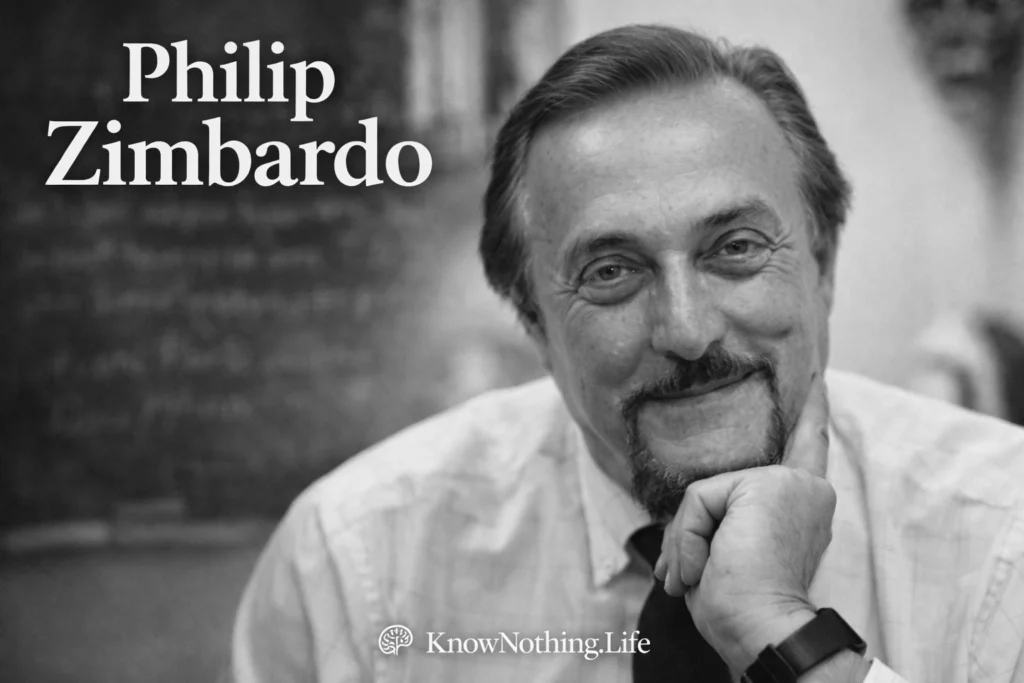
Few psychologists have influenced the modern understanding of human behavior under social pressure as profoundly as Philip Zimbardo. Best known for conducting the controversial Stanford Prison Experiment in 1971, Zimbardo became one of the central figures in social psychology by demonstrating how powerful situational forces can rapidly transform ordinary individuals into participants in cruelty, submission, and abuse of power. His work forced psychologists and society at large to confront a deeply uncomfortable truth: under certain conditions, ordinary people may behave in ways that radically contradict their normal moral character.
Zimbardo’s research challenged traditional assumptions that behavior is primarily determined by personality traits or inherent character. Instead, he argued that environments, roles, institutions, and systems often exert far greater influence than people realize. His work has shaped psychology, criminology, military ethics, leadership theory, education, and the study of institutional abuse. More than simply studying abnormal behavior, Zimbardo sought to understand how good people can be transformed by circumstances into agents of harm, a question that remains deeply relevant in understanding power structures across modern society.
Early Life and Intellectual Formation
Philip George Zimbardo was born on March 23, 1933, in New York City, growing up in the impoverished South Bronx in a working-class Sicilian immigrant family. His early life exposed him to inequality, social struggle, and institutional systems that treated different groups of people unequally. These experiences sparked an early fascination with how environment shapes identity, opportunity, and behavior. Unlike psychologists focused primarily on internal mental processes, Zimbardo became increasingly interested in how external social forces shape human action.
He attended Brooklyn College, where he studied psychology, sociology, and anthropology alongside two future influential psychologists, Stanley Milgram and Lee Cronbach. This interdisciplinary background helped shape his lifelong interest in understanding human behavior within broader social systems rather than viewing individuals in isolation. Zimbardo later completed his doctorate in psychology at Yale University, where he developed a strong foundation in experimental psychology and behavioral science.
From the beginning of his academic career, Zimbardo questioned overly simplistic views of personality. He believed people are far more adaptable—and vulnerable to social influence—than traditional psychology often assumed. This belief would eventually guide the research that defined his career and transformed public understanding of authority, power, and institutional behavior.
The Stanford Prison Experiment
Zimbardo’s most famous work began in August 1971 at Stanford University, where he designed what became one of the most controversial psychological experiments ever conducted. The study aimed to investigate how individuals adapt psychologically when assigned positions of authority or submission within institutional environments. Participants were healthy college students who volunteered to participate in what they believed was a study on prison life.
Volunteers were randomly divided into two groups. One group became prisoners, while the other group became prison guards. A mock prison was constructed in the basement of Stanford’s psychology department, complete with cells, uniforms, identification numbers, surveillance systems, and strict institutional rules. The experiment was scheduled to run for two weeks.
What followed shocked even Zimbardo himself. Within hours, participants assigned as guards began adopting authoritarian behaviors, enforcing arbitrary punishments and humiliating prisoners psychologically. Participants assigned as prisoners quickly became passive, emotionally distressed, anxious, and submissive. The simulation escalated so rapidly that several prisoners experienced severe emotional breakdowns. The experiment was terminated after only six days because conditions had become dangerously intense. Zimbardo later reflected, “I realized we had created a situation where ordinary people could become monsters.”
Situational Power and the Lucifer Effect
The Stanford Prison Experiment fundamentally reinforced Zimbardo’s belief that situational forces often overpower individual morality. He argued that people frequently overestimate the power of personality while underestimating the influence of environment, authority structures, institutional expectations, and assigned social roles. Individuals do not enter harmful situations intending to behave cruelly, but systems themselves can gradually normalize destructive behavior.
This insight became central to what Zimbardo later called “The Lucifer Effect,” referring to the process through which ordinary individuals become capable of committing harmful or immoral acts when placed inside toxic systems. Rather than focusing on evil as a property of inherently bad individuals, Zimbardo argued that harmful institutions often transform otherwise normal people by gradually shifting moral boundaries.
One of his most widely cited statements captures this philosophy clearly: “The line between good and evil is permeable and almost anyone can be induced to cross it.” For Zimbardo, understanding human behavior required recognizing that morality is often far more fragile than society prefers to believe. Situations shape choices more powerfully than individuals typically recognize.
The Psychology of Evil and Institutional Abuse
Much of Zimbardo’s later career focused on understanding how institutions can systematically encourage harmful behavior. He became particularly interested in military environments, authoritarian organizations, and systems that create anonymity, dehumanization, and diffusion of responsibility. These structural conditions, he argued, make ethical behavior far more difficult to maintain.
His research gained renewed attention following the Abu Ghraib torture and prisoner abuse scandal during the Iraq War, where American military personnel were photographed humiliating and abusing detainees. Public reaction initially focused on condemning individual soldiers, but Zimbardo argued the larger institutional environment deserved equal scrutiny. The system itself, he argued, had created conditions that encouraged dehumanization, obedience, and moral disengagement.
This perspective echoed themes earlier explored by Stanley Milgram. Both psychologists demonstrated that destructive behavior often emerges not because people are inherently cruel but because institutional structures redefine acceptable behavior. Zimbardo consistently emphasized that understanding evil requires examining systems as carefully as individuals.
Major Works and Intellectual Contributions
Zimbardo’s intellectual influence extends far beyond the Stanford Prison Experiment. His most important later work, The Lucifer Effect (2007), expanded his situational theory into a broad analysis of how environments transform behavior. In the book, he examined historical atrocities, military abuse scandals, cult behavior, and organizational corruption, arguing that systems often shape morality more than personal values alone.
Earlier in his career, Zimbardo also contributed significantly to research on shyness, identity formation, persuasion, and social influence. His book Shyness: What It Is, What To Do About It explored social anxiety and interpersonal inhibition, helping bring public attention to psychological struggles surrounding confidence and social connection. This research demonstrated the remarkable breadth of his interests beyond institutional behavior alone.
Another major contribution involved time perspective theory. Zimbardo became interested in how individuals psychologically orient themselves toward the past, present, and future. His later research argued that one’s relationship with time strongly influences decision-making, emotional health, motivation, and overall life satisfaction. This work expanded his influence beyond social psychology into personality and behavioral science more broadly.
Ethical Controversy and Scientific Criticism
Like Milgram’s obedience experiments, the Stanford Prison Experiment became deeply controversial within psychology. Critics argued participants experienced unacceptable psychological distress and that the study lacked proper ethical safeguards. Because Zimbardo himself played the role of prison superintendent during the experiment, many critics argued he became too personally involved, influencing participant behavior rather than remaining an objective researcher.
Some researchers later questioned the scientific validity of the experiment itself, arguing certain guards may have been indirectly encouraged to behave aggressively. Others argued the sample size was too small and the environment too artificial to support broad conclusions about human nature. These debates continue today and have led some scholars to reevaluate how the experiment should be interpreted historically.
Zimbardo acknowledged many of these criticisms but maintained that the experiment revealed genuine psychological processes surrounding power, institutional roles, and dehumanization. Regardless of methodological debate, its cultural influence remains enormous and continues shaping discussions surrounding ethics in psychological research.
The Heroic Imagination and Positive Psychology
In later years, Zimbardo increasingly shifted attention away from understanding evil toward understanding heroism. After decades studying harmful behavior, he became interested in the opposite question: what allows ordinary individuals to resist social pressure and act courageously under difficult circumstances?
This work led him to create the Heroic Imagination Project, an educational initiative teaching individuals how to recognize harmful group pressure, resist conformity, and develop the courage to act ethically even when authority encourages silence. Rather than simply warning about the dangers of situational influence, Zimbardo wanted people to develop psychological resilience against it.
He argued that heroism is rarely extraordinary or reserved for exceptional individuals. Instead, everyday acts of courage emerge when people consciously resist passive conformity. He wrote, “Heroism consists of acting to help others in need despite personal risk.” This represented an important philosophical evolution in his career, shifting from studying corruption to studying moral courage.
Legacy and Lasting Influence
Philip Zimbardo fundamentally changed psychology by demonstrating how rapidly social environments can reshape human behavior. His research challenged comforting assumptions about morality, revealing that personality alone often offers limited protection when individuals enter powerful institutional systems that normalize harmful conduct. His work remains central to understanding prisons, military behavior, organizational corruption, authoritarianism, bullying, and abusive power structures.
His influence extends beyond psychology into law, education, business leadership, ethics training, and political science. Modern discussions surrounding toxic workplace culture, institutional misconduct, police abuse, and bureaucratic harm frequently draw upon principles Zimbardo helped popularize. His central insight remains both powerful and deeply unsettling: systems often shape behavior more than character itself.
Zimbardo once said, “The key to understanding behavior is not the person, but the situation.” Few statements summarize modern social psychology more clearly. His career forced society to reconsider how ordinary individuals can become participants in extraordinary harm when systems quietly redefine what behavior becomes acceptable.
Final Thoughts
To study Philip Zimbardo is to confront one of psychology’s most sobering lessons about human nature. His work revealed that morality is not always a stable internal quality but often a fragile condition shaped by circumstance, authority, anonymity, and institutional pressure. The systems people inhabit matter profoundly.
Yet Zimbardo’s later work also offered hope. If situations can corrupt ordinary individuals, environments can also cultivate courage, empathy, and ethical resistance. His legacy remains not simply a warning about human vulnerability but a call to consciously design institutions that encourage moral responsibility rather than passive obedience. In understanding how power transforms behavior, Zimbardo gave psychology one of its clearest explanations for both humanity’s darkest failures and its greatest acts of courage.