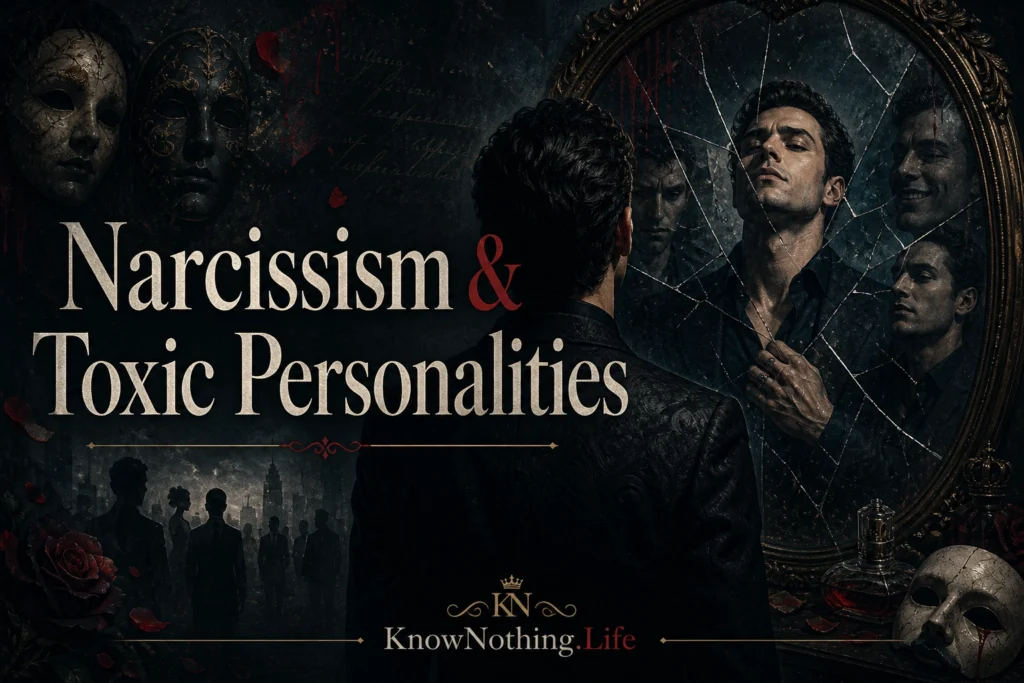
Narcissism and toxic personalities occupy a difficult place in psychology because they describe patterns that are both clinically serious and widely misunderstood. In everyday language, “narcissist” is often used as a casual insult for anyone selfish, arrogant, or attention-seeking. In psychology, however, narcissism refers to a deeper pattern involving grandiosity, fragile self-esteem, entitlement, lack of empathy, and a persistent need for admiration or control. Toxic personalities, more broadly, are individuals whose recurring behavior damages trust, emotional safety, and psychological well-being in the people around them. Not every difficult person has a personality disorder, and not every narcissistic trait is pathological, but repeated patterns of manipulation, exploitation, cruelty, and emotional domination deserve careful attention.
The study of narcissism reaches back to myth, psychoanalysis, personality theory, and modern clinical psychology. The ancient Greek myth of Narcissus, preserved most famously in Ovid’s Metamorphoses, tells of a beautiful young man who becomes entranced by his own reflection and wastes away because he cannot love anyone beyond himself. Sigmund Freud gave the concept psychological significance in his 1914 essay “On Narcissism,” where he explored self-love as a normal developmental force that can become distorted. Later thinkers such as Heinz Kohut, Otto Kernberg, Karen Horney, Erich Fromm, Alice Miller, Robert D. Hare, and Jean Twenge expanded the discussion, linking narcissistic patterns to shame, aggression, family dynamics, culture, trauma, entitlement, and emotional emptiness. Together, their work shows that narcissism is not merely vanity. It is a structure of personality built around the unstable management of self-worth.
What Narcissism Really Means
Narcissism exists on a spectrum. At the healthy end, it includes self-confidence, ambition, pride in achievement, and the ability to advocate for oneself. A person with healthy narcissism can accept praise without becoming dependent on it, tolerate criticism without collapsing, and care about their own needs without erasing the needs of others. This kind of self-regard is necessary for psychological development. Problems begin when self-esteem becomes rigid, defensive, inflated, or dependent on constant external validation.
Pathological narcissism is often marked by contradiction. The narcissistic person may appear superior, confident, charming, or untouchable, yet underneath this display there is often insecurity, shame, envy, or emotional fragility. Heinz Kohut, in The Analysis of the Self, described narcissistic disturbance as involving deficits in the development of a stable self. From this perspective, grandiosity is not simply arrogance; it is an attempt to protect a vulnerable inner structure. Otto Kernberg, in Borderline Conditions and Pathological Narcissism, offered a more conflict-based view, emphasizing aggression, envy, idealization, and devaluation. Where Kohut focused on injury and unmet developmental needs, Kernberg highlighted the destructive and exploitative side of narcissistic organization.
This distinction matters because narcissism can look different from person to person. Some narcissistic individuals are loud, boastful, and dominant. Others are covert, resentful, hypersensitive, and self-pitying. The grandiose narcissist demands admiration openly; the vulnerable narcissist may demand it through suffering, grievance, or moral superiority. Both forms revolve around the same central problem: the self must be constantly protected, inflated, or rescued from ordinary human limitation.
Narcissistic Personality Disorder and Clinical Features
Narcissistic Personality Disorder is a formal diagnosis in the Diagnostic and Statistical Manual of Mental Disorders, usually associated with grandiosity, fantasies of success or power, belief in one’s specialness, need for admiration, entitlement, interpersonal exploitation, lack of empathy, envy, and arrogant behavior. A diagnosis should only be made by a qualified clinician, and it requires more than occasional selfishness. Personality disorders involve enduring patterns that appear across many situations and cause impairment or harm.
One of the defining features of severe narcissism is entitlement. The narcissistic person may believe that normal rules do not apply to them, that others owe them admiration, obedience, forgiveness, attention, or special treatment. When reality does not confirm this belief, they may respond with rage, contempt, withdrawal, blame, or revenge. This reaction is sometimes called narcissistic injury: a wound to the grandiose self-image. The injury may seem minor to outsiders, but to the narcissistic person it can feel intolerable because it threatens the protective identity they depend on.
Lack of empathy is another central feature, though it is often more complicated than total emotional blindness. Many narcissistic individuals can read other people well when doing so serves their interests. They may understand what someone feels, but fail to value those feelings as morally important. This distinction between cognitive empathy and emotional empathy helps explain why some toxic personalities can be charming and socially skilled while still being harmful. They may know exactly what hurts another person; the problem is that this knowledge becomes a tool rather than a restraint.
Toxic Personalities Beyond Narcissism
The phrase “toxic personality” is not a clinical diagnosis, but it is useful when describing recurring patterns that poison relationships. Toxic people may be narcissistic, manipulative, chronically hostile, controlling, emotionally immature, deceitful, exploitative, or constantly victimized in ways that make others responsible for their feelings. What makes a personality toxic is not one bad mood or one selfish act, but the repeated creation of emotional damage without accountability.
Delroy Paulhus and Kevin Williams’ influential work on the “Dark Triad” helps clarify this broader territory. In their 2002 paper “The Dark Triad of Personality,” they identified narcissism, Machiavellianism, and psychopathy as overlapping but distinct socially aversive traits. Narcissism seeks admiration and superiority. Machiavellianism seeks strategic control through calculation and manipulation. Psychopathy is associated with callousness, impulsivity, and lack of remorse. A toxic personality may contain elements of all three, especially when charm, deception, dominance, and emotional coldness appear together.
Robert D. Hare’s work on psychopathy, especially Without Conscience, is also relevant because it shows how destructive personalities can imitate normal emotion while lacking deep concern for others. Hare described psychopathic individuals as social predators who can use charm, lies, and intimidation to exploit. Not every toxic person is psychopathic, and the term should not be applied carelessly, but Hare’s work reminds us that some harmful personalities do not merely misunderstand others; they use others deliberately.
The Narcissistic Relationship Pattern
Relationships with narcissistic or toxic personalities often follow a recognizable cycle. At first, the person may appear unusually charming, intense, admiring, or impressive. This early stage may involve love bombing: excessive praise, attention, promises, intimacy, or idealization. The target feels special, chosen, or finally understood. Over time, however, the emotional atmosphere changes. The same person who once admired intensely may become critical, dismissive, jealous, controlling, or emotionally unavailable.
This shift often reflects the movement from idealization to devaluation. In narcissistic dynamics, people are frequently experienced as either sources of admiration or threats to self-esteem. When another person reflects positively on the narcissistic individual, they may be idealized. When they disagree, disappoint, set boundaries, or become too independent, they may be devalued. Otto Kernberg emphasized this splitting pattern in his clinical work, where people are seen in extremes rather than as complex human beings with both strengths and flaws.
The target may respond by trying to recover the original warmth. They may become more careful, more apologetic, more giving, or more anxious. This is where the relationship becomes psychologically binding. B. F. Skinner’s research on reinforcement is useful for understanding the pattern: inconsistent rewards can create persistent behavior. In toxic relationships, affection may arrive unpredictably after periods of coldness or criticism. The victim keeps trying because the return of kindness feels like proof that the relationship can still be saved.
Gaslighting, Projection, and Blame Reversal
Toxic personalities often rely on reality distortion. Gaslighting is one of the most damaging forms because it causes a person to question their own perception. A narcissistic individual may deny things they said, minimize harm, accuse the other person of being too sensitive, or rewrite events so that the victim becomes the aggressor. The goal is not simply to avoid blame; it is to control the meaning of reality inside the relationship.
Projection is another common defense. The narcissistic or toxic person may accuse others of the very motives or behaviors they themselves display. A controlling person accuses others of control. A dishonest person constantly suspects deception. A cruel person insists they are the true victim. Freud discussed projection as a defense mechanism, and later psychoanalytic writers connected it to the avoidance of shame and unacceptable self-knowledge. Projection protects the toxic person from self-examination by relocating the problem into someone else.
Blame reversal keeps the target trapped in explanation. Instead of asking, “Was I harmed?” the target begins asking, “Did I cause this?” Instead of noticing disrespect, they defend their tone. Instead of evaluating the toxic person’s actions, they work to prove their own innocence. This is emotionally exhausting and strategically useful for the manipulator. A person who is constantly defending themselves has less energy to leave, resist, or think clearly.
Narcissism, Shame, and Fragile Self-Worth
Although narcissism often appears as excessive self-love, many theorists argue that shame lies near its center. Karen Horney, in Neurosis and Human Growth, described the construction of an idealized self-image that protects the individual from feelings of inadequacy. Alice Miller, in The Drama of the Gifted Child, explored how some children become organized around performance, approval, and the needs of others, losing contact with their authentic emotional life. While Miller’s work is not a simple explanation for all narcissism, it helps illuminate how grandiosity can grow from emotional deprivation and conditional love.
Shame-driven narcissism is unstable because the person must constantly defend against exposure. Ordinary criticism may feel like humiliation. Another person’s success may provoke envy. A boundary may feel like rejection. A disagreement may feel like disrespect. Because the narcissistic self is not securely grounded, it requires constant confirmation from outside. Praise temporarily soothes it; criticism threatens it.
This does not excuse abusive behavior, but it helps explain its emotional intensity. Toxic personalities often react so strongly because they are defending more than a preference or opinion. They are defending an identity. The tragedy is that their defenses often create the very rejection they fear. By demanding admiration, they destroy intimacy. By avoiding accountability, they lose trust. By protecting superiority, they sacrifice connection.
Culture, Social Media, and the Narcissistic Style
Modern culture has made narcissism more visible and perhaps more rewarded in certain contexts. Jean Twenge and W. Keith Campbell, in The Narcissism Epidemic, argue that contemporary society increasingly celebrates self-promotion, fame-seeking, entitlement, and personal branding. While their thesis has been debated, it captures a recognizable cultural pattern: visibility can be mistaken for value, confidence for wisdom, and attention for love.
Social media does not create narcissism by itself, but it can amplify narcissistic habits. Platforms reward performance, comparison, outrage, image management, and constant feedback. A person can curate identity, measure approval through likes, and experience criticism as public humiliation. For psychologically healthy users, this may be manageable. For narcissistically vulnerable users, it can become a cycle of validation seeking and emotional reactivity.
Erich Fromm’s The Sane Society and The Art of Loving offer a deeper cultural critique. Fromm argued that modern life often turns people into commodities who market themselves for approval. In such a world, the self becomes something to display, package, and sell. Narcissism then becomes not only an individual problem but a cultural temptation: to be admired rather than known, envied rather than loved, seen rather than understood.
Protecting Yourself from Toxic Personalities
The first step in dealing with narcissistic or toxic personalities is recognizing patterns rather than isolated incidents. Everyone can be selfish, defensive, or unkind at times. The warning sign is repetition without accountability. Does the person apologize and change, or apologize and repeat? Do conversations bring clarity, or do they leave you more confused? Are your boundaries respected, or treated as insults? Do you feel more like yourself around this person, or smaller, anxious, and constantly on trial?
Boundaries are essential because toxic personalities often interpret flexibility as permission. Clear boundaries should be specific, calm, and enforceable. Long explanations may become material for debate, distortion, or guilt. In some cases, especially with emotionally abusive or highly manipulative people, low contact or no contact may be necessary. This is not about punishment; it is about protecting psychological stability.
Outside perspective is also important. Toxic relationships often isolate people from their own judgment. Trusted friends, therapists, support groups, or written records can help restore reality. When someone repeatedly makes you doubt what happened, documenting patterns can be grounding. The goal is not to diagnose the other person from a distance, but to take your own experience seriously. Harm does not require a formal label to be real.
Final Thoughts
Narcissism and toxic personalities reveal the dark side of self-protection, influence, and emotional need. From Ovid’s Narcissus to Freud’s “On Narcissism,” from Kohut’s wounded self to Kernberg’s destructive grandiosity, from Paulhus and Williams’ Dark Triad to Hare’s study of psychopathy, the literature shows that toxic behavior is rarely simple. It may involve shame, entitlement, envy, charm, aggression, fear, emptiness, and a profound inability to love others as separate people.
Yet understanding is not the same as excusing. A person’s wounds may explain their behavior, but they do not erase the damage done to others. Narcissistic and toxic personalities can leave people doubting themselves, apologizing for normal needs, and mistaking emotional survival for love. The deepest injury is often not one insult or betrayal, but the slow erosion of self-trust.
To study narcissism wisely is to hold two truths at once: toxic people are human, and their behavior can still be harmful. Compassion does not require access. Empathy does not require submission. The healthiest response is clear sight: recognizing the pattern, refusing the distortion, protecting one’s dignity, and choosing relationships where respect is not a reward to be earned but a foundation that is already present.