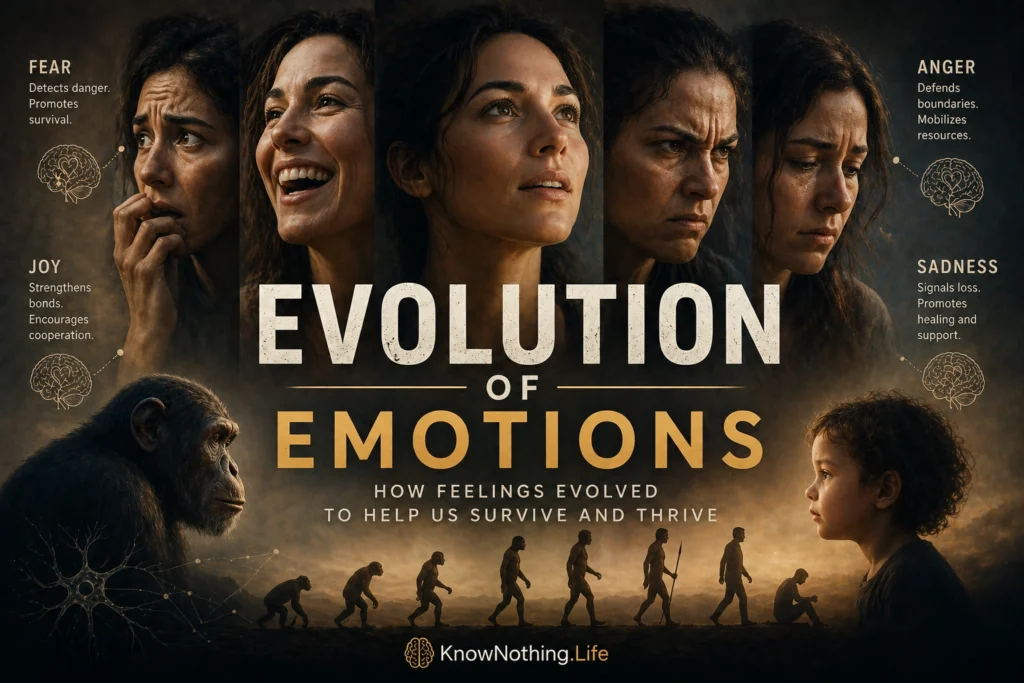
The evolution of emotions explores how feelings such as fear, anger, joy, and love developed as adaptive responses to environmental challenges. Rather than being irrational or purely subjective experiences, emotions are increasingly understood as functional systems that guide behavior, enhance survival, and facilitate social interaction. They organize perception, prioritize attention, and prepare the body for action, allowing organisms to respond efficiently to threats and opportunities.
The roots of this perspective can be traced to Charles Darwin, who argued in The Expression of the Emotions in Man and Animals that emotional expressions are universal and have evolutionary origins. Darwin proposed that “the expression of emotions in man and animals is a biological phenomenon,” shaped by natural selection to serve adaptive purposes. This insight challenged earlier views that emotions were uniquely human or culturally constructed, laying the groundwork for modern evolutionary and comparative approaches to emotion.
Adaptive Functions of Emotions
Emotions are best understood as adaptive mechanisms that evolved to solve specific problems faced by ancestral organisms. Fear, for example, prepares individuals to avoid danger, while anger mobilizes resources for confrontation or defense. Positive emotions such as joy and love reinforce behaviors that promote survival and reproduction, including social bonding and cooperation.
Evolutionary psychologists such as Leda Cosmides and John Tooby have argued that emotions function as “superordinate programs” that coordinate multiple systems in response to environmental cues. These programs integrate physiological, cognitive, and behavioral processes, ensuring that responses are rapid and appropriate. By prioritizing certain actions over others, emotions increase the efficiency of decision-making, particularly in situations where time and resources are limited. This perspective highlights the functional role of emotions in guiding behavior.
Basic Emotions and Universality
One of the central debates in the study of emotions concerns whether certain emotions are universal across cultures. Research by Paul Ekman has provided strong evidence for the existence of basic emotions, including happiness, sadness, fear, anger, surprise, and disgust. Ekman’s cross-cultural studies demonstrated that individuals from diverse backgrounds could reliably recognize these emotions from facial expressions.
Ekman argued that “emotions are not culturally constructed but biologically based,” suggesting that they are part of our evolutionary heritage. These basic emotions are thought to have distinct neural and physiological signatures, supporting their role as fundamental components of human experience. However, while the core emotions may be universal, their expression and interpretation can vary across cultures, reflecting the influence of social norms and context.
Neurobiology of Emotions
The evolution of emotions is closely linked to the development of the brain, particularly structures involved in processing and regulating emotional responses. The limbic system, including the amygdala and hippocampus, plays a central role in detecting and responding to emotional stimuli. These structures are highly conserved across species, indicating their importance in survival.
Research by Joseph LeDoux has highlighted the role of the amygdala in fear processing, describing it as a “low road” that allows rapid responses to potential threats. LeDoux argued that “emotional systems operate largely outside conscious awareness,” emphasizing the automatic nature of many emotional responses. At the same time, higher brain regions, such as the prefrontal cortex, are involved in regulating emotions, allowing for more flexible and context-dependent behavior. This interplay between automatic and controlled processes reflects the evolutionary layering of the brain.
Emotions and Social Behavior
Emotions play a crucial role in social interaction, facilitating communication, cooperation, and group cohesion. Expressions of emotion provide information about intentions, needs, and states, allowing individuals to coordinate their behavior with others. For example, displays of empathy can strengthen social bonds, while expressions of anger can signal boundaries or violations.
The evolutionary significance of social emotions has been explored by researchers such as Robert Trivers, whose theory of reciprocal altruism highlights the role of emotions in maintaining cooperation. Trivers argued that emotions such as gratitude and guilt help regulate social exchanges, ensuring that individuals adhere to norms of reciprocity. Similarly, Jonathan Haidt has emphasized the role of moral emotions in shaping ethical behavior, suggesting that “morality binds and blinds,” reflecting both the unifying and divisive effects of emotional responses. These insights underscore the importance of emotions in social life.
Emotional Development and Learning
While emotions have evolutionary origins, their expression and regulation are shaped by development and learning. From early childhood, individuals learn to recognize, interpret, and manage their emotions, influenced by interactions with caregivers and cultural norms. This process involves both biological maturation and socialization.
The work of John Bowlby on attachment theory highlights the importance of early relationships in shaping emotional development. Bowlby argued that “the propensity to make strong emotional bonds to particular individuals is a basic component of human nature,” emphasizing the role of attachment in survival and well-being. Through these bonds, individuals develop patterns of emotional regulation that influence their behavior throughout life. Learning thus refines and contextualizes the emotional systems inherited through evolution.
Cultural Influences on Emotion
Although emotions have biological foundations, culture plays a significant role in shaping how they are expressed and understood. Cultural norms influence which emotions are considered appropriate, how they are displayed, and how they are interpreted. This interaction between biology and culture creates a rich diversity of emotional expression across societies.
Anthropological research by Geert Hofstede has highlighted differences in emotional expression across cultures, reflecting variations in values such as individualism and collectivism. While the underlying emotional systems may be universal, cultural contexts shape their manifestation. This perspective challenges simplistic views of emotion, emphasizing the need to consider both evolutionary and cultural factors in understanding human behavior.
Emotions in Modern Environments
The environments in which humans evolved differ significantly from those of modern society, leading to potential mismatches between emotional responses and current conditions. For example, the stress response, which evolved to address immediate physical threats, is often activated by chronic psychological pressures in modern life. This can lead to negative health outcomes, such as anxiety and cardiovascular disease.
Psychologist Hans Selye introduced the concept of the general adaptation syndrome, describing how prolonged stress affects the body. Selye noted that “stress is the nonspecific response of the body to any demand,” highlighting its pervasive impact. Understanding these mismatches is essential for addressing modern challenges and developing strategies for emotional regulation and well-being.
Critiques and Alternative Perspectives
The evolutionary approach to emotions has been subject to criticism, particularly regarding its reliance on assumptions about ancestral environments. Critics argue that some explanations may be speculative and difficult to test empirically. Additionally, there is concern that evolutionary theories may overlook the role of culture and individual variability.
Scholars such as Lisa Feldman Barrett have proposed alternative models, such as the theory of constructed emotion, which suggests that emotions are not fixed biological entities but are constructed through experience and context. Barrett argues that “emotions are not reactions to the world; they are your brain’s constructions of the world,” challenging traditional evolutionary perspectives. These debates highlight the complexity of emotions and the need for interdisciplinary approaches.
Future Directions in Emotion Research
The study of the evolution of emotions continues to evolve, integrating insights from neuroscience, psychology, and anthropology. Advances in brain imaging and genetic research are providing new tools for understanding the biological basis of emotion, while cross-cultural studies are expanding knowledge of diversity in emotional expression.
There is also growing interest in the role of emotions in areas such as decision-making, artificial intelligence, and mental health. Understanding how emotions evolved can inform interventions for psychological disorders and enhance well-being. As research progresses, the integration of evolutionary and contemporary perspectives will be essential for developing a comprehensive understanding of emotions.
Conclusion
The evolution of emotions provides a powerful framework for understanding the origins and functions of human feelings. By viewing emotions as adaptive responses shaped by natural selection, researchers can explain their role in survival, social interaction, and decision-making. From basic emotions to complex social behaviors, the study of emotional evolution reveals the deep connections between biology and behavior.
At the same time, emotions are not static or uniform; they are shaped by development, culture, and individual experience. By integrating these factors, the study of emotions can offer a more nuanced and comprehensive understanding of human nature. Ultimately, emotions are not merely reactions but essential components of how humans navigate and make sense of the world.