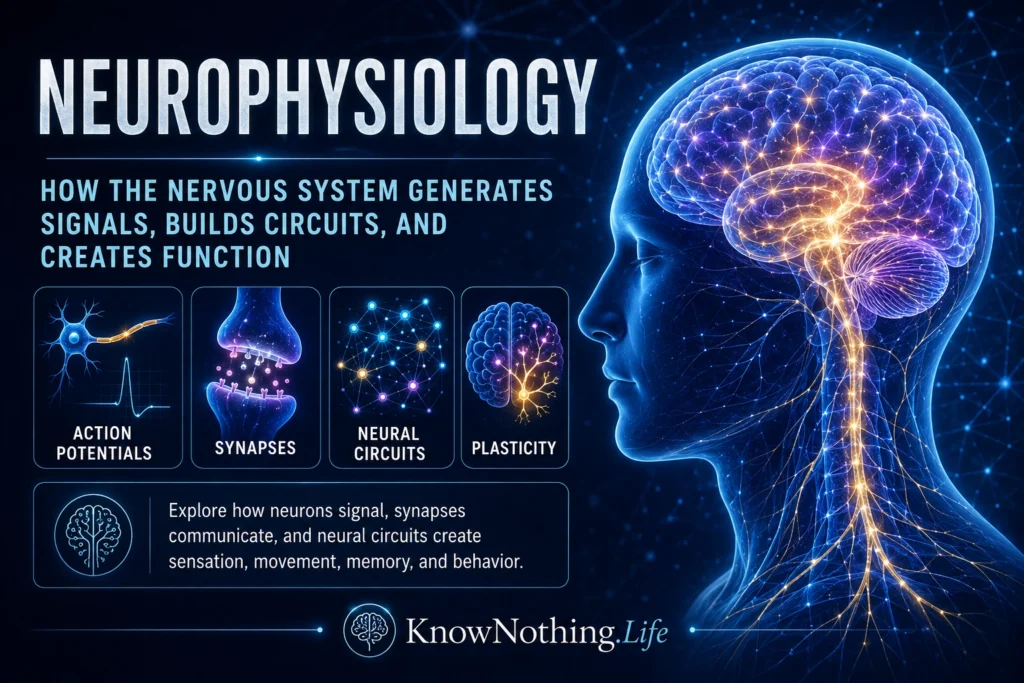
Neurophysiology is the study of how the nervous system works. While neuroanatomy asks where structures are and what they look like, neurophysiology asks how neurons, synapses, circuits, and networks produce activity. It examines electrical signals, chemical communication, reflexes, sensory processing, movement, sleep, attention, learning, memory, and brain-body regulation. In the simplest sense, neurophysiology is the science of nervous-system function: how cells communicate, how signals travel, how circuits coordinate behavior, and how the brain turns biological activity into perception, action, and experience.
The field sits at the intersection of biology, medicine, psychology, physics, chemistry, and computation. A neurophysiologist may study ion channels in a single neuron, electrical rhythms across the scalp, spinal reflexes, pain pathways, motor control, sleep stages, or the firing patterns of neurons during memory. This range is part of what makes the subject so important. Human thought and behavior depend on cells that can generate electrical impulses, release neurotransmitters, change with experience, and organize themselves into networks. Neurophysiology explains how the nervous system is not merely a structure, but an active, living system.
Neurons and Electrical Excitability
The central unit of neurophysiology is the neuron, a specialized cell capable of receiving, integrating, and transmitting information. Neurons are electrically excitable, meaning they can respond to input by changing their membrane voltage and generating impulses. A neuron’s resting membrane potential exists because ions such as sodium, potassium, chloride, and calcium are unevenly distributed across the cell membrane. Ion channels and pumps maintain these gradients, creating the conditions for electrical signaling. StatPearls describes action potentials as electrical impulses generated by changes in sodium and potassium gradients across the neuronal membrane.
The action potential is one of the most important events in biology. When a neuron reaches threshold, voltage-gated sodium channels open, sodium enters the cell, and the membrane depolarizes. Potassium channels then help repolarize and restore the membrane toward its resting state. This rapid electrical event travels along the axon toward synaptic terminals, where it can influence other cells. A separate StatPearls overview describes the neuronal action potential through depolarization, repolarization, and hyperpolarization. This means the nervous system uses controlled instability: neurons remain quiet until the right input arrives, then they fire in a precise all-or-none signal.
Hodgkin, Huxley, and the Action Potential
The modern understanding of action potentials owes much to Alan Hodgkin and Andrew Huxley, whose experiments on the squid giant axon became one of the great achievements of twentieth-century physiology. Their 1952 work showed how voltage-dependent sodium and potassium currents could explain the shape and propagation of the action potential. Later reviews describe their model as foundational for modern ion-channel physiology and computational neuroscience.
The importance of the Hodgkin-Huxley model is not only historical. It showed that nervous-system function could be described mathematically without reducing the living neuron to a vague metaphor. The neuron was not simply “charged” or “activated” in a loose sense; its behavior could be explained through measurable conductances, voltage changes, ion movement, and membrane dynamics. This changed how scientists thought about the brain. Mental life may be complex, but at its foundation are physical processes that can be measured, modeled, and tested.
Synapses and Chemical Communication
Neurons do not work alone. They communicate at synapses, specialized junctions where one neuron influences another. When an action potential reaches a presynaptic terminal, voltage-gated calcium channels open, calcium enters, and synaptic vesicles release neurotransmitters into the synaptic cleft. Those neurotransmitters bind to receptors on the postsynaptic cell, increasing or decreasing the likelihood that it will fire. Neurotransmission can be excitatory, inhibitory, or modulatory depending on the neurotransmitter, receptor, and circuit involved.
Bernard Katz’s work on synaptic transmission helped establish the concept of quantal neurotransmitter release. Research by Paul Fatt and Katz showed that small spontaneous events at the neuromuscular junction reflected packets of acetylcholine released from presynaptic terminals. The Nobel Prize summary of Katz’s work notes that he showed acetylcholine is released in defined amounts and that calcium helps trigger this quantal release. This discovery helped reveal the synapse as a precise biological communication system, not a vague gap between cells.
Excitation, Inhibition, and Circuit Balance
Neurophysiology depends on balance. Excitatory signals make neurons more likely to fire, while inhibitory signals make them less likely to fire. Glutamate is the main excitatory neurotransmitter in the brain, while GABA is the main inhibitory neurotransmitter. Without excitation, circuits would not activate. Without inhibition, neural activity could become chaotic, excessive, or seizure-like. The brain’s stability depends on the careful coordination of these opposing forces.
John Eccles was one of the major figures in understanding central synaptic transmission, excitation, and inhibition. Historical reviews describe Eccles and his collaborators as central to establishing mechanisms of chemical synaptic transmission in the central nervous system. This work matters because the nervous system is not merely a chain of signals moving forward. It is a regulated field of competing influences. Every perception, movement, thought, and emotional response depends on circuits that amplify some signals, suppress others, and maintain enough stability for coherent function.
Myelin, Speed, and Neural Timing
Neural signaling depends not only on whether a signal occurs, but also on how fast and accurately it travels. Myelin is the fatty insulating sheath that surrounds many axons. In the central nervous system, myelin is produced by oligodendrocytes; in the peripheral nervous system, it is produced by Schwann cells. Myelin allows action potentials to travel rapidly through saltatory conduction, in which the electrical signal effectively jumps from one node of Ranvier to the next. A neuroscience text in NCBI Bookshelf explains that myelin greatly speeds conduction and that active excitation jumps from node to node.
Timing is essential to nervous-system function. Speech, walking, music, reflexes, eye movements, and thought all depend on signals arriving in coordinated patterns. White-matter pathways allow distant brain regions to communicate with enough speed and precision to support integrated behavior. When myelin is damaged, as in multiple sclerosis or other demyelinating disorders, signaling may slow, weaken, or fail. This shows that neurophysiology is not only about neurons firing. It is also about insulation, timing, conduction velocity, and the physical conditions that allow circuits to synchronize.
Reflexes, Sensation, and Movement
Neurophysiology explains how the body reacts to the world. Sensory receptors convert physical stimuli into neural signals, a process called transduction. Light becomes retinal activity, sound becomes activity in auditory pathways, pressure becomes touch signals, and tissue damage becomes pain signaling. These signals travel through peripheral nerves, spinal pathways, brainstem relays, thalamic nuclei, and cortical regions. By the time sensation reaches conscious awareness, it has already been filtered, transformed, and organized.
Movement also depends on physiological coordination. The motor cortex, basal ganglia, cerebellum, brainstem, spinal cord, and muscles work through loops of command, feedback, prediction, and correction. A spinal reflex can withdraw the hand from danger before conscious thought catches up. A voluntary action, such as writing a sentence, requires planning, motor-unit recruitment, sensory feedback, and ongoing correction. Neurophysiology therefore bridges the microscopic and the practical: ion channels and synapses ultimately matter because they allow bodies to sense, move, adapt, and survive.
Plasticity, Learning, and Memory
One of the most important principles in neurophysiology is plasticity, the nervous system’s ability to change with experience. Synapses can strengthen or weaken, circuits can reorganize, and patterns of activity can become more efficient through learning. Donald Hebb’s 1949 work The Organization of Behavior famously argued that repeated coordinated activity between neurons can strengthen their connection, an idea now often summarized as “neurons that fire together wire together.”
A major physiological model of learning is long-term potentiation, or LTP. In 1973, Tim Bliss and Terje Lømo reported long-lasting increases in synaptic transmission in the hippocampus after brief trains of stimulation, suggesting that synaptic efficiency can be persistently strengthened. Eric Kandel’s work on Aplysia later helped connect learning and memory with changes in synaptic strength and molecular signaling, showing how experience can alter communication between neurons. Neurophysiology therefore explains memory not as a mysterious imprint, but as a change in the working properties of circuits.
Clinical Neurophysiology
Clinical neurophysiology applies these principles to diagnosis and medicine. Electroencephalography, or EEG, records electrical activity from the brain and is widely used in evaluating epilepsy, sleep disorders, coma, encephalopathy, and abnormal brain rhythms. Electromyography and nerve conduction studies assess muscles and peripheral nerves. Evoked potentials measure how sensory pathways respond to stimulation. These tools allow clinicians to study function, not just structure.
This distinction matters because a scan may show anatomy while physiology reveals activity. A seizure disorder is not only a structural problem; it is abnormal synchronized electrical activity. A nerve injury is not only a damaged cable; it is impaired conduction. A sleep disorder is not only fatigue; it may involve altered rhythms of brain activity. Clinical neurophysiology helps connect symptoms to measurable nervous-system behavior, making it one of the most practical branches of neuroscience.
Why Neurophysiology Matters
Neurophysiology matters because it explains how the nervous system comes alive. Anatomy gives the brain its structure, but physiology gives it movement, rhythm, communication, and change. Action potentials carry signals. Synapses transmit and modify information. Myelin speeds communication. Inhibition and excitation balance circuits. Plasticity allows learning. Rhythms organize sleep, attention, and consciousness. These processes are the living operations beneath every sensation, movement, memory, emotion, and thought.
The deeper lesson of neurophysiology is that the mind is not separate from biological activity. It emerges from cells that signal, circuits that coordinate, and networks that adapt. A person’s ability to see, speak, remember, feel, decide, and act depends on the continuous physiological work of the nervous system. To understand neurophysiology is to understand the brain not as a static organ, but as an active electrical-chemical system constantly communicating with itself, the body, and the world.