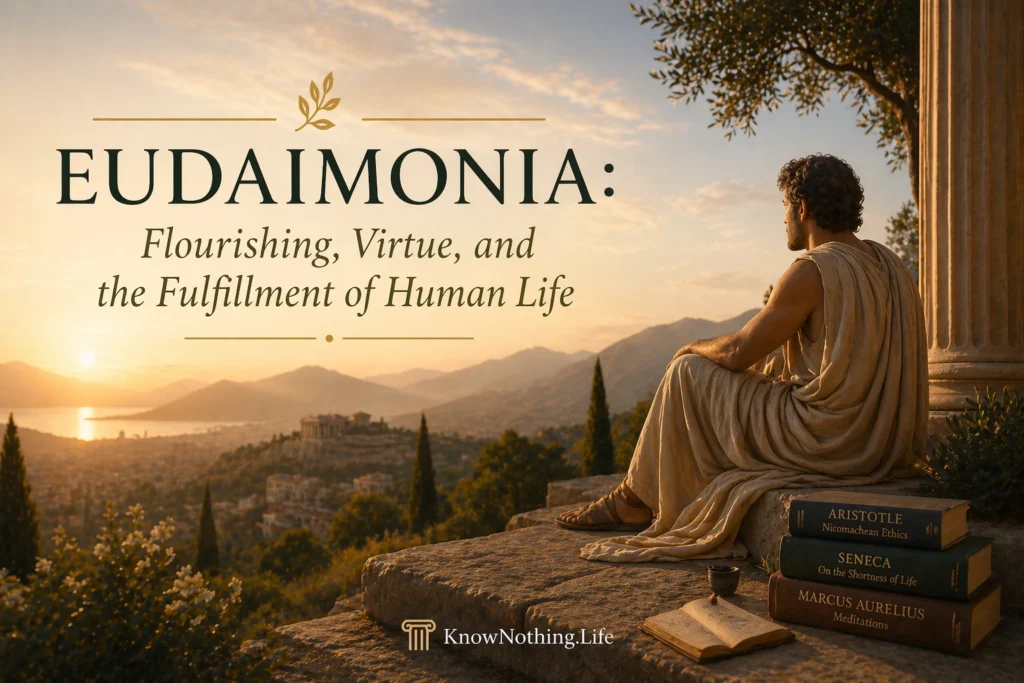
Eudaimonia is one of the most central and enduring concepts in philosophy, often translated as “happiness,” though its meaning extends far beyond simple pleasure or emotional satisfaction. Rooted in ancient Greek thought, eudaimonia refers to a state of flourishing—a life lived in accordance with virtue, purpose, and reason. It captures the idea that the good life is not defined by momentary feelings but by the overall quality and direction of one’s existence.
The concept raises profound questions about what it means to live well. Is flourishing determined by external success, internal character, or some combination of both? Can a life be considered good even in the presence of hardship? By examining eudaimonia, philosophy seeks to understand not only what individuals desire but what they ought to pursue. It shifts the focus from short-term satisfaction to long-term fulfillment, offering a framework for thinking about the ultimate aims of human life.
Ancient Origins of Eudaimonia
The concept of eudaimonia emerges most prominently in the work of Aristotle, who developed one of the most influential accounts of the good life. For Aristotle, eudaimonia is the highest human good, the ultimate end toward which all actions aim. It is not a transient state but a sustained activity of living in accordance with reason and virtue. Unlike pleasure, which can be fleeting, eudaimonia reflects the overall success of a life.
Aristotle’s account builds on earlier philosophical traditions while offering a distinctive synthesis. He argued that every being has a function, and the good for that being consists in fulfilling its function well. For humans, this function involves rational activity, as reason distinguishes humans from other forms of life. Eudaimonia, therefore, is achieved through the cultivation and exercise of rational capacities, guided by virtue.
This ancient framework emphasizes the importance of character and development. Eudaimonia is not something that can be achieved instantly or passively; it requires effort, practice, and reflection. By living virtuously and engaging in meaningful activities, individuals can achieve a state of flourishing that reflects their full potential.
Virtue and the Structure of Flourishing
Virtue plays a central role in the concept of eudaimonia. According to Aristotle, virtues are qualities that enable individuals to act and feel in the right way, balancing extremes of excess and deficiency. Courage, for example, lies between recklessness and cowardice, while generosity lies between extravagance and stinginess. These virtues are not innate but developed through habit and practice.
The cultivation of virtue is essential for achieving eudaimonia because it shapes how individuals respond to the world. A virtuous person does not merely perform good actions but does so with the right intentions and emotions. This alignment between action, thought, and feeling creates a harmonious and integrated life, reflecting the deeper meaning of flourishing.
At the same time, virtue is not limited to moral qualities. Intellectual virtues, such as wisdom and understanding, are equally important in guiding rational activity. Together, moral and intellectual virtues form the foundation of a flourishing life, enabling individuals to navigate complex situations with clarity and integrity. This comprehensive view highlights the multifaceted nature of eudaimonia, encompassing both character and cognition.
Eudaimonia and External Conditions
While Aristotle emphasized the importance of virtue, he also recognized that external conditions play a role in achieving eudaimonia. Factors such as health, wealth, and social relationships can influence an individual’s ability to live well. A life marked by extreme misfortune may hinder flourishing, even if the individual possesses strong character.
This acknowledgment introduces a tension within the concept of eudaimonia. On one hand, it suggests that well-being depends on factors beyond individual control, raising questions about fairness and accessibility. On the other hand, it maintains that virtue remains central, providing a degree of stability and resilience in the face of adversity.
Philosophers have debated how to reconcile these aspects, with some emphasizing the independence of eudaimonia from external conditions and others highlighting their importance. This debate reflects a broader question about the nature of the good life: whether it is primarily determined by internal qualities or by the circumstances in which one lives.
Eudaimonia Beyond Aristotle
Although Aristotle’s account of eudaimonia is foundational, other philosophical traditions have offered alternative interpretations. Stoic philosophers, such as Epictetus, emphasized the importance of inner freedom and rational control, arguing that true flourishing depends on one’s ability to align with reason and accept what cannot be changed. For the Stoics, eudaimonia is largely independent of external conditions, focusing instead on the cultivation of inner virtue.
In contrast, Epicurus associated flourishing with pleasure, particularly the absence of pain and disturbance. While this view differs from Aristotle’s emphasis on virtue, it shares a concern with achieving a stable and enduring form of well-being. Epicurus’ approach highlights the diversity of interpretations within ancient philosophy, each offering a different path to the good life.
These variations demonstrate that eudaimonia is not a fixed concept but an evolving idea, shaped by different philosophical perspectives. Each interpretation reflects a particular understanding of human nature and the conditions necessary for flourishing.
Eudaimonia and Modern Thought
In contemporary philosophy, the concept of eudaimonia continues to influence discussions of well-being and ethics. Modern thinkers often contrast eudaimonic approaches with hedonic theories, which focus on pleasure and satisfaction. Eudaimonic theories emphasize meaning, purpose, and personal development, aligning closely with Aristotle’s original framework.
Psychological research has also incorporated the concept of eudaimonia, exploring factors that contribute to a fulfilling life. Studies suggest that well-being involves more than positive emotions, including elements such as autonomy, competence, and meaningful relationships. These findings support the idea that flourishing is a multidimensional phenomenon, reflecting both internal and external aspects of life.
At the same time, modern society presents new challenges for achieving eudaimonia. The emphasis on material success and immediate gratification can conflict with the pursuit of long-term fulfillment. This tension highlights the continued relevance of philosophical reflection, providing guidance for navigating the complexities of contemporary life.
Eudaimonia, Meaning, and Purpose
A key aspect of eudaimonia is its connection to meaning and purpose. Flourishing involves not only living well but understanding why one’s life matters. This sense of purpose provides direction and coherence, allowing individuals to integrate their actions into a broader narrative.
Philosophers such as Friedrich Nietzsche emphasized the importance of creating meaning, particularly in the face of challenges and uncertainty. While Nietzsche’s perspective differs from Aristotle’s, it shares a focus on active engagement with life. Eudaimonia, in this sense, is not a passive state but an ongoing process of striving and self-realization.
This emphasis on purpose highlights the dynamic nature of flourishing. It suggests that eudaimonia is not a fixed endpoint but a continuous journey, shaped by choices, actions, and experiences. By engaging with life in a meaningful way, individuals can achieve a deeper sense of fulfillment that goes beyond momentary satisfaction.
Conclusion
Eudaimonia offers a rich and comprehensive account of the good life, emphasizing flourishing, virtue, and the fulfillment of human potential. From its origins in ancient philosophy to its influence on modern thought, the concept has provided a framework for understanding what it means to live well. It challenges simplistic notions of happiness, encouraging a deeper exploration of meaning, purpose, and character.
The study of eudaimonia reveals that well-being is not merely a matter of feeling good but of living in accordance with one’s values and capacities. It involves a balance between internal qualities and external conditions, reflecting the complexity of human life. By cultivating virtue, engaging in meaningful activities, and navigating challenges with resilience, individuals can achieve a state of flourishing that defines the good life.
Ultimately, eudaimonia invites reflection on the ultimate aims of existence. It encourages individuals to consider not only what they desire but what they ought to pursue, offering a vision of life that is both fulfilling and meaningful. In doing so, it remains one of the most profound and enduring contributions of philosophy.