Kabbalah is the central mystical tradition of Judaism, a body of teachings concerned with God, creation, the soul, scripture, divine language, spiritual repair, and the hidden structure beneath visible reality. The Hebrew word kabbalah means “receiving” or “tradition,” suggesting wisdom handed down through interpretation, discipline, and inner transmission. Although Kabbalah is often presented in popular culture as a universal system of secret symbols, its historical roots are deeply Jewish. It developed through Hebrew scripture, rabbinic interpretation, medieval mysticism, symbolic readings of Torah, and intense speculation about the relationship between the infinite God and the finite world.
At its heart, Kabbalah asks how the unknowable divine becomes manifest in creation. If God is infinite, beyond form, beyond description, and beyond human comprehension, how can a finite world exist at all? How can human beings speak of divine attributes, moral action, prayer, evil, suffering, exile, redemption, and the soul’s journey? Kabbalah answers through symbolic metaphysics. It teaches that reality is structured through hidden emanations, sacred language, cosmic balance, and spiritual interdependence. Human actions are not merely private moral choices; they participate in the repair or distortion of the world.
Origins of Jewish Mysticism
Kabbalah did not appear from nowhere. It grew from earlier streams of Jewish mysticism, including merkavah mysticism, which focused on visionary ascent to the divine throne-chariot described in the book of Ezekiel. Early Jewish mystical texts explored angels, heavenly palaces, divine names, and the dangers of approaching sacred realities without preparation. Another important early work is the Sefer Yetzirah, or Book of Creation, a short and mysterious text that links creation to Hebrew letters, numbers, and cosmic structure. It presents language not merely as communication but as a creative force woven into the architecture of reality.
These early sources helped prepare the ground for later Kabbalah. Judaism had always treated words as sacred. In Genesis, God creates through speech: “Let there be light.” The Torah itself is not only a record of law and story but a divine text whose letters, patterns, and hidden meanings can be endlessly interpreted. Kabbalah radicalized this idea. It suggested that Hebrew letters, divine names, and scriptural symbols reveal the inner life of creation. To study Torah mystically is not only to read about God, but to participate in the unfolding of divine wisdom.
The Zohar and Medieval Kabbalah
The most important Kabbalistic text is the Zohar, or Book of Splendor. It emerged in medieval Spain in the late thirteenth century and is traditionally associated with the second-century sage Rabbi Shimon bar Yochai. Modern scholarship generally connects its composition or redaction to Moses de León and his circle, though believers often preserve the traditional attribution. The Zohar is written largely in Aramaic and presents mystical commentary on the Torah through symbolic stories, dialogues, and interpretations.
The Zohar transformed Jewish spirituality by presenting scripture as a vast symbolic map of divine life. Biblical figures, commandments, letters, and narratives become signs of deeper realities. The text describes God’s hiddenness, the sefirot, the divine feminine presence known as the Shekhinah, the drama of exile and union, and the soul’s relationship to cosmic repair. Unlike ordinary philosophy, the Zohar does not explain through abstract argument alone. It reveals through image, metaphor, paradox, and sacred imagination. It teaches that every word of Torah contains layers of meaning, and that the visible world is only the outer garment of divine mystery.
Ein Sof: The Infinite Beyond Thought
One of Kabbalah’s central ideas is Ein Sof, meaning “without end.” Ein Sof refers to God as infinite, unknowable, boundless, and beyond all attributes. Human beings cannot grasp Ein Sof directly because every concept imposes limitation. To say God is wise, merciful, powerful, or beautiful is already to speak of God in relation to creation. Ein Sof is deeper than all names and descriptions.
This creates a theological problem: if God is absolutely infinite, how can anything finite exist? Kabbalah answers through emanation. Creation is not simply a mechanical act performed by a distant deity. It is the unfolding of divine energy through structured channels. These channels are called the sefirot. They do not divide God into parts, but symbolize ways divine life becomes manifest and relational. Through them, the hidden infinite becomes present in the world without ceasing to be infinite.
The Sefirot and the Tree of Life
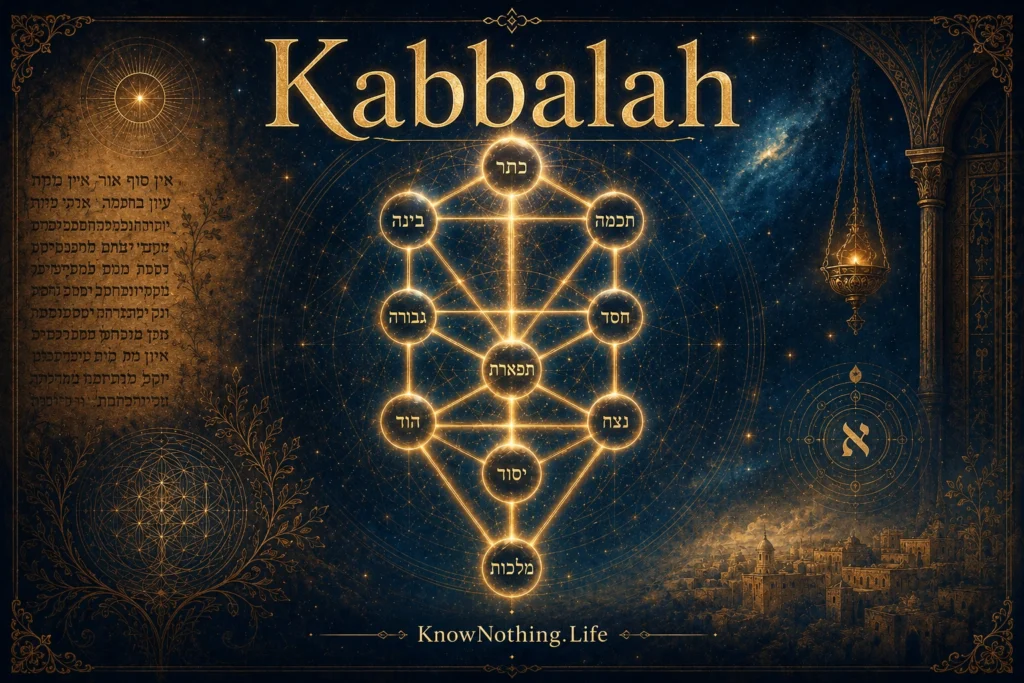
The ten sefirot are among the most famous concepts in Kabbalah. They are often represented as the Tree of Life, a symbolic diagram showing divine emanations and their relationships. The sefirot are usually named Keter, Chokhmah, Binah, Chesed, Gevurah, Tiferet, Netzach, Hod, Yesod, and Malkhut. They represent crown, wisdom, understanding, lovingkindness, judgment, beauty, endurance, splendor, foundation, and kingdom. These are not merely abstract virtues. They are dynamic dimensions of divine manifestation.
The Tree of Life expresses balance. Chesed, expansive love, must be balanced by Gevurah, boundary and judgment. Tiferet harmonizes mercy and severity through beauty and compassion. Malkhut represents the divine presence as it enters the world, closely associated with the Shekhinah. The sefirot also offer a map of the soul. Human beings reflect the divine pattern in miniature. Ethical and spiritual life therefore involves aligning one’s inner qualities with the harmony of the sefirot. To become more compassionate, disciplined, truthful, and balanced is not merely psychological growth; it is participation in cosmic order.
Shekhinah, Exile, and Divine Presence
The Shekhinah is the indwelling presence of God, often associated in Kabbalah with the feminine aspect of divinity and with the sefirah Malkhut. In rabbinic tradition, the Shekhinah accompanies Israel in exile. Kabbalah expands this into a cosmic drama. Divine presence is understood as somehow exiled, hidden, or fragmented within creation. Human sin, disorder, and spiritual ignorance deepen separation; prayer, mitzvot, study, and righteous action help restore union.
This gives Kabbalah a powerful spiritual psychology. Exile is not only political or historical. It is also metaphysical and personal. Human beings experience separation from God, from one another, from their own souls, and from the hidden unity of reality. The spiritual task is to reunite what has been divided. This is why Kabbalistic practice emphasizes intention, called kavanah. A commandment performed mechanically is not the same as one performed with sacred awareness. Intention directs action toward repair.
Isaac Luria and Tikkun Olam
In the sixteenth century, Kabbalah underwent a major transformation in the city of Safed through the teachings of Rabbi Isaac Luria, known as the Ari. Lurianic Kabbalah introduced a dramatic myth of creation, catastrophe, and repair. One of its central ideas is tzimtzum, often described as divine contraction or withdrawal. In order for creation to exist, the infinite divine presence makes space for finitude. Into that space, divine light flows through vessels. But the vessels cannot contain the intensity of the light and shatter, scattering sparks of holiness throughout creation.
The human task is tikkun, repair. Through ethical life, prayer, mitzvot, study, and spiritual intention, human beings help raise the scattered sparks and restore divine harmony. This myth profoundly shaped later Jewish thought, especially Hasidism and modern Jewish ethics. The phrase tikkun olam, repairing the world, has older rabbinic roots, but in Kabbalistic and later usage it gained a powerful mystical meaning. The world is broken, but not abandoned. Human action matters because it participates in restoration.
Hasidism and the Inner Life
Kabbalah became more emotionally accessible through Hasidism, the Jewish spiritual movement founded in the eighteenth century by Rabbi Israel ben Eliezer, known as the Baal Shem Tov. Hasidism drew heavily from Kabbalistic ideas but translated them into devotional life, joy, prayer, storytelling, song, and the sanctification of everyday experience. Instead of reserving mystical awareness only for scholars and ascetics, Hasidism taught that ordinary Jews could encounter divine presence through sincerity, humility, and joy.
Hasidic masters such as Dov Ber of Mezeritch, Schneur Zalman of Liadi, Nachman of Breslov, and many others developed rich psychological interpretations of Kabbalistic themes. Divine sparks could be found in daily tasks. Prayer could elevate the soul. Struggle itself could become a path. The hiddenness of God was not only a cosmic condition but an emotional reality people live through. Hasidism made Kabbalah practical, intimate, and existential.
Christian Kabbalah and Western Esotericism
During the Renaissance, some Christian scholars became fascinated with Jewish Kabbalah and adapted it into Christian theology and occult philosophy. Giovanni Pico della Mirandola argued that Kabbalah could confirm Christian truths, while Johannes Reuchlin wrote works such as De Arte Cabalistica. This Christian Kabbalah was not the same as Jewish Kabbalah. It often reinterpreted Jewish symbols through Christian doctrines and detached them from Jewish law and communal practice.
Later Western esoteric traditions also absorbed Kabbalistic imagery. Hermeticism, ceremonial magic, Rosicrucianism, Freemasonry, the Hermetic Order of the Golden Dawn, and modern occult systems all used versions of the Tree of Life, Hebrew letters, divine names, and sefirotic symbolism. This influence made Kabbalah central to Western occultism, but it also created confusion. Many popular “Kabbalah” systems are not traditional Jewish Kabbalah but hybrid esoteric adaptations.
Common Misunderstandings
Kabbalah is often misunderstood as magic, numerology, celebrity spirituality, or a shortcut to mystical power. Traditional Jewish Kabbalah is far more demanding. It is rooted in Torah, commandments, Hebrew language, rabbinic tradition, prayer, ethical discipline, and years of study. Historically, many teachers warned that mystical study required maturity because symbolic theology can easily be misused, misunderstood, or detached from moral responsibility.
Another misunderstanding is that Kabbalah is separate from Judaism. While Kabbalistic ideas have influenced non-Jewish esoteric systems, Jewish Kabbalah is not merely a universal self-help method. It is a mystical interpretation of Jewish revelation and practice. Its symbols can speak broadly to the human search for meaning, but their original context matters. To remove Kabbalah from Judaism entirely is to misunderstand its language, purpose, and depth.
Final Thoughts
Kabbalah is one of the great mystical traditions of the world. Through the Sefer Yetzirah, the Zohar, Moses de León, Isaac Luria, the Baal Shem Tov, Hasidic masters, and later interpreters such as Gershom Scholem and Moshe Idel, it has shaped Jewish spirituality and global esoteric thought. Its central ideas—Ein Sof, the sefirot, the Shekhinah, divine sparks, tzimtzum, tikkun, sacred language, and cosmic repair—offer a vision of reality as deeply interconnected and spiritually meaningful.
Its power lies in the way it joins metaphysics with ethics. Kabbalah does not ask only what God is or how creation began. It asks how human beings participate in the healing of a broken world. Every action, word, intention, and relationship can either conceal or reveal holiness. In that sense, Kabbalah is not merely a theory of hidden reality. It is a discipline of perception. It teaches that the world is full of sparks, that the visible is woven with the invisible, and that the deepest wisdom is received not only by knowing more, but by becoming more awake to the sacred structure of life.