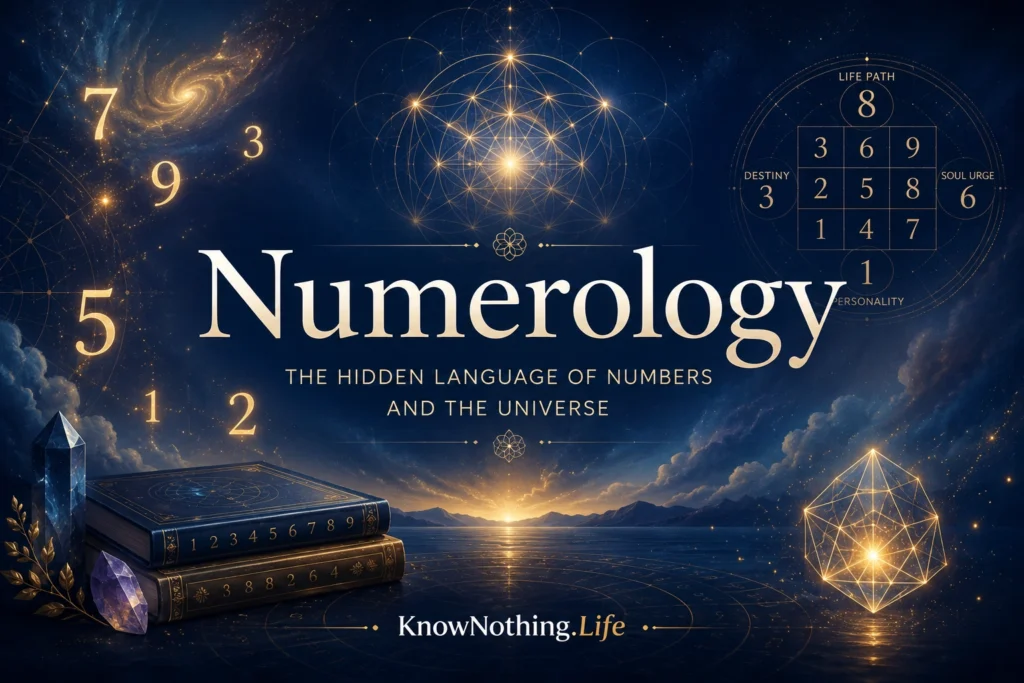
Numerology is the belief that numbers carry symbolic, spiritual, psychological, or cosmic meaning beyond their ordinary use in counting and measurement. To the modern scientific mind, numbers are tools of calculation: they measure distance, time, weight, money, probability, speed, and structure. But throughout history, numbers have also been treated as signs of hidden order. They have been used to interpret character, fate, divine messages, sacred texts, names, dates, cycles, and the architecture of the universe. Numerology begins with a simple intuition: numbers are not only quantities; they may also be qualities.
This idea is ancient and widespread. Human beings noticed very early that numbers seem to organize reality. Days and seasons repeat. The moon follows cycles. Music depends on ratios. Geometry produces harmony. The human body has proportion. Sacred rituals often use repeated numbers. Myths and scriptures give special importance to numbers such as three, seven, twelve, and forty. Numerology grows from the feeling that number reveals pattern, and that pattern may point toward meaning. Whether understood as mystical wisdom, symbolic psychology, religious interpretation, or superstition, numerology belongs to humanity’s long attempt to read the world as an ordered text.
Pythagoras and the Sacred Power of Number
The figure most often associated with numerology is Pythagoras, the Greek philosopher and religious teacher of the sixth century BCE. Pythagoras and his followers believed that number was fundamental to the structure of reality. They were fascinated by mathematics, music, proportion, geometry, and cosmic harmony. The discovery that musical intervals could be expressed through numerical ratios deeply shaped the Pythagorean imagination. If sound, beauty, and harmony could be explained through number, perhaps the entire cosmos was numerical in its deepest structure.
Pythagoreanism was not mathematics in the narrow modern sense. It was a way of life, a spiritual discipline, and a metaphysical vision. Numbers were associated with principles. One could symbolize unity; two, polarity; three, harmony; four, stability; ten, completion. The famous tetractys, a triangular arrangement of ten points, became a sacred symbol of cosmic order. Later writers such as Iamblichus and Proclus helped preserve and elaborate Pythagorean number symbolism, blending philosophy, mathematics, music, and mysticism into a tradition that strongly influenced Western esoteric thought.
Numerology and Sacred Texts
Numerology also appears in religious interpretation. In Jewish tradition, gematria assigns numerical values to Hebrew letters and uses those values to interpret words, phrases, and scriptural relationships. Since Hebrew letters also function as numbers, words can be read numerically as well as linguistically. A word may share a number with another word, inviting symbolic connection. This technique became especially important in Kabbalah, where language is not merely human communication but a sacred structure through which creation itself is understood.
Christian interpreters also developed symbolic readings of numbers. Three could represent the Trinity. Seven could represent completion or divine order. Twelve could refer to the tribes of Israel or the apostles. Forty often appears in contexts of trial, testing, or transformation. In Islamic, Hindu, Buddhist, Chinese, and other traditions, numbers also carry spiritual significance. Numerology in these contexts is not always separate from theology. It becomes part of a larger symbolic universe in which scripture, ritual, time, architecture, and cosmology are connected through number.
The Meaning of Numbers
Modern numerology often assigns symbolic meanings to single-digit numbers. One is commonly associated with individuality, leadership, beginnings, and assertion. Two represents relationship, duality, cooperation, and sensitivity. Three is linked to creativity, expression, communication, and growth. Four suggests structure, order, work, foundation, and stability. Five is associated with change, freedom, movement, and instability. Six often represents responsibility, harmony, home, and care. Seven is linked to introspection, mystery, spirituality, and analysis. Eight suggests power, ambition, material success, and authority. Nine represents completion, compassion, wisdom, and endings.
These meanings are not scientific facts. They are symbolic associations built from tradition, analogy, and interpretation. Their power lies in how they function psychologically. A number becomes a mirror. When someone reads a numerological profile, they may see patterns in their personality, life choices, strengths, fears, and desires. Whether the number caused those patterns is a separate question. Symbolic systems often work less like laboratory explanations and more like interpretive languages. They help people organize self-reflection.
Names, Birth Dates, and Life Path Numbers
The most familiar form of popular numerology uses a person’s birth date and name. A “life path number” is usually calculated by reducing the digits of a birth date into a single number, except in systems that preserve master numbers such as 11, 22, or 33. Names are often converted into numbers by assigning numerical values to letters, then reducing the total. These numbers are interpreted as indicators of personality, destiny, challenge, talent, or spiritual direction.
This style of numerology became especially popular in modern occult and New Thought circles. Writers such as Cheiro, who wrote Cheiro’s Book of Numbers, and later numerologists such as Juno Jordan helped shape twentieth-century numerology as a personal guidance system. In this form, numerology resembles astrology, tarot, or personality typology. It offers a symbolic map of the self. Its appeal lies partly in the desire to feel that life has pattern, that one’s name and birth carry meaning, and that personal experience belongs to a larger design.
Numerology, Astrology, and Occult Philosophy
Numerology is closely connected to occult philosophy because both seek hidden correspondences. Renaissance thinkers such as Heinrich Cornelius Agrippa treated numbers as part of a larger magical and symbolic structure. In Three Books of Occult Philosophy, Agrippa discussed the virtues and meanings of numbers in relation to celestial magic, Kabbalah, Orphic tradition, and cosmic order. Numbers were not isolated abstractions; they belonged to a web of planets, angels, elements, letters, proportions, and divine names.
Astrology also uses numerical symbolism, though in a different way. The twelve zodiac signs, seven traditional planets, houses, degrees, cycles, and aspects all depend on number. Tarot contains numbered cards whose meanings often draw on numerological ideas. Sacred architecture uses proportion and geometry to create symbolic space. Numerology therefore belongs to a much larger history of number mysticism, where mathematics, ritual, art, religion, and metaphysics overlap.
Why Numerology Appeals to People
Numerology appeals to people because human beings are pattern-seeking creatures. The mind naturally looks for order in experience. It connects dates, coincidences, repetitions, names, anniversaries, and cycles. When a number appears repeatedly, people often feel that it means something. This instinct can become superstition, but it can also become symbolic reflection. Numbers give people a language for asking questions about identity, timing, purpose, and change.
There is also comfort in the idea that life is not random. Birth dates, names, addresses, years, ages, and repeating numbers can feel like signs that one’s life belongs to a meaningful pattern. In uncertain times, numerology can provide structure. It turns chaos into interpretation. A person may consult numerology not because they believe numbers mechanically control fate, but because the system gives them a way to think about life direction, relationships, and inner conflict.
Numerology and the Problem of Evidence
From a scientific perspective, numerology has serious limitations. There is no strong empirical evidence that numbers derived from names or birth dates determine personality, destiny, or future events. Many numerological readings rely on broad descriptions that can apply to many people. Psychologists call this the Barnum effect or Forer effect: people often accept vague, flattering, or general statements as personally accurate. Confirmation bias also plays a role. People remember the “hits” and forget the “misses.”
This does not mean numerology is culturally meaningless. It means its claims should be understood carefully. Numerology is not a science in the modern empirical sense. It does not test predictions under controlled conditions or explain personality through biology, environment, development, or cognition. Its value, if it has value, is symbolic, historical, reflective, or spiritual rather than scientific. The danger comes when numerology is used to make major life decisions without reason, evidence, or responsibility.
Numerology as Symbolic Psychology
A balanced view sees numerology as a symbolic system rather than a literal machine of fate. Numbers can help people reflect on recurring themes. A person told they have a “four” pattern may think about order, discipline, and rigidity. A “five” reading may invite reflection on freedom, restlessness, and change. A “seven” may encourage examination of solitude, study, or spiritual searching. The number does not need to be objectively causal to function as a prompt for self-awareness.
In this sense, numerology resembles myth, dream interpretation, tarot, or archetypal psychology. Carl Jung argued that symbols can organize unconscious material and help people discover meaning. Numerology can work similarly when used thoughtfully. It becomes less about predicting fate and more about asking questions. What patterns do I repeat? What qualities do I identify with? What possibilities am I ignoring? What story am I telling about my life?
Final Thoughts
Numerology is the ancient and modern art of finding meaning in numbers. Its roots reach into Pythagorean philosophy, sacred geometry, religious symbolism, Kabbalah, gematria, astrology, Renaissance occultism, and modern spiritual self-interpretation. It has been used to read scripture, understand names, interpret birth dates, organize rituals, and imagine the universe as a structure of hidden harmony.
Its claims should be treated with discernment. Numerology is not established science, and numbers do not replace evidence, ethics, psychology, or practical judgment. But numerology remains important because it reveals something deep about human consciousness. People do not live by facts alone. They also live by symbols, patterns, stories, and the desire to feel that existence has order. Numerology is one expression of that desire. It turns number into meaning, and meaning into a mirror in which human beings search for themselves.