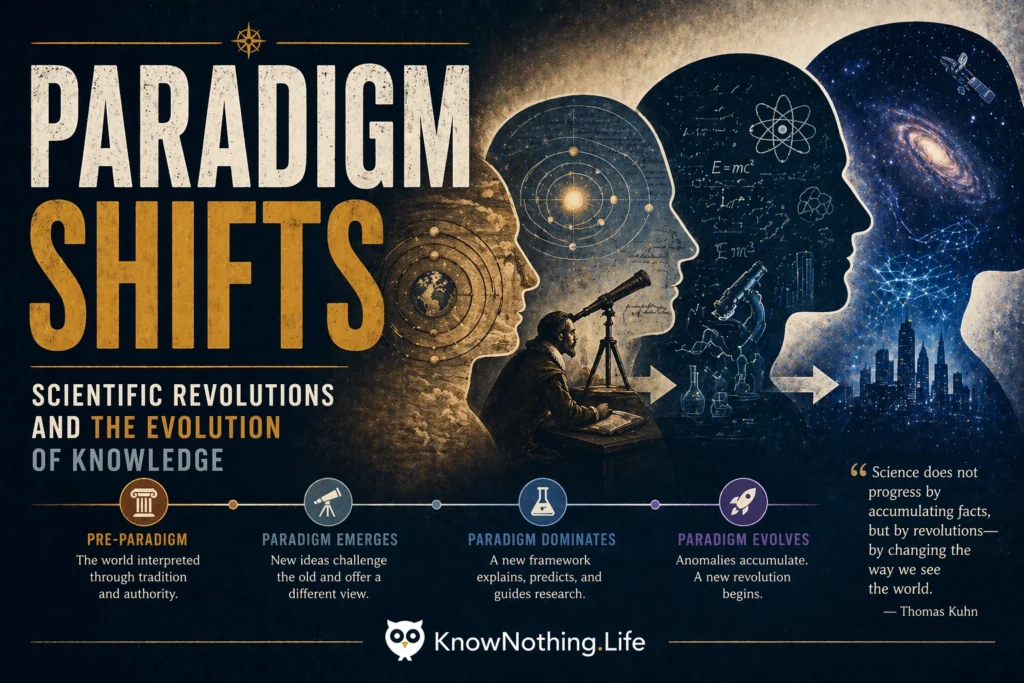
The concept of paradigm shifts represents one of the most influential ideas in the philosophy of science. It challenges the traditional view that science progresses through a steady accumulation of knowledge, instead proposing that major advances occur through radical transformations in how the world is understood. A paradigm shift is not merely the addition of new facts to an existing framework, but a fundamental reorganization of concepts, methods, and assumptions.
This idea was most famously developed by Thomas Kuhn in his groundbreaking work The Structure of Scientific Revolutions. Kuhn argued that scientific progress is episodic rather than continuous, marked by periods of stability interrupted by revolutionary change. His theory reshaped how philosophers and scientists think about the development of knowledge, emphasizing the role of historical context, community consensus, and conceptual frameworks.
What Is a Paradigm?
A paradigm, in Kuhn’s sense, is more than a theory. It is a comprehensive framework that includes not only scientific theories but also methods, standards, assumptions, and exemplars that guide research within a scientific community. A paradigm defines what counts as a legitimate problem, what methods are acceptable for solving it, and what constitutes a valid solution.
During periods of “normal science,” researchers work within an established paradigm, applying its principles to solve puzzles and extend its scope. This phase is characterized by stability and consensus, as scientists share a common set of assumptions and goals. Rather than questioning the paradigm itself, they focus on refining and elaborating it.
The strength of a paradigm lies in its ability to organize knowledge and guide inquiry. It provides a coherent framework that allows scientists to make sense of complex phenomena. However, this same coherence can also limit perspective, making it difficult to recognize alternative approaches or question foundational assumptions.
Anomalies and Crisis
Over time, anomalies—observations or problems that cannot be explained within the existing paradigm—begin to accumulate. Initially, these anomalies may be dismissed or treated as minor issues to be resolved through further research. However, as they persist and multiply, they can undermine confidence in the paradigm.
Kuhn described this stage as a period of crisis, where the limitations of the existing framework become increasingly apparent. Scientists may begin to explore alternative theories or question previously accepted assumptions. This process is often marked by uncertainty and debate, as the scientific community grapples with competing interpretations.
The transition from normal science to crisis highlights the dynamic nature of scientific inquiry. It shows that scientific frameworks are not immutable but are subject to revision in light of new evidence. This openness to change is a key feature of scientific progress, even if it is not always smooth or straightforward.
Scientific Revolutions
A paradigm shift occurs when a new framework replaces the old one, resolving the anomalies that led to the crisis. This process is not merely a matter of adding new information but involves a fundamental change in how phenomena are understood. Kuhn referred to these transformations as scientific revolutions, emphasizing their disruptive and transformative nature.
Historical examples illustrate the impact of paradigm shifts. The transition from the Ptolemaic geocentric model to the Copernican heliocentric model redefined our understanding of the cosmos. Similarly, the development of Newtonian mechanics and later Einstein’s theory of relativity transformed our conception of space, time, and motion. In each case, the new paradigm did not simply extend the old one but replaced it with a fundamentally different framework.
These revolutions often involve changes in terminology, methodology, and standards of evidence. What counts as a valid explanation or a meaningful question can shift dramatically, reflecting the deep conceptual changes that accompany a new paradigm.
Incommensurability
One of the most controversial aspects of Kuhn’s theory is the idea of incommensurability. According to this concept, competing paradigms may be so different in their assumptions and language that they cannot be directly compared using a common standard. Scientists working within different paradigms may effectively “see” the world differently, making communication and evaluation challenging.
Incommensurability suggests that paradigm shifts are not purely rational or objective processes. Instead, they involve changes in perspective that cannot be fully justified by evidence alone. This has led to debates about whether Kuhn’s view implies a form of relativism, where scientific truth is dependent on the prevailing paradigm.
Critics have argued that despite differences between paradigms, there are still shared criteria—such as empirical adequacy and predictive success—that allow for comparison. Nonetheless, the concept of incommensurability highlights the complexity of scientific change and the role of conceptual frameworks in shaping understanding.
The Role of the Scientific Community
Kuhn emphasized that paradigm shifts are not individual achievements but collective processes involving the scientific community. The acceptance of a new paradigm depends on the willingness of scientists to adopt it, which can be influenced by factors such as persuasion, generational change, and the perceived success of the new framework.
This social dimension challenges the view of science as a purely objective and rational enterprise. While evidence and logic play crucial roles, the adoption of a paradigm also involves human judgment, values, and institutional dynamics. Scientific communities must negotiate and agree on what counts as valid knowledge, reflecting the collaborative nature of inquiry.
The role of the community also explains why paradigm shifts can be contentious and slow. Established scientists may resist new ideas that challenge their work, while younger researchers may be more open to change. This interplay of perspectives contributes to the gradual acceptance of new paradigms.
Beyond Science: Broader Applications
Although Kuhn developed the concept of paradigm shifts in the context of science, it has been applied more broadly to other fields, including social sciences, humanities, and even everyday thinking. The idea of a paradigm shift has become a metaphor for fundamental change in perspective, used to describe transformations in technology, culture, and society.
In business and innovation, for example, paradigm shifts refer to disruptive changes that redefine industries and practices. In philosophy, the concept has been used to analyze shifts in intellectual traditions and conceptual frameworks. These applications demonstrate the versatility and enduring influence of Kuhn’s idea.
However, some critics argue that the term “paradigm shift” is often used too loosely, losing its original meaning. Kuhn’s concept was specific to the structure of scientific revolutions, and its broader use may oversimplify complex processes of change.
Critiques and Developments
Kuhn’s theory has been both influential and controversial, prompting extensive debate among philosophers of science. Critics such as Karl Popper argued that science should be characterized by continuous critical testing rather than periods of unchallenged normal science. Others have sought to reconcile Kuhn’s insights with more traditional views of scientific rationality.
Subsequent philosophers have refined and expanded Kuhn’s ideas, exploring the mechanisms of scientific change and the role of evidence, theory, and community. Some have emphasized the continuity between paradigms, suggesting that even revolutionary changes retain elements of earlier frameworks.
Despite these debates, the concept of paradigm shifts remains a powerful tool for understanding the evolution of knowledge. It highlights the importance of conceptual frameworks and the potential for transformative change in scientific inquiry.
Conclusion
Paradigm shifts represent a fundamental aspect of scientific progress, revealing that knowledge evolves through periods of stability and revolutionary change. Through the work of Thomas Kuhn, this concept has reshaped our understanding of science, emphasizing the role of frameworks, anomalies, and community dynamics.
By examining how paradigms emerge, persist, and transform, we gain insight into the nature of knowledge itself. Paradigm shifts remind us that even the most established ideas are subject to revision, and that progress often requires a willingness to rethink the foundations of our understanding.