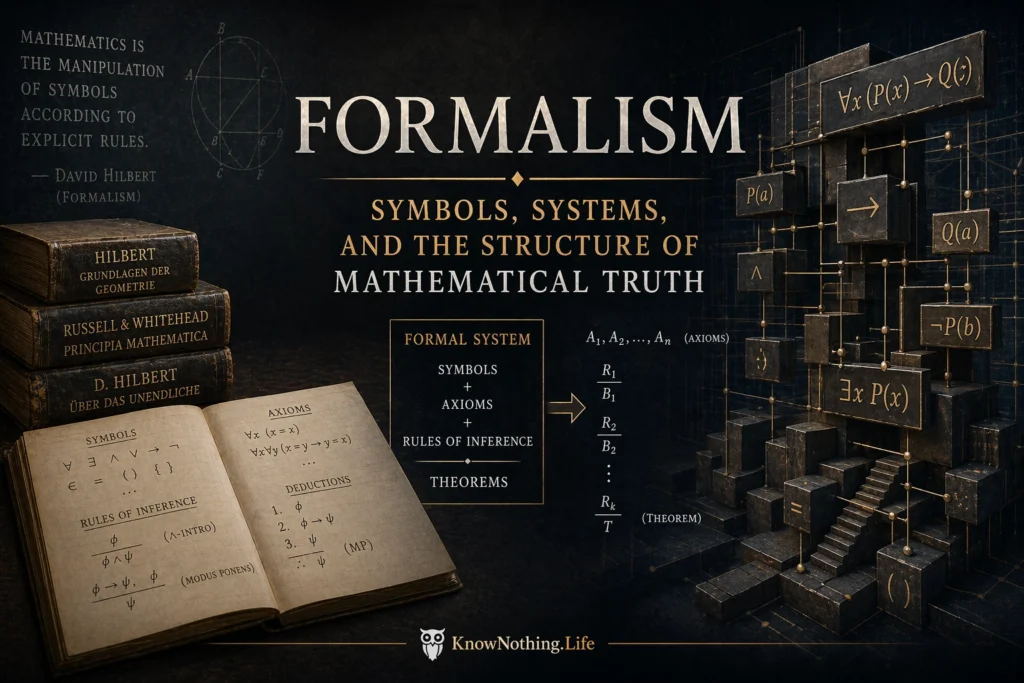
Formalism is one of the most influential approaches in the philosophy of mathematics, offering a distinctive answer to the question of what mathematics fundamentally is. Rather than viewing mathematics as a discovery of abstract objects or a reflection of an independent reality, formalism treats it as a system of symbols governed by rules. On this view, mathematics is not about numbers or entities in any metaphysical sense, but about the manipulation of signs according to well-defined procedures.
This perspective shifts attention away from ontology—the question of what exists—and toward structure and consistency. Formalism emphasizes that mathematical practice is grounded in the creation and transformation of symbolic systems. The meaning of mathematical statements is secondary to their role within these systems. By focusing on form rather than content, formalism offers a way to understand mathematics without committing to controversial metaphysical claims, while still preserving its rigor and precision.
Historical Foundations
Formalism is most closely associated with David Hilbert, who developed it as part of a broader effort to secure the foundations of mathematics in the early twentieth century. Hilbert’s program aimed to provide a complete and consistent set of axioms for all of mathematics, along with proofs demonstrating that these axioms would never lead to contradictions. His vision was to establish mathematics as a self-contained system, grounded in formal logic and free from uncertainty.
Hilbert’s approach was motivated in part by the crises that had emerged in set theory, where paradoxes threatened the stability of mathematical reasoning. By reducing mathematics to formal systems, Hilbert sought to avoid these issues and restore confidence in the discipline. His work inspired a generation of mathematicians and philosophers, shaping the development of modern logic and influencing the direction of foundational research. Formalism thus emerged not only as a philosophical position but also as a practical methodology for mathematical inquiry.
The Core Idea: Mathematics as Symbol Manipulation
At the heart of formalism is the idea that mathematics consists of symbols and rules for manipulating them. These symbols need not have any intrinsic meaning; what matters is how they are combined and transformed within a system. A mathematical statement is true if it can be derived from a set of axioms using the rules of the system. Truth, in this sense, is internal to the system rather than dependent on any external reality.
This approach allows formalism to avoid questions about the existence of mathematical objects. Numbers, sets, and functions are not treated as entities but as elements of a symbolic language. This perspective aligns closely with the practice of formal proof, where the validity of a result depends on the correctness of its derivation rather than on any interpretation of its content. By focusing on form, formalism provides a clear and precise framework for understanding mathematical reasoning.
Axioms, Systems, and Consistency
Formal systems are built from a set of axioms—basic statements taken as given—and rules of inference that determine how new statements can be derived. In formalism, the choice of axioms is not necessarily tied to any notion of truth about the world. Instead, axioms are selected for their usefulness, simplicity, or coherence within a system.
Consistency is the central criterion for evaluating a formal system. A system is consistent if it does not lead to contradictions, meaning that it cannot prove both a statement and its negation. For formalists, ensuring consistency is more important than establishing any connection between the system and an external reality. This focus reflects the view that mathematics is a self-contained activity, defined by its internal structure rather than by its correspondence to the world.
Formalism and Mathematical Truth
Formalism offers a distinctive account of mathematical truth. Instead of viewing truth as correspondence with an external reality, it treats truth as derivability within a system. A statement is true if it can be proven from the axioms using the rules of the system. This redefinition shifts the emphasis from meaning to method, highlighting the procedural nature of mathematical reasoning.
This perspective has both strengths and limitations. On one hand, it provides a clear and objective criterion for truth, grounded in formal proof. On the other hand, it raises questions about the significance of mathematical statements. If truth is purely a matter of derivation, what does mathematics tell us about the world? Formalism answers this by suggesting that mathematics is a tool for organizing and exploring structures, rather than a direct description of reality.
Gödel’s Challenge
The formalist program faced a major challenge with the work of Kurt Gödel, whose incompleteness theorems demonstrated fundamental limitations of formal systems. Gödel showed that any sufficiently powerful system cannot be both complete and consistent. There will always be true statements that cannot be proven within the system.
This result had profound implications for formalism. Hilbert’s goal of establishing a complete and consistent foundation for all of mathematics was shown to be unattainable. While formal systems remain essential tools for mathematical reasoning, Gödel’s work revealed that they cannot capture all mathematical truths. This limitation does not invalidate formalism but suggests that it cannot fully account for the richness of mathematics.
Formalism and Practice
Despite these challenges, formalism has had a lasting impact on mathematical practice. Modern mathematics relies heavily on formal systems, symbolic notation, and rigorous proof methods. The emphasis on clarity, precision, and logical structure reflects the influence of formalist ideas, even among those who do not fully embrace the philosophy.
Formalism also plays a crucial role in computer science, where algorithms and programming languages are defined in terms of formal rules. The ability to represent and manipulate information symbolically is central to computation, making formalist principles highly relevant in this context. In this way, formalism extends beyond philosophy, shaping practical approaches to problem-solving and technological development.
Critiques of Formalism
Critics of formalism argue that it fails to capture the intuitive and conceptual aspects of mathematics. Mathematicians often rely on insight, creativity, and informal reasoning, which cannot be fully reduced to symbol manipulation. From this perspective, formalism provides an incomplete picture of mathematical activity, focusing on its final products rather than its processes.
Another criticism concerns the applicability of mathematics. If mathematics is merely a system of symbols, how can it be so effective in describing the physical world? This question echoes the broader philosophical challenge of explaining the relationship between abstract reasoning and empirical reality. Formalism addresses this by emphasizing the flexibility of symbolic systems, but some argue that this does not fully account for the deep connections between mathematics and nature.
Contemporary Perspectives
In contemporary philosophy, formalism is often combined with other approaches to provide a more comprehensive understanding of mathematics. Structuralism, for example, shares formalism’s focus on systems and relations but emphasizes the role of structure over symbols. Similarly, pragmatic approaches highlight the usefulness of mathematical systems without committing to a particular ontology.
These developments reflect a shift away from seeking a single foundational theory toward embracing a plurality of perspectives. Formalism remains an important part of this landscape, offering tools and insights that complement other approaches. Its emphasis on rigor and structure continues to influence both philosophical debates and mathematical practice.
Final Thoughts
Formalism presents a compelling vision of mathematics as a system of symbols governed by rules. By focusing on form rather than content, it avoids many of the metaphysical challenges associated with other theories. At the same time, it highlights the importance of consistency, structure, and proof in mathematical reasoning.
Yet formalism also reveals the limits of a purely symbolic approach. Mathematics is not only about manipulation but also about meaning, insight, and application. The enduring significance of formalism lies in its ability to clarify one aspect of this complex discipline while inviting further reflection on the others. In exploring formalism, we come to see mathematics not as a single, unified entity, but as a rich and multifaceted field that continues to challenge our understanding of knowledge and reality.