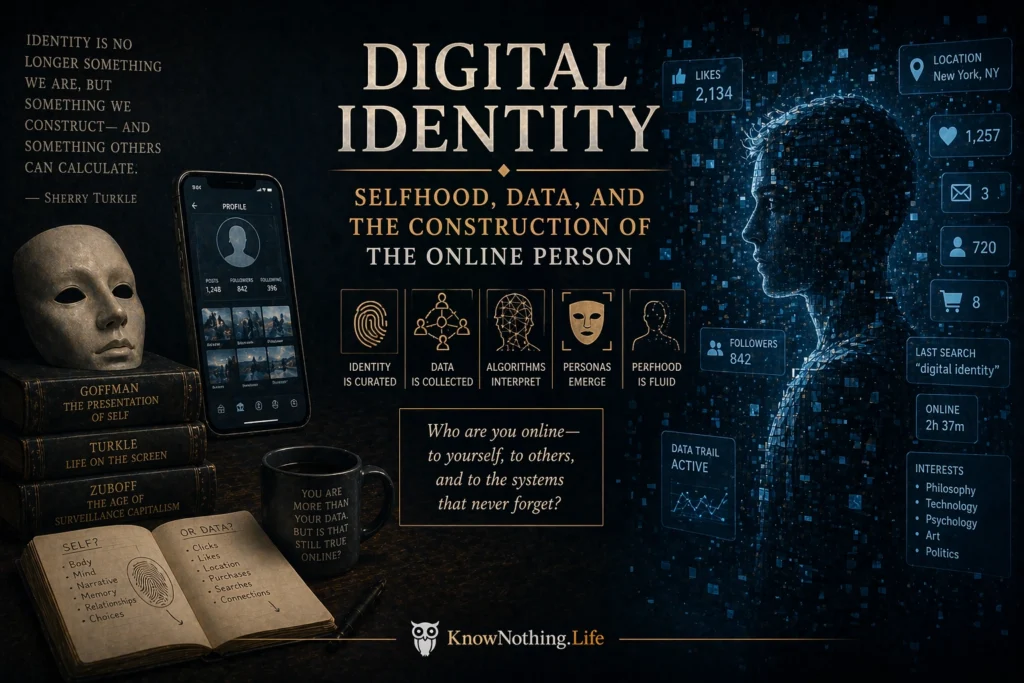
Digital identity has become one of the defining features of contemporary life. As individuals interact through social media, online platforms, and digital systems, they generate representations of themselves that exist alongside—or sometimes in tension with—their offline identities. These representations are not merely passive reflections; they actively shape how individuals are perceived, how they interact with others, and how they understand themselves. The philosophy of digital identity explores this evolving relationship between selfhood and technology.
Unlike traditional notions of identity, which are often grounded in physical presence and personal continuity, digital identity is fragmented, dynamic, and mediated by systems. A person may maintain multiple online personas across different platforms, each curated for specific audiences or purposes. At the same time, digital identity is increasingly shaped by data—records of behavior, preferences, and interactions that are collected, analyzed, and often monetized. This raises fundamental questions about authenticity, control, and the nature of the self in a digital age.
What Is Digital Identity?
Digital identity can be understood as the collection of information, representations, and interactions that define an individual within digital environments. This includes explicit elements such as usernames, profiles, and posts, as well as implicit data such as browsing history, location tracking, and algorithmic inferences. Together, these components form a composite picture of the individual, often more detailed and persistent than traditional forms of identity.
Importantly, digital identity is not entirely under individual control. While users can curate their profiles and manage certain aspects of their online presence, much of their digital identity is constructed through automated processes. Algorithms analyze behavior to generate profiles, predict preferences, and influence outcomes. This creates a form of identity that is both personal and impersonal—rooted in individual actions but shaped by systems beyond direct control.
The Fragmentation of the Self
One of the most striking features of digital identity is its fragmentation. In the physical world, identity is typically experienced as continuous and unified, even if it evolves over time. Online, however, individuals often present different aspects of themselves in different contexts. A professional persona on a networking site may differ significantly from a more casual or expressive identity on social media.
This fragmentation can be both empowering and destabilizing. On one hand, it allows individuals to explore different facets of their identity, experiment with self-expression, and connect with diverse communities. On the other hand, it can lead to a sense of disconnection or inconsistency, as individuals navigate multiple, sometimes conflicting representations of themselves. The philosophy of digital identity examines how these fragmented selves relate to the notion of a coherent personal identity.
Data and the Quantified Self
Digital identity is increasingly defined by data. Every interaction—clicks, searches, purchases—generates information that contributes to a growing digital profile. This phenomenon has given rise to the concept of the “quantified self,” where aspects of identity are measured, tracked, and analyzed through data.
This data-driven identity has significant implications. It enables personalized experiences, from targeted recommendations to tailored services, but it also raises concerns about surveillance and control. Data profiles can be used to predict behavior, influence decisions, and even determine access to opportunities. In this sense, digital identity becomes a form of power—one that can be wielded by individuals, corporations, or governments. The challenge is to ensure that this power is exercised in ways that respect autonomy and dignity.
Authenticity in the Digital Age
The question of authenticity is central to discussions of digital identity. What does it mean to be authentic when identity is mediated by technology? Online environments often encourage curation and performance, where individuals present idealized or selective versions of themselves. This can create a gap between the digital persona and the lived experience of the individual.
However, authenticity in the digital age may not require a perfect alignment between online and offline selves. Instead, it may involve a more fluid understanding of identity, where different contexts allow for different expressions of the self. The key issue is not whether digital identities are identical to offline identities, but whether they are experienced as meaningful and coherent by the individual. This perspective shifts the focus from authenticity as correspondence to authenticity as engagement.
Privacy and Control
Digital identity is deeply intertwined with issues of privacy. The data that constitutes digital identity is often collected and stored by third parties, raising questions about ownership and control. Who has the right to access, use, or modify this information? And how can individuals protect their identities in an environment where data is constantly being generated and shared?
Privacy is not only about protecting information but also about maintaining autonomy. When digital identities are shaped by external forces, individuals may lose control over how they are represented and perceived. This can have significant consequences, from targeted advertising to discrimination based on algorithmic profiling. The philosophy of digital identity must therefore address the ethical and political dimensions of data ownership and control.
Algorithmic Identity
A particularly complex aspect of digital identity is the role of algorithms. These systems analyze data to create profiles that may influence decisions about individuals, such as creditworthiness, employment opportunities, or social visibility. In this sense, algorithms do not merely reflect identity; they actively construct it.
Algorithmic identity raises important questions about fairness and transparency. If decisions are based on algorithmic profiles, individuals need to understand how those profiles are generated and how they can be challenged. However, many algorithms operate as “black boxes,” making it difficult to assess their impact. This lack of transparency can lead to biases and inequalities that are difficult to detect and address.
Social and Cultural Dimensions
Digital identity is not only an individual phenomenon but also a social and cultural one. Online platforms create new forms of community and interaction, shaping how identities are formed and expressed. Cultural norms and expectations influence what is considered acceptable or desirable, affecting how individuals present themselves.
At the same time, digital identity can transcend traditional boundaries, enabling connections across geographic and cultural divides. This can lead to the emergence of new identities and communities that challenge conventional categories. The philosophy of digital identity explores how these social and cultural dynamics interact with technological systems, shaping the evolution of identity in a connected world.
The Persistence of Digital Identity
One of the defining features of digital identity is its persistence. Unlike many aspects of offline identity, which fade over time, digital records can remain accessible indefinitely. This creates a form of temporal extension, where past actions and representations continue to influence present and future perceptions.
This persistence has both positive and negative implications. It allows for continuity and accountability, but it can also limit the ability to change or redefine oneself. Mistakes or outdated representations may remain visible, affecting opportunities and relationships. The challenge is to balance the benefits of persistence with the need for flexibility and growth in personal identity.
Final Thoughts
Digital identity represents a fundamental transformation in how individuals understand themselves and interact with the world. It is shaped by a complex interplay of personal choices, technological systems, and social dynamics. As digital environments continue to evolve, so too will the nature of identity itself.
The philosophy of digital identity invites us to reflect on these changes, asking how we can maintain autonomy, authenticity, and dignity in a data-driven world. It challenges us to consider not only how we are represented but how we wish to be understood. In doing so, it highlights the importance of thoughtful engagement with the technologies that increasingly define our lives.