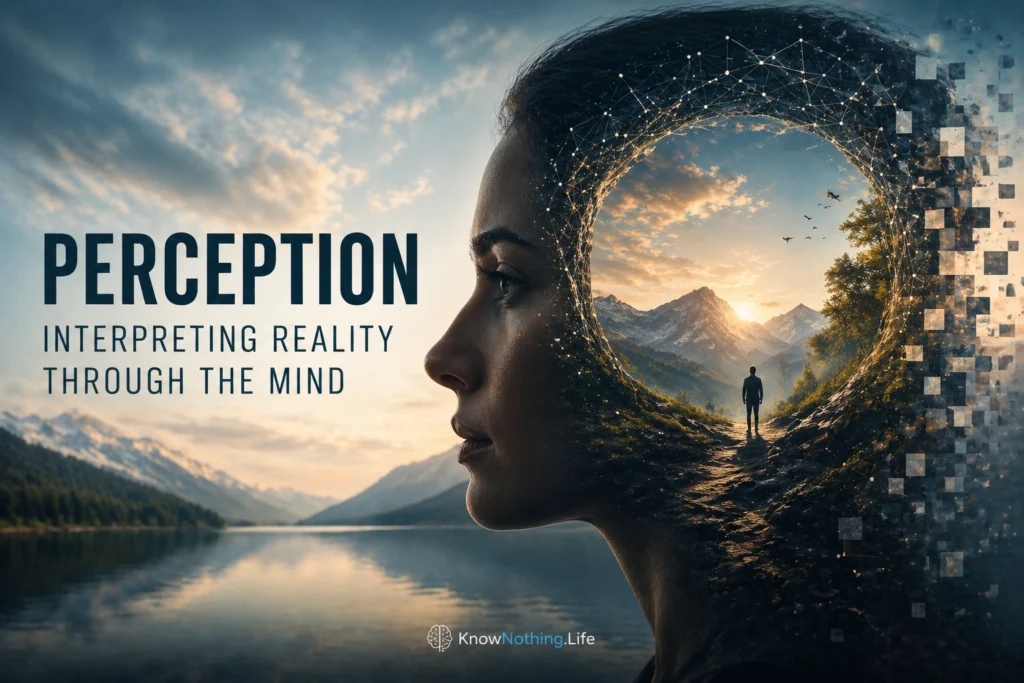
Perception is the cognitive process through which sensory information is organized, interpreted, and transformed into meaningful experience. While sensation provides the raw data—light entering the eyes, sound waves striking the ears, chemical signals activating taste and smell receptors—perception is what allows us to recognize objects, understand speech, and navigate the world. It is not a passive recording of reality but an active construction, shaped by both incoming stimuli and internal cognitive processes. What we perceive is not simply what is “out there,” but what the brain makes of it.
At its foundation, perception reflects the brain’s attempt to solve a complex problem: how to infer the structure of the external world from incomplete and often ambiguous sensory input. This requires the integration of multiple sources of information, including prior knowledge, expectations, and contextual cues. As a result, perception is inherently interpretive. It allows for remarkable efficiency and adaptability, enabling rapid recognition and decision-making, but it also introduces the possibility of error. Illusions, misperceptions, and biases reveal that what we experience as reality is a constructed representation, not a direct copy of the world.
Historical Foundations and Theoretical Perspectives
The study of perception has deep roots in both philosophy and psychology, reflecting enduring questions about the nature of reality and the reliability of the senses. Early philosophical debates considered whether perception provides direct access to the world or whether it is mediated by mental representations. These questions laid the groundwork for scientific inquiry, which began to take shape in the late 19th and early 20th centuries with the emergence of experimental psychology.
One of the most influential movements in the study of perception was Gestalt psychology, associated with figures such as Max Wertheimer. Gestalt theorists argued that perception is organized according to principles of structure and pattern, rather than being a simple sum of sensory elements. Concepts such as figure-ground organization, proximity, similarity, and closure describe how the mind naturally groups elements into coherent wholes. This perspective emphasized the holistic nature of perception, challenging reductionist approaches that focused solely on individual components.
Later developments introduced more mechanistic and computational models of perception, particularly with the rise of cognitive psychology. These models framed perception as a process of information processing, involving stages of analysis and transformation. Contemporary approaches integrate these perspectives, recognizing that perception involves both bottom-up processes driven by sensory input and top-down processes shaped by knowledge and expectations. This integration reflects the complexity of perception as both a biological and cognitive phenomenon.
Sensation and Perceptual Processing
Perception begins with sensation, the detection of physical energy by sensory receptors. Each sensory system is specialized for a particular type of input, such as light for vision or sound for hearing. These signals are transduced into neural impulses and transmitted to the brain, where they undergo further processing. However, sensation alone does not produce meaningful experience; it provides only the raw material that perception must organize and interpret.
The transformation from sensation to perception involves multiple stages of processing. Early stages focus on basic features, such as edges, colors, or frequencies, while later stages integrate these features into more complex representations, such as objects or scenes. This hierarchical organization allows the brain to build increasingly sophisticated interpretations of sensory input. For example, in vision, simple features are combined to form shapes, which are then recognized as familiar objects.
Importantly, perceptual processing is not strictly linear. Feedback from higher levels can influence earlier stages, allowing expectations and prior knowledge to shape how sensory information is interpreted. This interaction between bottom-up and top-down processes enables flexible and adaptive perception, but it also means that perception can be influenced by context, experience, and belief. The interplay between sensation and interpretation lies at the heart of perceptual experience.
Visual Perception: Constructing the Seen World
Vision is the most extensively studied sensory modality, offering rich insights into how perception operates. Visual perception involves the transformation of light patterns on the retina into a coherent representation of the environment. This process requires the brain to solve several complex problems, including depth perception, object recognition, and motion detection. Despite the apparent simplicity of seeing, these tasks involve sophisticated computations that occur rapidly and largely outside conscious awareness.
Depth perception, for example, relies on multiple cues, including binocular disparity, motion parallax, and perspective. These cues allow the brain to infer three-dimensional structure from two-dimensional retinal images. Similarly, object recognition involves matching visual input to stored representations, enabling the identification of familiar objects across different contexts and viewpoints. These processes demonstrate the brain’s ability to extract meaningful information from limited data.
Visual illusions provide compelling evidence for the constructive nature of perception. They reveal how the brain’s assumptions and heuristics can lead to systematic errors. For instance, certain illusions exploit the brain’s tendency to interpret ambiguous stimuli in specific ways, highlighting the role of prior knowledge in shaping perception. These phenomena underscore the idea that perception is an active process, guided by both sensory input and cognitive expectations.
Auditory and Multisensory Perception
While vision often dominates discussions of perception, other sensory modalities play equally important roles. Auditory perception allows us to interpret sound, enabling communication, music appreciation, and environmental awareness. Like vision, it involves the transformation of physical stimuli into meaningful representations, such as recognizing speech or identifying the location of a sound source.
Auditory perception is particularly sensitive to temporal patterns, allowing for the processing of complex sequences such as language and music. The brain must segment continuous streams of sound into discrete units, such as words or notes, a task that requires both bottom-up analysis and top-down knowledge. This process highlights the dynamic nature of perception, as the brain continuously updates its interpretations based on incoming information.
Multisensory perception refers to the integration of information from different sensory modalities. In everyday life, perception is rarely limited to a single sense; instead, the brain combines inputs from vision, hearing, touch, and other systems to create a unified experience. This integration enhances accuracy and robustness, allowing for more reliable interpretation of the environment. However, it can also lead to conflicts, as seen in phenomena where one sense influences or overrides another. Multisensory perception illustrates the complexity and interconnectedness of perceptual processes.
Perception and Cognition: Top-Down Influences
Perception is deeply intertwined with cognition, as higher-level processes such as attention, memory, and expectation influence how sensory information is interpreted. Top-down processing allows the brain to use prior knowledge and context to guide perception, enabling rapid and efficient interpretation of ambiguous stimuli. For example, reading involves recognizing words not only based on visual input but also on linguistic knowledge and context.
Expectations can shape perception in powerful ways. When individuals anticipate certain stimuli, they are more likely to perceive them, even when the sensory evidence is weak or ambiguous. This can lead to perceptual biases, where interpretation is influenced by beliefs or prior experiences. While these biases can enhance efficiency, they can also result in errors, particularly in situations where expectations do not match reality.
The interaction between perception and cognition highlights the active nature of experience. Rather than being a one-way process from sensation to interpretation, perception involves continuous feedback between different levels of processing. This dynamic interaction allows for flexibility and adaptability but also introduces complexity, as multiple factors influence what is ultimately perceived.
Perceptual Constancies and Stability
One of the remarkable features of perception is its stability in the face of changing sensory input. Perceptual constancies allow us to perceive objects as consistent in size, shape, and color, even when the conditions of observation vary. For example, an object appears to maintain its size despite changes in distance, and its color remains relatively constant under different lighting conditions.
These constancies reflect the brain’s ability to account for contextual factors and maintain coherent representations of the environment. They are essential for navigating the world, as they allow for reliable recognition and interaction with objects. Without perceptual constancies, the world would appear unstable and unpredictable, making everyday tasks significantly more difficult.
The mechanisms underlying perceptual constancies involve both sensory processing and cognitive interpretation. The brain uses contextual cues and prior knowledge to adjust its interpretations, ensuring that perception remains consistent despite variability in input. This balance between stability and flexibility is a defining feature of perceptual systems, enabling both reliability and adaptability.
Applications and Future Directions
The study of perception has wide-ranging applications across multiple fields, from neuroscience and psychology to technology and design. In clinical contexts, understanding perceptual processes can inform the diagnosis and treatment of disorders that affect perception, such as visual impairments or neurological conditions. In technology, insights from perception research guide the development of interfaces, virtual reality systems, and artificial intelligence, enhancing usability and realism.
In everyday life, perception influences decision-making, communication, and social interaction. Misperceptions can lead to misunderstandings, while accurate perception supports effective behavior. As environments become increasingly complex and mediated by technology, understanding how perception operates becomes more important for navigating modern challenges.
Future research in perception is likely to focus on integrating multiple levels of analysis, from neural mechanisms to social and cultural influences. Advances in brain imaging and computational modeling are providing new tools for exploring how perception works in real-world contexts. As the field continues to evolve, it will deepen our understanding of how the mind constructs reality, offering insights into one of the most fundamental aspects of human experience.