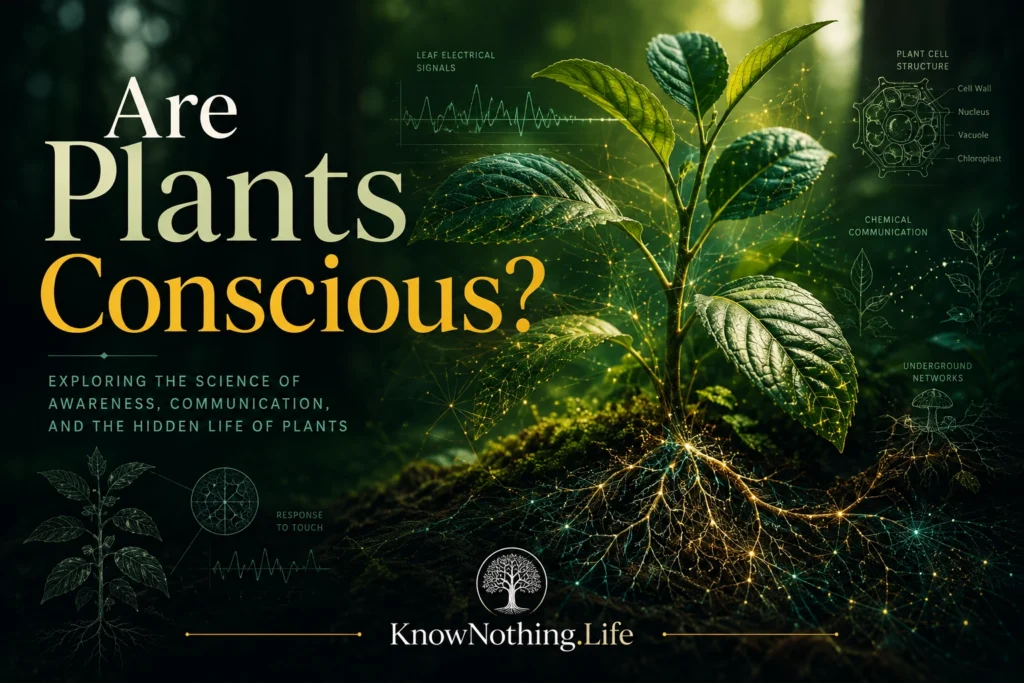
The question “Are plants conscious?” sounds simple, but it quickly opens into one of the most difficult debates in biology and philosophy. Plants clearly sense and respond to the world. They grow toward light, send roots toward water, close leaves when touched, release chemical signals when attacked, cooperate with fungi, compete with neighbors, and alter their behavior in response to changing conditions. They are not passive green machines. They are living organisms with astonishing sensitivity to light, gravity, moisture, temperature, pressure, chemicals, vibration, and injury.
But consciousness is a stronger claim than responsiveness. To say that plants respond is not the same as saying they feel. To say they communicate is not the same as saying they have inner experience. A thermostat responds to temperature, but few would call it conscious. A bacterium moves toward nutrients, but that does not prove it has a point of view. The real question is whether a plant merely processes information or whether there is something it is like to be a plant. That phrase echoes philosopher Thomas Nagel’s famous question, “What is it like to be a bat?” Consciousness, in its deepest sense, means subjective experience: the presence of an inner world.
What Plants Can Sense
Plants are far more perceptive than ordinary human intuition suggests. A seedling detects the direction of light and bends toward it. Roots detect gravity and grow downward. Leaves respond to shade from neighboring plants. Flowers time their openings around pollinators. Some plants detect chemical signals from wounded neighbors and prepare defensive responses. The Venus flytrap can count touches before closing, avoiding wasted energy from false alarms. The sensitive plant, Mimosa pudica, folds its leaves when disturbed and can reduce that response after repeated harmless stimulation.
These abilities show that plants possess complex biological intelligence, if intelligence is understood broadly as adaptive problem-solving. They gather information, integrate signals, and change behavior in ways that help survival. Charles Darwin was fascinated by plant movement and sensitivity. In The Power of Movement in Plants, written with his son Francis Darwin, he suggested that the root tip acts “like the brain of one of the lower animals,” receiving impressions and directing movement. Darwin did not mean that plants literally had brains like animals. He meant that plant behavior was organized, responsive, and worthy of serious scientific attention.
Plant Communication and Memory
Plants communicate through chemicals, electrical signals, hormones, fungal networks, and physical changes. When attacked by insects, some plants release volatile compounds that warn nearby plants or attract predators of the herbivores. Roots exchange signals in soil. Mycorrhizal fungi can connect plants into underground networks through which nutrients and chemical information move. A plant can also remember in a biological sense. Prior drought, stress, light exposure, or attack can change later responses through molecular and epigenetic mechanisms.
The difficult question is whether memory and communication require consciousness. In humans, memory is usually associated with experience, but biology contains many forms of memory without awareness. The immune system “remembers” pathogens. Cells “remember” developmental states. A tree may respond differently after past stress, but that does not prove it remembers as a person remembers. Plant memory may be real without being conscious memory. The danger is anthropomorphism: using human-like language so casually that biological processes begin to sound like feelings, thoughts, or intentions.
The Plant Neurobiology Debate
The modern debate intensified with the rise of “plant neurobiology,” a controversial field associated with researchers such as Stefano Mancuso, František Baluška, Monica Gagliano, and Paco Calvo. The term is provocative because plants do not have neurons, synapses, or brains in the animal sense. Supporters argue that the word “neurobiology” is useful because plants use electrical signaling, chemical communication, distributed decision-making, and complex behavior. They suggest that cognition may not require a brain if cognition is defined as flexible, adaptive information processing.
Critics object that this language can mislead the public. Lincoln Taiz and other plant scientists have argued that plants neither possess nor require consciousness. Their position is not that plants are simple. It is that consciousness, as far as we know, evolved in animals with nervous systems capable of integrated sensory experience, rapid movement, pain, attention, and centralized processing. From this view, plants solve problems through growth, chemistry, and distributed physiology, not through awareness. They are extraordinary without being conscious.
Intelligence Is Not the Same as Consciousness
Much confusion comes from treating intelligence, sentience, and consciousness as if they were identical. Intelligence means the ability to solve problems or adapt behavior. Sentience usually means the capacity to feel, especially pleasure or pain. Consciousness means subjective experience. A plant may display intelligence in the first sense without being sentient or conscious in the second and third senses. It can adapt without feeling. It can signal without suffering. It can behave flexibly without having an inner life.
This distinction matters ethically and scientifically. If every adaptive system is called conscious, the word consciousness becomes too broad to explain anything. If consciousness requires something like a nervous system, then plants are probably not conscious. But if consciousness is defined more minimally, as a primitive form of integrated responsiveness, then the possibility becomes harder to dismiss. The disagreement is partly empirical and partly philosophical. Scientists can study plant behavior, signaling, and physiology. But deciding when information processing becomes experience remains one of the hardest problems in philosophy of mind.
Philosophical Possibilities
Several philosophical positions shape the debate. Strict materialists often argue that consciousness depends on specific kinds of biological organization, especially nervous systems. Panpsychists argue that consciousness, or proto-consciousness, may be a basic feature of matter, present in extremely simple forms throughout nature. Process philosophers see life as dynamic activity rather than mechanical substance, making plant agency easier to take seriously. Phenomenologists remind us that human consciousness is not the only possible mode of being, though they cannot prove that plants have experience.
Aristotle described plants as having a nutritive soul, meaning the power of growth, reproduction, and nourishment, but not sensation in the animal sense. This ancient distinction remains surprisingly relevant. Plants are alive, self-organizing, and purposeful in a biological way, yet they do not obviously perceive the world as animals do. The challenge is to respect plant life without projecting human interiority onto it. Wonder does not require exaggeration. A plant can be marvelous without being mentally human-like.
Pain, Harm, and Ethics
A common question is whether plants feel pain. The best current answer is that plants detect damage and respond to injury, but there is no strong evidence that they experience pain as animals do. Pain, in animals, is not merely tissue damage. It is a conscious unpleasant experience connected to nervous systems, motivation, learning, and protective behavior. Plants lack nociceptors, brains, and the rapid escape behaviors associated with animal pain. They can respond dramatically to harm, but response is not the same as suffering.
Still, the absence of plant pain does not mean plants have no ethical value. Forests, crops, gardens, and wild ecosystems deserve respect because they are living communities that sustain Earth’s atmosphere, food webs, climate, soil, and beauty. Ethical concern for plants does not have to depend on proving plant consciousness. We can value plants as living beings, ecological partners, sources of nourishment, and forms of life with their own integrity. The moral question is not only “Do they feel like us?” but “What kind of relationship should humans have with the living world?”
Why the Question Matters
The debate over plant consciousness matters because it challenges human arrogance. For centuries, people often treated plants as background: scenery, fuel, food, decoration, or property. Modern plant science has made that view impossible to maintain. Plants are active, responsive, communicative, and deeply embedded in ecological networks. They do not live as animals live, but they are not inert. They solve problems through growth, chemistry, timing, architecture, and relationship.
At the same time, the debate warns against romantic overcorrection. Saying plants are conscious may attract attention, but it can blur the difference between metaphor and evidence. Science needs careful language. Plants can be intelligent in a biological sense without being conscious in a subjective sense. They can be active without having intentions. They can communicate without conversation. They can remember without autobiographical memory. The more precise we are, the more remarkable plants become.
Final Thoughts
So, are plants conscious? The most responsible answer is: probably not in the way animals are conscious, and there is currently no strong evidence that plants have subjective experience, feelings, or awareness. But plants are far more sophisticated than traditional assumptions allowed. They sense, signal, adapt, learn in limited biological ways, and participate in complex ecological relationships. They are not conscious humans in green form. They are plants, and that is already extraordinary.
The question should not be closed with ridicule or answered with fantasy. It should be held with scientific caution and philosophical openness. Plants may not have minds, but they force us to rethink what intelligence means. They may not feel pain, but they remind us that life is not valuable only when it resembles us. The deepest lesson of plant consciousness may be humility: the living world is stranger, more responsive, and more interconnected than human-centered thinking has often admitted.