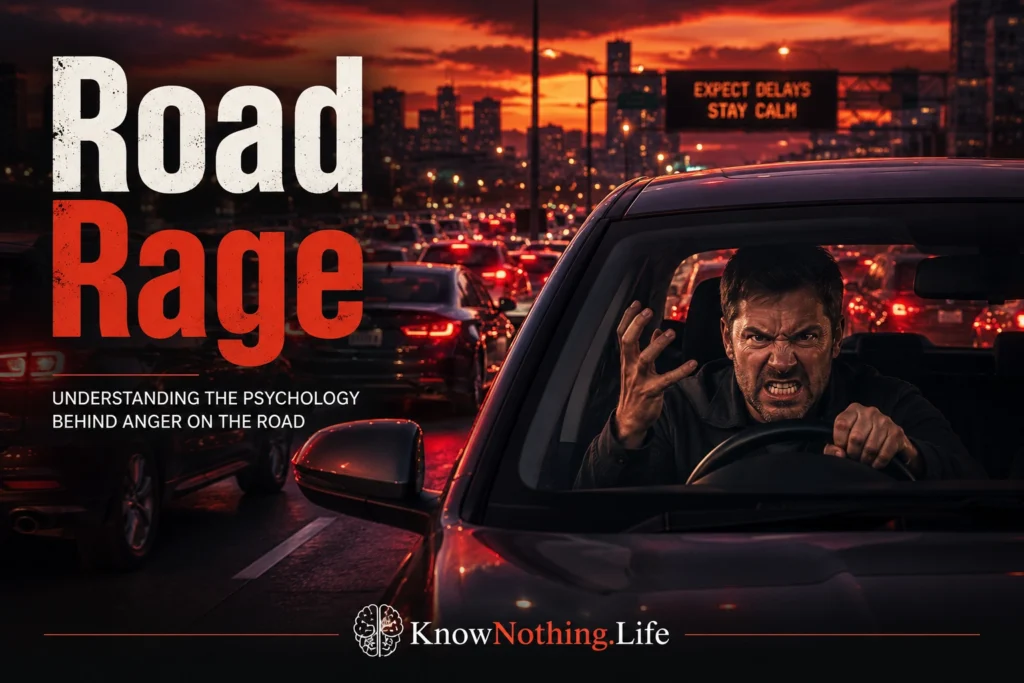
Road rage is one of the clearest examples of how quickly ordinary frustration can become dangerous aggression. A person who may be polite in a grocery store or calm at work can suddenly shout, tailgate, gesture, honk, block another driver, or chase a car down the road. Driving places people inside powerful machines, moving at high speed, surrounded by strangers, under pressure from time, traffic, noise, weather, risk, and perceived disrespect. The result is a social environment where small mistakes can feel like personal attacks.
Road rage is not the same as ordinary irritation behind the wheel. Almost everyone has felt annoyed by slow traffic, careless merging, or being cut off. Road rage begins when anger becomes aggressive, retaliatory, or unsafe. It is the difference between feeling angry and using the vehicle, voice, horn, gesture, or body as a weapon of intimidation. Psychologically, road rage reveals how anger, stress, anonymity, status, control, and threat perception interact in modern life.
What Road Rage Means
Road rage generally refers to aggressive or violent behavior that arises from conflict while driving. It may include yelling, obscene gestures, aggressive honking, tailgating, brake-checking, blocking lanes, cutting someone off in revenge, following another car, getting out of the vehicle to confront someone, or escalating a traffic dispute into physical violence. Aggressive driving is the broader category; road rage is the more emotionally intense and hostile form.
The key feature is not simply bad driving but emotional escalation. A distracted driver may make a dangerous mistake without rage. A road-raging driver acts from anger, insult, dominance, or revenge. This distinction matters because road rage is not only a traffic problem. It is a psychological problem expressed through traffic. The car becomes the tool through which frustration, fear, ego, and aggression are acted out.
Why Driving Triggers Anger
Driving is uniquely stressful because it combines speed, danger, uncertainty, and limited communication. On the road, people must constantly predict the behavior of others. A sudden lane change, slow acceleration, missed signal, or close merge can feel threatening because the consequences of error are serious. The brain is designed to detect danger quickly, and driving provides endless possible threats.
At the same time, drivers have very little real communication with one another. A stranger’s mistake may have an innocent explanation: distraction, confusion, poor visibility, unfamiliar roads, fear, inexperience, or a genuine accident. But from inside another car, motives are invisible. The mind fills in the gap, often harshly. Instead of thinking, “Maybe they did not see me,” a driver may think, “They disrespected me.” That interpretation turns a mistake into an insult.
The Frustration-Aggression Link
Psychology has long connected frustration with aggression. In the classic 1939 work Frustration and Aggression, John Dollard, Neal Miller, Leonard Doob, O. H. Mowrer, and Robert Sears argued that blocked goals can produce aggressive impulses. Later psychologists revised the theory, but the basic insight remains useful: when people feel prevented from reaching a goal, anger often rises. Driving is filled with blocked goals. People want to arrive on time, move smoothly, feel safe, and maintain control. Traffic blocks all of those desires.
Leonard Berkowitz later developed a more nuanced view of aggression, emphasizing that frustration creates anger, but aggression depends on interpretation, cues, habits, and context. A driver stuck in traffic may be irritated but not aggressive. Add heat, noise, lateness, a reckless driver, an insulting gesture, or a history of anger problems, and the situation can escalate. Road rage is rarely caused by one event alone. It often emerges when stress and interpretation collide.
Anonymity and Deindividuation
Road rage is intensified by anonymity. Drivers are surrounded by people but separated by metal, glass, speed, and distance. Other drivers become vehicles rather than full human beings. A person is no longer a tired parent, nervous teenager, elderly driver, delivery worker, or lost traveler. They become “that idiot,” “that jerk,” or “that guy who cut me off.” This reduction makes hostility easier.
Social psychologists call this process deindividuation: when people feel anonymous or detached from ordinary social accountability, they may behave in ways they would avoid face-to-face. A driver may scream insults inside a car that they would never say across a dinner table. The windshield creates emotional distance. The license plate is not a biography. The other person becomes a symbol of everything irritating, selfish, or incompetent about the world.
Control, Status, and Ego
Driving also creates illusions of control and status. People often experience their car as an extension of the self. Being blocked, passed, honked at, tailgated, or cut off can feel like a personal challenge. The road becomes a competitive space where speed, position, and right-of-way are interpreted as signs of respect or dominance. This is why road rage often contains language of insult: “They think they can do that to me?”
For some people, the vehicle becomes a temporary source of power. Someone who feels powerless elsewhere may feel stronger behind the wheel. A larger car, faster engine, aggressive driving style, or loud horn can become tools of dominance. Road rage then becomes less about transportation and more about ego defense. The driver is not only trying to get somewhere. They are trying to restore a threatened sense of status.
The Role of Stress and Emotional Spillover
Road rage often begins before the driver enters the car. Someone may already be angry from work, financial pressure, family conflict, lack of sleep, chronic stress, or feeling rushed. Traffic becomes the trigger, not the true source. A minor driving mistake by someone else can release emotion that has been building all day.
This is emotional spillover. The road absorbs anger that belongs partly elsewhere. A person may believe they are furious because another driver merged badly, but the intensity of the reaction may come from exhaustion, resentment, fear, or humiliation carried from another part of life. Driving is dangerous because it provides immediate opportunities to act on emotion. Anger that might otherwise remain internal can become speed, pressure, pursuit, or confrontation.
Attribution Error on the Road
One of the most important psychological concepts behind road rage is the fundamental attribution error, associated with social psychologist Lee Ross. People tend to explain others’ behavior through character while explaining their own behavior through circumstance. If another driver speeds, they are reckless. If we speed, we are late. If another driver hesitates, they are incompetent. If we hesitate, we are being careful.
This bias is especially strong in traffic because context is hidden. Drivers see behavior but not reasons. The result is moral judgment. A mistake becomes selfishness. A delay becomes stupidity. A close call becomes malice. Road rage thrives on certainty about motives. The angrier the driver becomes, the less likely they are to imagine innocent explanations.
Consequences of Road Rage
Road rage is dangerous because anger narrows attention and increases risk-taking. A furious driver may follow too closely, accelerate impulsively, ignore blind spots, run lights, brake suddenly, or focus on revenge instead of safety. Anger shifts the goal from arriving safely to “winning” the encounter. That shift can be deadly.
There are also psychological consequences. Road rage reinforces itself. Each aggressive episode teaches the brain that anger leads to action and action feels temporarily powerful. But the relief is short-lived. Afterward, the person may feel shame, fear, embarrassment, or lingering agitation. If repeated, road rage becomes a habit of emotional regulation: the driver uses aggression to discharge discomfort. Over time, the car becomes a place where anger is practiced.
How to Reduce Road Rage
Reducing road rage begins with changing interpretation. The safest mental habit is to assume error before malice. Most bad driving is not personal. People are distracted, confused, tired, inexperienced, stressed, or simply imperfect. This does not excuse dangerous behavior, but it prevents the mind from turning every mistake into an insult. A driver who refuses to personalize traffic is harder to provoke.
Practical strategies also matter. Leaving earlier reduces pressure. Keeping distance reduces threat. Avoiding eye contact and gestures prevents escalation. Letting aggressive drivers pass is not weakness; it is risk management. Deep breathing, relaxing the jaw and hands, turning down overstimulating audio, and reminding oneself that the goal is arrival rather than victory can all interrupt escalation. The central question is simple: “Do I want to be right, or do I want to be safe?”
Final Thoughts
Road rage happens because driving combines many of the conditions that make human anger dangerous: stress, anonymity, blocked goals, perceived disrespect, limited communication, high stakes, and immediate power. The road turns ordinary psychological biases into physical risk. A misread gesture, a delayed merge, or a careless lane change can become a battle for control if the driver’s mind interprets it as personal.
The deeper lesson of road rage is that anger often tells only part of the truth. It may signal danger, but it may also conceal stress, ego, fear, exhaustion, or wounded pride. Mature driving requires more than technical skill. It requires emotional discipline. Every driver eventually faces a choice between escalation and restraint. Road rage says, “They disrespected me.” Wisdom says, “This is not worth my life, their life, or anyone else’s.” The safest driver is not the one who never feels anger. It is the one who refuses to let anger take the wheel.