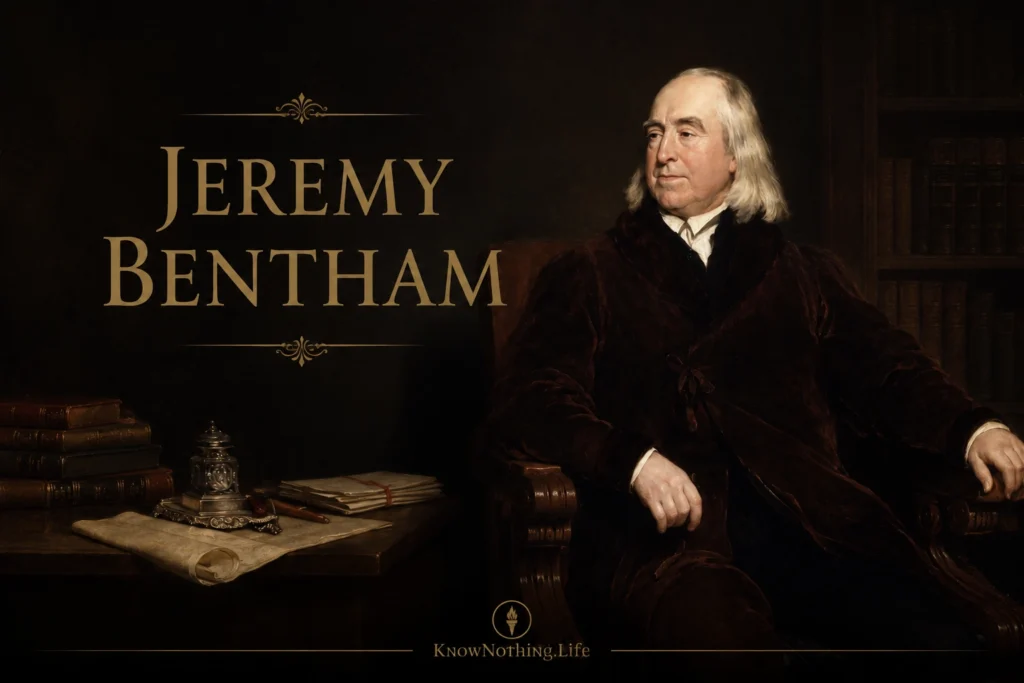
Jeremy Bentham was born on February 15, 1748, in Spitalfields, London, and became one of the most influential moral, legal, and political reformers of the modern age. He was a child prodigy from a prosperous legal family, reportedly reading serious history as a small child and studying Latin at the age of three. At twelve, he entered Queen’s College, Oxford, because his father expected him to become a great lawyer, perhaps even Lord Chancellor. Bentham did study law, but the experience did not inspire obedience to the English legal system. It inspired lifelong rebellion against it.
Bentham became especially disillusioned after hearing the lectures of William Blackstone, the celebrated defender of English common law. Where Blackstone saw inherited legal wisdom, Bentham saw confusion, fiction, cruelty, and privilege protected by tradition. He decided not to practice law, but to examine law as a human invention that should be judged by its consequences. That decision shaped his entire career. Bentham became the philosopher of reform: the thinker who asked whether customs, punishments, rights, courts, prisons, constitutions, and moral rules actually served human well-being.
The Principle of Utility
Bentham’s defining idea was the principle of utility, the view that actions, laws, and institutions should be judged by their tendency to increase happiness and reduce suffering. In An Introduction to the Principles of Morals and Legislation, published in 1789, he opened with one of the most famous sentences in moral philosophy: “Nature has placed mankind under the governance of two sovereign masters, pain and pleasure.” For Bentham, this was not merely a psychological observation. It was the basis of ethics and legislation. Human beings seek pleasure and avoid pain; therefore, public policy should be organized around the real interests of sentient beings rather than inherited dogma.
Bentham’s most famous formula, first stated in A Fragment on Government, was that “it is the greatest happiness of the greatest number that is the measure of right and wrong.” This made morality public, calculable, and reformist. The point was not that every private pleasure is noble or that life can be reduced to arithmetic. The point was that moral and legal judgment must answer to consequences. A law that produces misery should not be defended merely because it is ancient. A punishment that causes more suffering than it prevents is irrational. A political system that serves elites while burdening the many fails the test of utility.
Law Reform and the Attack on Legal Fiction
Bentham’s first major publication, A Fragment on Government, appeared in 1776 and attacked Blackstone’s reverence for the English constitution. Bentham objected to theories that treated government as if it rested on an original contract or sacred inheritance. He wanted political obligation to be explained by utility: people obey government because, and only so far as, government produces greater security and happiness than disorder would. His famous civic motto was “to obey punctually; to censure freely.” Citizens should obey the law when necessary for social order, but they must also criticize law without superstition.
His legal writings were vast, including Of Laws in General, Rationale of Judicial Evidence, The Book of Fallacies, Constitutional Code, and many works on punishment, procedure, codification, and evidence. Bentham opposed the technical obscurity of common law and wanted laws written clearly, publicly, and systematically. He attacked what he saw as “sinister interests,” by which lawyers, judges, priests, aristocrats, and officeholders protected profitable confusion. Law, for Bentham, was not a mysterious inheritance. It was a tool, and like any tool, it should be redesigned when it injured the people it claimed to serve.
Punishment, the Panopticon, and Social Control
Bentham’s theory of punishment followed directly from utilitarianism. Punishment is itself an evil because it inflicts pain; it can be justified only when it prevents greater harm. This led him to criticize excessive punishment, legal cruelty, and irrational penalties. He wanted penalties proportioned to offenses and designed for deterrence, reform, and public security. The question was never whether offenders deserved suffering in some absolute sense. The question was whether punishment improved the general welfare.
His most famous institutional design was the Panopticon, a proposed prison built so that inmates could be observed from a central point without knowing when they were being watched. Bentham described it as a “new mode of obtaining power of mind over mind.” He hoped it would make supervision efficient and reform prisoners through constant visibility. Later critics, especially Michel Foucault, turned the Panopticon into a symbol of modern surveillance and disciplinary control. This tension remains part of Bentham’s legacy. He was a reformer who wanted to reduce cruelty, but his faith in rational administration also opened unsettling questions about inspection, control, and the management of human behavior.
Democracy, Rights, and Political Reform
Bentham became increasingly radical as he aged. He supported parliamentary reform, wider suffrage, secret ballots, freedom of expression, government accountability, and eventually a form of representative democracy justified by utility. He was suspicious of natural rights language, famously dismissing certain abstract rights claims as “nonsense upon stilts.” This phrase is often misunderstood. Bentham did not deny that people need legal protections. He denied that rights exist as magical entities before law and outside social utility. Real rights, he believed, must be created, defined, and protected by institutions.
His Constitutional Code was one of his most ambitious late works. It tried to design a political system in which officials would be accountable to the people, publicity would expose abuse, and public opinion would serve as a tribunal against misrule. Bentham believed secrecy protected corruption. Good government required visibility: citizens must be able to know what rulers do, judge their conduct, and remove them when necessary. In this way, his utilitarianism became democratic. The happiness of the many could not safely be entrusted to the unchecked power of the few.
Animal Welfare, Equality, and Radical Implications
One of Bentham’s most remarkable contributions was his extension of moral concern beyond narrow human privilege. In An Introduction to the Principles of Morals and Legislation, he wrote of animals: “The question is not, Can they reason? nor, Can they talk? but, Can they suffer?” This sentence became foundational for later animal ethics because it shifted moral status from rational superiority to the capacity for suffering. Bentham did not develop a modern animal rights theory, but he clearly saw that pain matters wherever it is felt.
Bentham’s reforming spirit also led him toward positions far ahead of his time. He criticized slavery, opposed many forms of religious and legal persecution, advocated women’s interests more seriously than many contemporaries, supported universal suffrage in some writings, and argued for the decriminalization of homosexuality in manuscripts unpublished during his lifetime. These views followed from the same principle: if institutions cause needless suffering, tradition is no defense. Utility made Bentham dangerous to established power because it asked every hierarchy to justify itself by human consequences.
Major Works and Intellectual Influence
Bentham’s major works include A Fragment on Government, An Introduction to the Principles of Morals and Legislation, Defence of Usury, Panopticon, Anarchical Fallacies, Chrestomathia, The Book of Fallacies, Rationale of Judicial Evidence, Constitutional Code, and many manuscripts later edited into collected volumes. His writings influenced John Stuart Mill, John Austin, legal positivism, welfare economics, public administration, prison reform, democratic theory, and later debates about consequentialism. Even critics who found his system too cold or calculating had to answer the force of his challenge: what good does a law actually do?
Bentham died on June 6, 1832, one day before the Reform Act received royal assent. In his will, he directed that his body be preserved as an “auto-icon,” and his clothed skeleton remains associated with University College London, where the Bentham Project continues to edit and study his vast manuscripts. The auto-icon is strange, but fitting. Bentham turned even his death into a lesson against convention and a final act of philosophical utility.
Legacy and Lasting Importance
Jeremy Bentham’s lasting importance lies in the moral pressure of his question: does this practice increase happiness or suffering? That question changed ethics, law, politics, economics, and social reform. He rejected inherited authority, mystical rights, legal obscurity, useless punishment, and institutional privilege when they failed the test of human welfare. His philosophy was often severe, but its severity came from impatience with avoidable misery.
Bentham’s weaknesses are also part of his importance. His effort to measure happiness can seem too simple for the richness of human life. His faith in administration can seem too trusting of systems that watch, classify, and manage people. Yet his central demand remains powerful. Laws and institutions should serve living beings, not tradition, ceremony, or elite convenience. Bentham made morality answerable to consequences, and he made reform a philosophical duty. Few thinkers have done more to turn compassion into policy and criticism into a program for changing the world.