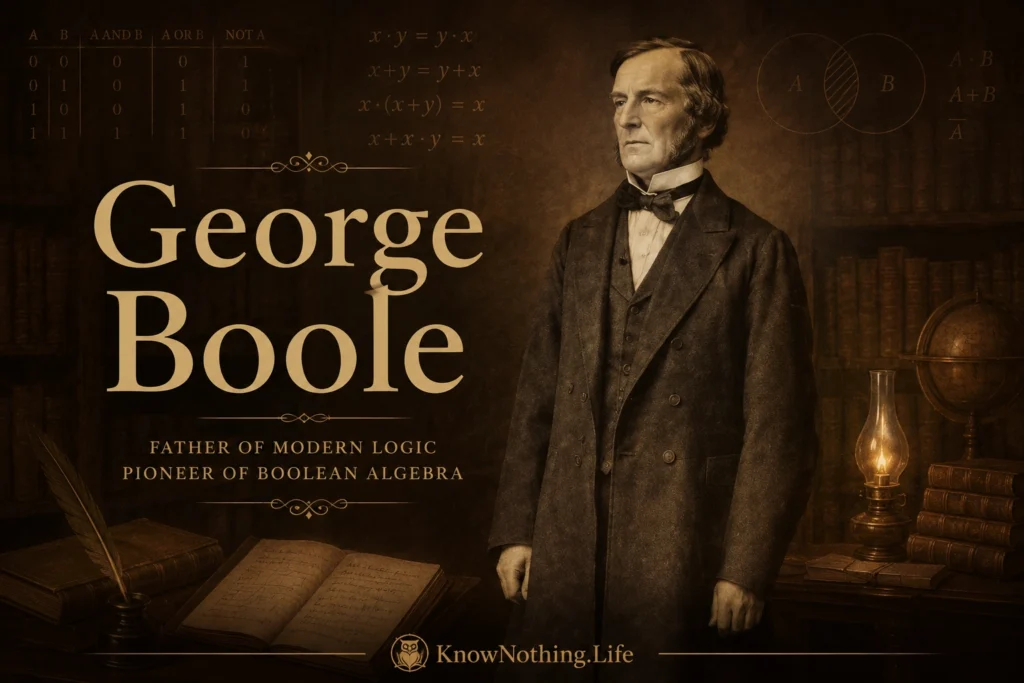
George Boole was born on November 2, 1815, in Lincoln, Lincolnshire, England, into a modest family far from the elite universities that usually produced nineteenth-century mathematicians. His father, John Boole, was a shoemaker with a strong interest in science, mathematics, and optical instruments. George’s early education came partly from local schools and partly from his father’s encouragement, but much of his intellectual development was self-directed. He taught himself languages, mathematics, and philosophy with a seriousness that became one of the defining features of his life.
Boole began working as a teacher while still young and opened his own school in his late teens. Without a university degree, he entered mathematics through private study, correspondence, and publication. This outsider status matters because Boole did not approach logic as a traditional philosopher trained inside ancient syllogistic methods. He approached it as a self-taught mathematician who saw that reasoning itself might have laws expressible in symbols. His career became a proof that intellectual originality does not always come from institutions; sometimes it comes from someone standing just outside them.
Early Mathematical Work
Before Boole became famous for logic, he built his reputation through mathematical research. He studied differential equations, algebra, calculus, and analysis, and in the 1840s he began publishing in serious mathematical journals. His paper “On a General Method in Analysis,” published in the Philosophical Transactions of the Royal Society in 1844, brought him significant recognition and earned him a Royal Society medal. By the time he was still in his twenties, Boole had become known to leading mathematicians despite having no conventional academic pedigree.
His early mathematical work trained him to think structurally. He was interested not merely in solving isolated problems, but in finding general methods. That habit would later make his logic revolutionary. Traditional logic often focused on verbal forms of argument, especially the Aristotelian syllogism. Boole wanted a calculus of reasoning: a symbolic system in which logical relations could be manipulated with something like the precision of algebra. This was the bridge between his mathematical research and his philosophical legacy.
The Mathematical Analysis of Logic
In 1847, Boole published The Mathematical Analysis of Logic, a short but groundbreaking work that introduced his attempt to turn logic into a branch of mathematical analysis. The book argued that logic could be treated through symbols and operations rather than only through ordinary language. Boole wrote that he sought to establish a “Calculus of Logic” and claim for it a place among the recognized forms of mathematical analysis. That was a bold claim in an intellectual world where logic was still often treated as a philosophical or rhetorical discipline rather than a mathematical one.
The importance of The Mathematical Analysis of Logic lies in its shift of method. Boole did not merely translate old syllogisms into new notation. He showed that logical classes and propositions could be represented symbolically, combined, transformed, and solved. His algebra was not exactly the same as modern Boolean algebra, but it created the path toward it. Logic was no longer only the study of correct argument. It became a formal system that could be calculated.
Queen’s College, Cork
Boole’s reputation led to his appointment in 1849 as the first professor of mathematics at Queen’s College, Cork, now University College Cork. This was an extraordinary achievement for a man without a university degree. At Cork, he became a respected teacher, researcher, and public intellectual. He remained there for the rest of his life, producing his greatest works while also teaching mathematics and participating in local intellectual life.
In 1855, Boole married Mary Everest, niece of George Everest, after whom Mount Everest was named. Mary Everest Boole later became known for her own writings on mathematics education. Their family included daughters who also became intellectually notable, including Alicia Boole Stott, who worked on four-dimensional geometry, and Ethel Lilian Voynich, author of the famous novel The Gadfly. Boole’s household, like his work, stood at the intersection of mathematics, education, imagination, and reforming intelligence.
The Laws of Thought
Boole’s masterpiece, An Investigation of the Laws of Thought, was published in 1854. Its full title announced its ambition: An Investigation of the Laws of Thought on Which are Founded the Mathematical Theories of Logic and Probabilities. Boole wanted to uncover the fundamental operations of reasoning and express them in a symbolic calculus. He later described the work as an inquiry into the “laws of those operations of the mind” by which reasoning is performed. This was not merely logic as a tool for debate; it was logic as a science of thought.
The book developed symbolic methods for classes, propositions, and probability. Boole used algebraic symbols such as 0 and 1 to represent logical extremes, with operations corresponding to relations among classes. In modern terms, Boolean algebra became associated with true and false, yes and no, on and off. Boole himself did not live to see digital computers, but his work created a formal language that later proved ideal for switching circuits, programming, search, and computation. Bertrand Russell later called The Laws of Thought “the work in which pure mathematics was discovered,” a tribute to its astonishing reach.
Probability, Science, and the Mind
Boole’s work on probability was not an afterthought. In The Laws of Thought, he tried to connect logic and probability under a general theory of reasoning. He believed that the mind’s operations could be studied through formal laws, and that uncertainty itself could be approached mathematically. This made him important not only for logic, but for the broader history of rational inquiry. He saw that human reasoning often moves not from certainty to certainty, but from partial information toward measured belief.
His interest in probability also shows the philosophical depth of his project. Boole was not simply building a symbolic machine. He was asking how thought relates to truth, evidence, and the structure of the world. One saying attributed to him captures his aesthetic standard for mathematics: a theorem should not fully satisfy the mind until it gives “the impression of being beautiful.” That line reveals the unity of precision and beauty in his thought. For Boole, mathematics was not mechanical bookkeeping. It was a disciplined search for form.
Later Works and Honors
Boole continued to write serious mathematical works after The Laws of Thought. His Treatise on Differential Equations appeared in 1859, followed by A Treatise on the Calculus of Finite Differences in 1860. Both works were respected and used in mathematical instruction. He also published many papers on differential equations, probability, analysis, and algebra. In 1857, he was elected a Fellow of the Royal Society, and he received honorary degrees from Dublin and Oxford.
His later career shows that he was not only the inventor of a single famous idea. He was a wide-ranging mathematician whose symbolic logic grew out of a larger mathematical imagination. Yet it is Boolean logic that made his name permanent. Later thinkers such as William Stanley Jevons, Charles Sanders Peirce, Ernst Schröder, and others developed algebraic logic further. In the twentieth century, Claude Shannon showed how Boolean logic could be applied to electrical switching circuits, helping lay the conceptual foundation for digital computing. Boole’s abstract logic became the hidden grammar of the information age.
Death and Lasting Legacy
George Boole died on December 8, 1864, in Ballintemple, County Cork, Ireland, at only forty-nine. Accounts of his death connect it to pneumonia after he walked through heavy rain to lecture and then taught in wet clothes. His death came far too early, but by then he had already changed the future of logic and mathematics. He was buried in Cork, where his memory remains closely tied to University College Cork and its Boole Library.
Boole’s lasting importance lies in the fact that he changed what logic could be. Before him, logic was often treated as a verbal discipline rooted in ancient forms. After him, logic could be algebraic, symbolic, mathematical, and eventually computational. The modern digital world depends on operations that echo Boole’s insight: complex reasoning can be represented through formal structures of combination, exclusion, negation, and truth value. George Boole did not build a computer, but he helped make computation thinkable. His legacy is the algebra of reason itself.