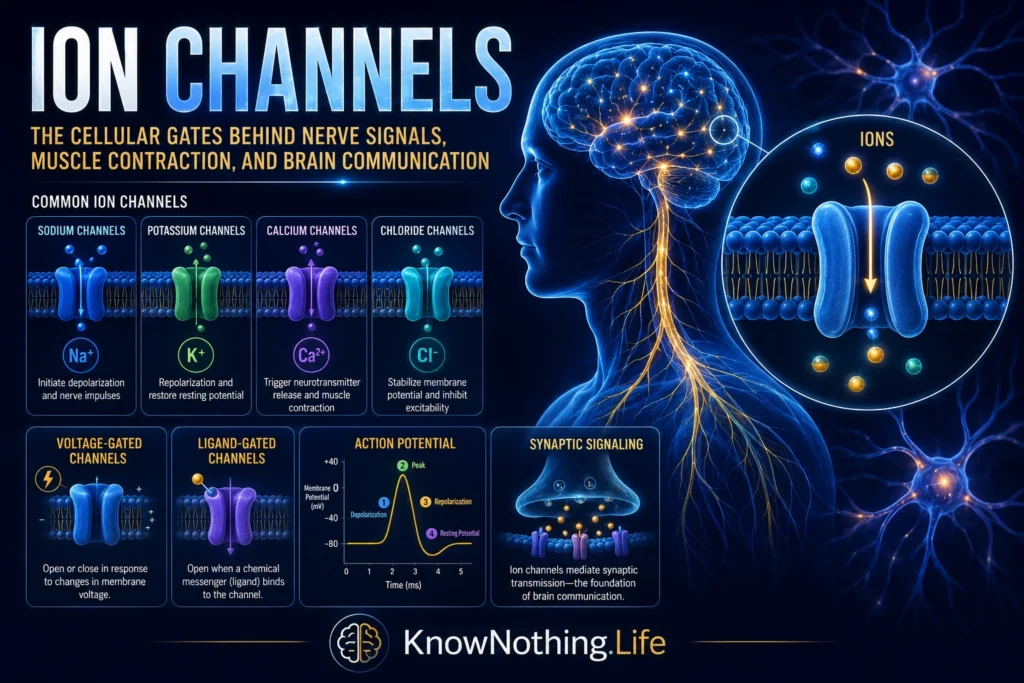
Ion channels are specialized protein pores embedded in cell membranes that allow charged particles, called ions, to move into or out of cells. In the nervous system, they are essential for electrical signaling because ions such as sodium, potassium, calcium, and chloride determine the voltage across the neuronal membrane. When ion channels open or close, they change the flow of these charged particles, altering the membrane potential and allowing neurons to generate signals, respond to neurotransmitters, and communicate with other cells. The opening of ion channels lets permeable ions move down electrochemical gradients, changing membrane potential.
Ion channels are sometimes described as microscopic gates, but they are more than simple holes in a membrane. They are highly selective molecular machines. Some channels mainly allow sodium ions through, others potassium, calcium, or chloride. Some open in response to voltage changes, some open when a neurotransmitter binds, and others respond to mechanical force, temperature, intracellular messengers, or chemical signals. This ability to open, close, and select specific ions makes ion channels one of the foundations of neurophysiology. Without them, neurons would not fire action potentials, synapses would not transmit signals properly, muscles would not contract normally, and the brain would lose the electrical language that makes rapid communication possible.
Ion Gradients and Membrane Potential
Every neuron maintains an electrical difference between the inside and outside of its membrane. This voltage is created by unequal ion concentrations and the selective permeability of the membrane. Sodium is more concentrated outside many neurons, while potassium is more concentrated inside. Chloride and calcium also have important concentration gradients. These gradients are maintained by pumps, transporters, and channels, especially the sodium-potassium pump, which helps preserve the conditions required for excitability. Ion channels do not usually create the gradients by themselves; they use those gradients by allowing ions to move when the channel opens.
The resting membrane potential exists because the membrane is more permeable to some ions than others at rest, especially potassium. When potassium channels are open, potassium tends to move out of the cell, leaving the inside relatively negative. This negative resting state is not a sign of inactivity. It is an actively maintained condition that allows neurons to respond quickly. A neuron is like a charged system held in readiness. When the right ion channels open at the right time, the stored electrochemical energy becomes a signal.
Voltage-Gated Ion Channels
Voltage-gated ion channels open or close in response to changes in membrane voltage. They are especially important for action potentials, the rapid electrical impulses that travel along axons. Voltage-gated sodium channels open during the rising phase of the action potential, allowing sodium to enter and depolarize the neuron. Voltage-gated potassium channels then help repolarize the membrane by allowing potassium to leave. Voltage-gated cation channels are the principal channels involved in generating and propagating neuronal action potentials.
The importance of voltage-gated channels was clarified through the classic work of Alan Hodgkin and Andrew Huxley on the squid giant axon. Their experiments showed that changes in sodium and potassium conductance could explain the action potential, creating one of the most influential models in neuroscience. A historical review notes that the ideas and equations behind the Hodgkin-Huxley model remain standard building blocks of neuronal modeling in teaching and research. Their work revealed that nerve impulses are not vague electrical sparks, but precise physiological events produced by voltage-sensitive ion channels and electrochemical gradients.
Sodium, Potassium, Calcium, and Chloride Channels
Different ion channels do different jobs. Sodium channels are central to the rapid depolarization of neurons and muscle cells. When they open, sodium rushes inward and helps initiate the electrical spike of an action potential. Potassium channels are essential for repolarization, resting membrane potential, firing frequency, and neuronal stability. They help determine how quickly a neuron returns to rest and how easily it can fire again. In his Nobel lecture, Roderick MacKinnon described ion channels as having three basic properties: they conduct specific ions rapidly, they are selective, and they are gated by opening and closing.
Calcium channels are especially important because calcium is not only an electrical charge carrier but also a powerful intracellular signal. Voltage-gated calcium channels convert membrane voltage changes into calcium entry, which can trigger neurotransmitter release, gene expression, enzyme activity, and many forms of plasticity. A major review by William Catterall describes voltage-gated calcium channels as key transducers of membrane potential changes into intracellular calcium signals that initiate physiological events. Chloride channels, often associated with inhibitory signaling, help regulate excitability. In many mature neurons, chloride movement through GABA-related channels makes firing less likely, helping maintain the balance between excitation and inhibition.
Ligand-Gated Ion Channels and Synaptic Communication
Ligand-gated ion channels open when a chemical messenger binds to them. In the nervous system, many of these channels are neurotransmitter receptors. When glutamate, GABA, acetylcholine, or another neurotransmitter binds to an ionotropic receptor, the channel can open and allow ions to flow. This produces fast synaptic responses, often within milliseconds. NCBI Bookshelf describes ionotropic receptors as ligand-gated ion channels that combine receptor and channel functions, while metabotropic receptors act through slower signaling mechanisms.
This distinction is crucial for understanding synaptic transmission. Ionotropic receptors allow fast communication because neurotransmitter binding directly changes ion flow. At excitatory synapses, glutamate receptors may allow positive ions to enter, making the postsynaptic neuron more likely to fire. At inhibitory synapses, GABA or glycine receptors often allow chloride flow that reduces excitability. A review of synaptic neurotransmitter-gated receptors describes these channels as responsible for fast synaptic transmission because they decode chemical signals into electrical activity. Ion channels therefore form the bridge between chemical messaging and electrical response.
Selectivity, Gating, and Molecular Structure
One of the great scientific questions about ion channels is how they can be so selective. Potassium and sodium are both positively charged ions, yet potassium channels can allow potassium through while largely excluding sodium. Roderick MacKinnon’s structural work helped answer this question by revealing how the architecture of potassium channels creates a selectivity filter. The Howard Hughes Medical Institute summarized MacKinnon’s Nobel-recognized work as landmark studies of ion-channel architecture, and NIH later described his discovery of the potassium channel selectivity filter as central to understanding how these channels choose potassium over other ions.
Gating is the other major principle. A channel must not only select the right ion; it must open and close at the right time. Voltage-gated channels respond to membrane voltage. Ligand-gated channels respond to chemical binding. Mechanosensitive channels respond to physical force. Some channels respond to heat, cold, pH, intracellular calcium, cyclic nucleotides, or G proteins. This diversity gives cells enormous control. Ion channels allow neurons and other cells to turn environmental signals, chemical signals, mechanical signals, and electrical signals into changes in membrane activity.
Patch Clamp and the Study of Single Channels
For much of early neuroscience, scientists could infer ion-channel behavior from whole-cell currents, but they could not easily observe the activity of individual channels. That changed with the development of the patch-clamp technique by Erwin Neher and Bert Sakmann. Patch clamp allowed researchers to measure tiny currents through single ion channels in living cell membranes. A PubMed summary of their Nobel-recognized work explains that the patch-clamp technique enables measurement of ionic currents through channels in the plasma membrane of living cells.
This discovery transformed physiology because it made ion channels experimentally visible as individual functional units. Scientists could observe channels opening and closing, measure their conductance, study how drugs affect them, and identify how mutations alter their behavior. Patch clamp helped show that ion channels are not theoretical abstractions. They are real molecular gates producing measurable currents. This method became one of the most important tools in cellular neuroscience, pharmacology, cardiology, and physiology.
Ion Channels in Sensation, Movement, and the Body
Ion channels are essential for sensation. Mechanosensitive channels help convert pressure, stretch, and touch into neural signals. Reviews of mechanotransduction note that mechanosensitive ion channels are important in touch sensitivity, pain, tissue development, and neuronal pathfinding. Temperature-sensitive channels help detect heat and cold. Channels in photoreceptors participate in visual transduction. Channels in hair cells of the inner ear help convert sound vibration into neural activity. In each case, the body turns physical energy into electrical and chemical signals through ion-channel function.
Movement also depends on ion channels. Motor neurons rely on ion channels to fire action potentials. Muscle fibers rely on channels to become electrically activated and contract. Calcium channels and intracellular calcium release are essential for linking excitation to contraction. The heart also depends on ion channels for rhythmic electrical activity. This is why ion-channel dysfunction can affect the brain, muscles, nerves, and heart. These channels are not only neuroscience molecules. They are basic machinery for life.
Channelopathies and Clinical Importance
Channelopathies are diseases caused by abnormal ion-channel function. They may arise from genetic mutations, autoimmune processes, toxins, metabolic problems, or acquired injury. A review in PMC defines channelopathies as diseases that develop because of defects in ion channels caused by genetic or acquired factors. Neurological channelopathies can affect the brain, spinal cord, peripheral nerves, or muscles and may contribute to epilepsy, migraine, episodic ataxia, periodic paralysis, myotonia, pain disorders, and certain movement disorders.
These disorders show how small molecular changes can create large clinical effects. A mutation that slightly alters sodium-channel inactivation can make neurons too excitable. A calcium-channel problem can disturb neurotransmitter release or thalamocortical rhythms. A potassium-channel defect can impair repolarization and destabilize firing patterns. Because ion channels control excitability, they are major targets for medications, including antiseizure drugs, local anesthetics, pain medications, antiarrhythmics, and some psychiatric or neurological treatments. Understanding ion channels is therefore not only basic science. It is central to medicine.
Why Ion Channels Matter
Ion channels matter because they make cells electrically alive. They allow neurons to rest, fire, reset, communicate, and adapt. They turn ion gradients into action potentials, neurotransmitter binding into postsynaptic responses, calcium entry into synaptic release, and sensory stimulation into perception. The brain’s ability to think, feel, remember, move, and respond depends on billions of ion channels opening and closing with extraordinary precision.
The deeper lesson is that nervous-system function begins at the membrane. The mind may emerge from vast networks, but those networks rely on tiny molecular gates that control the movement of sodium, potassium, calcium, and chloride. Ion channels are where chemistry becomes electricity, where signals become action, and where cellular structure becomes nervous-system function. To understand ion channels is to understand one of the most basic mechanisms by which the brain and body communicate with themselves and the world.