The autonomic nervous system, or ANS, is the part of the nervous system that regulates many involuntary body functions. It helps control heart rate, blood pressure, breathing patterns, digestion, sweating, pupil size, bladder function, sexual arousal, body temperature, and many organ responses that happen without deliberate effort. A person does not consciously instruct the stomach to move food, the pupils to widen in darkness, or the heart to beat faster when standing up. These functions depend heavily on autonomic control. StatPearls describes the autonomic nervous system as a component of the peripheral nervous system that regulates involuntary physiologic processes including heart rate, blood pressure, respiration, digestion, and sexual arousal.
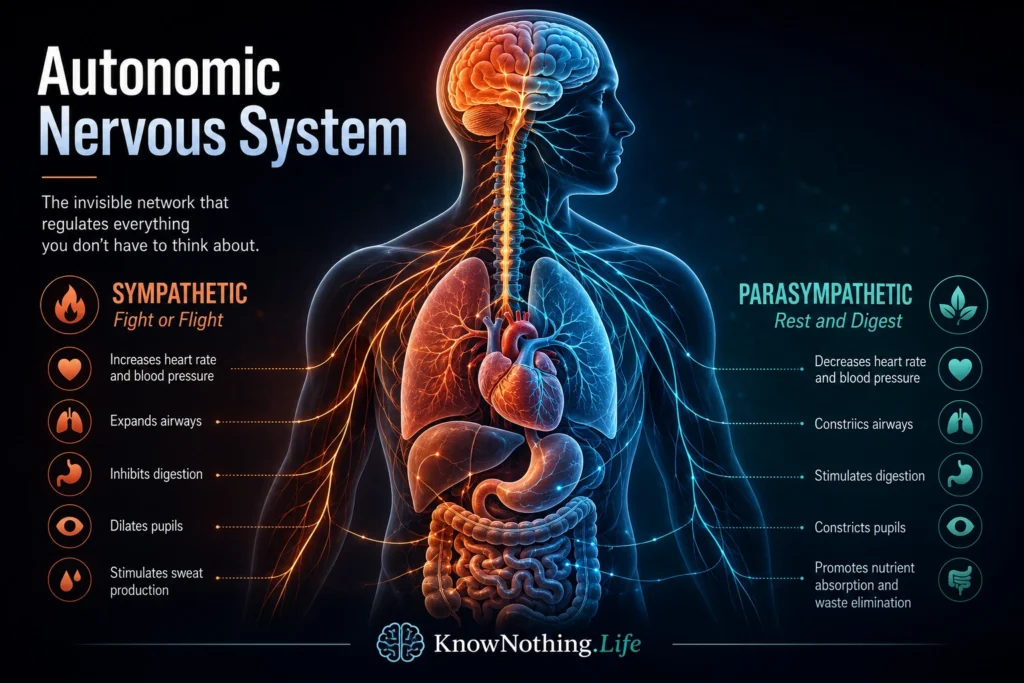
The ANS is usually divided into three major parts: the sympathetic nervous system, the parasympathetic nervous system, and the enteric nervous system. The sympathetic system is often associated with mobilization, stress, alertness, and “fight-or-flight” responses. The parasympathetic system is often associated with rest, digestion, conservation, and recovery. The enteric nervous system is the complex neural network of the gastrointestinal tract. These divisions are useful, but they should not be treated as simple opposites. The body is not either “stressed” or “relaxed” in a crude on-off way. Autonomic regulation is dynamic, organ-specific, and constantly adjusted to match internal needs and external conditions.
Sympathetic Nervous System: Mobilization and Emergency Response
The sympathetic nervous system prepares the body for action. Its neurons arise mainly from the thoracic and lumbar spinal cord and influence organs through chains of ganglia and widespread projections. When sympathetic activity increases, heart rate may rise, blood vessels in some regions may constrict, airways may widen, pupils may dilate, sweating may increase, and energy stores may become more available. This does not happen only during extreme danger. Sympathetic tone also helps regulate ordinary blood pressure, temperature, attention, posture, and daily physiological readiness.
Walter Cannon, the Harvard physiologist who popularized the concept of “fight or flight,” showed how strong emotion and danger mobilize the body through sympathetic and adrenal responses. His 1915 book Bodily Changes in Pain, Hunger, Fear and Rage helped establish the idea that the body prepares for emergency by redistributing blood flow, mobilizing sugar, and coordinating internal resources. A historical review of Cannon’s work notes that he connected sympathetic activation and adrenaline with the emergency response of “flight or fight,” while also developing the broader concept of homeostasis.
Parasympathetic Nervous System: Rest, Digestion, and Recovery
The parasympathetic nervous system helps regulate quiet, restorative, and maintenance functions. Its major outflow comes from the brainstem and sacral spinal cord. The vagus nerve is especially important because it carries parasympathetic fibers to many organs in the chest and abdomen. StatPearls notes that the vagus nerve provides parasympathetic innervation to much of the thoracic and abdominal viscera, while sacral parasympathetic fibers supply parts of the lower colon and rectum.
Parasympathetic activity often slows the heart, supports digestion, stimulates salivation, promotes gastrointestinal movement, helps with bladder emptying, and contributes to sexual function. It is commonly summarized as “rest and digest,” but that phrase is incomplete. The parasympathetic system is not merely a relaxation switch. It helps regulate organ function continuously, including during active life. For example, the vagus nerve carries not only motor signals from brain to organs, but also sensory information from organs back to the brain. The brain must know what is happening inside the body in order to regulate it. Parasympathetic pathways therefore support communication between internal organs and central regulatory systems.
The Enteric Nervous System: The Gut’s Local Brain
The enteric nervous system is the neural network embedded in the wall of the gastrointestinal tract. It contains sensory neurons, motor neurons, interneurons, glial cells, neurotransmitters, and reflex circuits that regulate digestion. It controls gut motility, secretion, blood flow, immune interactions, and communication with the microbiome and endocrine cells. Because of its complexity, the enteric nervous system is sometimes called the “second brain,” although that phrase should not be misunderstood. It does not think like the cerebral cortex, but it can coordinate many digestive functions locally.
A review titled “Building a second brain in the bowel” describes the enteric nervous system as sometimes being called the second brain because of its diverse neuronal cell types and complex integrated circuits. Another review describes the enteric nervous system as a master regulator of bowel motility, epithelial secretion, blood flow, immune interaction, and communication with enteroendocrine cells. This means digestion is not controlled only by top-down commands from the brain. The gut has its own local control network, while still communicating with the central nervous system through sympathetic, parasympathetic, hormonal, immune, and microbial pathways.
Homeostasis and Internal Balance
The central purpose of the autonomic nervous system is homeostasis: maintaining internal balance while conditions change. The body must regulate temperature, blood pressure, blood sugar, oxygen, digestion, hydration, inflammation, waste removal, and organ function. These variables are constantly shifting. Standing up changes blood pressure demands. Eating changes digestive and metabolic demands. Exercise changes oxygen and heat demands. Fear changes circulation and attention demands. The ANS helps the body respond without requiring conscious control of each organ.
Blood pressure regulation is a clear example. Baroreceptors in blood vessels detect stretch related to pressure and send information into autonomic reflex circuits. The nervous system can then adjust heart rate, vessel tone, and cardiac output to help maintain pressure. StatPearls describes baroreceptors as mechanoreceptors that relay blood-pressure information through the autonomic nervous system, allowing rapid changes in peripheral resistance and cardiac output. This kind of regulation happens moment by moment, usually without awareness. The ANS is therefore one of the body’s main systems for keeping life stable beneath consciousness.
Neurotransmitters and Autonomic Communication
Autonomic signaling depends on neurotransmitters. Acetylcholine is used by preganglionic neurons in both sympathetic and parasympathetic divisions. In the parasympathetic system, many postganglionic neurons also use acetylcholine at target organs. In the sympathetic system, many postganglionic neurons use norepinephrine, though there are exceptions, such as sympathetic pathways to sweat glands. StatPearls notes that acetylcholine is used by presynaptic neurons in both sympathetic and parasympathetic systems to communicate with postsynaptic neurons.
These neurotransmitter differences matter because drugs, toxins, and diseases can affect autonomic function by altering receptors or chemical signaling. Medications that influence adrenergic receptors can affect blood pressure, heart rate, airway tone, and alertness. Medications that influence cholinergic signaling can affect digestion, salivation, bladder function, pupil size, and heart rate. Autonomic physiology is therefore not only anatomical. It is chemical, receptor-based, and clinically important.
Brain Control of the Autonomic Nervous System
Although the ANS is often described as “automatic,” it is not independent of the brain. The hypothalamus, brainstem, insula, amygdala, anterior cingulate cortex, and prefrontal regions all participate in autonomic regulation. The hypothalamus helps coordinate temperature, hunger, thirst, stress hormones, reproductive function, and bodily balance. The brainstem contains nuclei that regulate breathing, cardiovascular function, swallowing, vomiting, and visceral reflexes. The amygdala and related limbic networks influence autonomic responses to threat, fear, and emotional salience.
This is why emotions are physical. Fear may speed the heart. Embarrassment may produce blushing. Grief may alter appetite and sleep. Anxiety may affect breathing, stomach sensation, sweating, and muscle tension. These are not imaginary symptoms. They are examples of brain-body communication. The autonomic nervous system translates internal meaning into organ-level change. It is one of the main pathways by which psychological states become bodily states.
Stress, Recovery, and Autonomic Flexibility
A healthy autonomic nervous system is flexible. It can increase sympathetic activity during challenge and increase parasympathetic influence during recovery. Problems arise when the body cannot shift states appropriately. Chronic stress, poor sleep, trauma, inflammation, illness, pain, and anxiety can all affect autonomic regulation. A person may feel “stuck on high alert,” with elevated heart rate, shallow breathing, digestive disruption, sweating, or sleep problems. Another may experience dizziness, faintness, fatigue, or poor blood pressure regulation when standing.
Heart rate variability is often discussed as one noninvasive marker related to autonomic regulation, especially parasympathetic influence on the heart, though it should not be treated as a perfect measure of health. Autonomic flexibility matters because life requires both activation and recovery. The body must be able to mobilize resources, then return toward balance. The goal is not constant calm or constant stimulation. It is adaptive regulation.
Polyvagal Theory and Modern Debate
One influential modern theory of autonomic function is Stephen Porges’s polyvagal theory, which argues that autonomic states shape how organisms respond to cues of safety, danger, and life threat. A 2026 scholarly response by Porges describes the theory as proposing that autonomic state acts as a neurophysiological platform influencing behavior, emotion, cognition, homeostasis, and social engagement. The theory has become popular in trauma therapy, body-based psychology, and discussions of nervous-system regulation.
However, polyvagal theory is also debated. Some critics argue that parts of the theory oversimplify vertebrate evolution, vagal anatomy, or the relationship between autonomic state and social behavior. A 2023 critique by Doody and colleagues argued that the theory’s use of an asocial-reptile-to-social-mammal evolutionary contrast is too simplistic and does not account well for social behavior across reptiles, birds, and mammals. For an authority article, the safest view is balanced: polyvagal theory has influenced how people think about safety, threat, and bodily regulation, but not all of its claims are universally accepted in neuroscience.
Clinical Importance of the Autonomic Nervous System
Autonomic dysfunction can affect many systems because the ANS reaches so many organs. Symptoms may include dizziness on standing, fainting, abnormal sweating, fast or slow heart rate, blood pressure instability, digestive problems, urinary problems, sexual dysfunction, temperature intolerance, dry eyes or mouth, and abnormal pupil responses. Conditions involving autonomic dysfunction include diabetic autonomic neuropathy, Parkinson’s disease and related disorders, multiple system atrophy, spinal cord injury, postural orthostatic tachycardia syndrome, autoimmune autonomic ganglionopathy, and some peripheral neuropathies.
The ANS also matters in emergency medicine, cardiology, gastroenterology, neurology, psychiatry, sleep medicine, and pain medicine. It affects how the body responds to shock, dehydration, bleeding, infection, anesthesia, panic, trauma, and exertion. Because autonomic symptoms can be widespread and sometimes invisible, they are often difficult for patients to explain and clinicians to localize. Understanding the ANS helps connect symptoms that may otherwise appear unrelated: heart rate, digestion, sweating, breathing, blood pressure, and fatigue can all reflect a shared regulatory system.
Why the Autonomic Nervous System Matters
The autonomic nervous system matters because it keeps the body alive beneath conscious awareness. It regulates organs, maintains homeostasis, responds to stress, supports recovery, coordinates digestion, adjusts blood pressure, and connects internal bodily states with emotion and behavior. It is the nervous system’s deep management network: always active, always adjusting, usually unnoticed until something goes wrong.
The deeper lesson is that the mind and body are not separate systems. The brain interprets the world, but the autonomic nervous system prepares the body to live in it. Fear, calm, hunger, nausea, fatigue, warmth, alertness, and safety all involve communication between brain, organs, hormones, immune signals, and nerves. To understand the autonomic nervous system is to understand one of neuroscience’s central truths: human experience is embodied, and the body’s internal regulation shapes how the world feels from moment to moment.