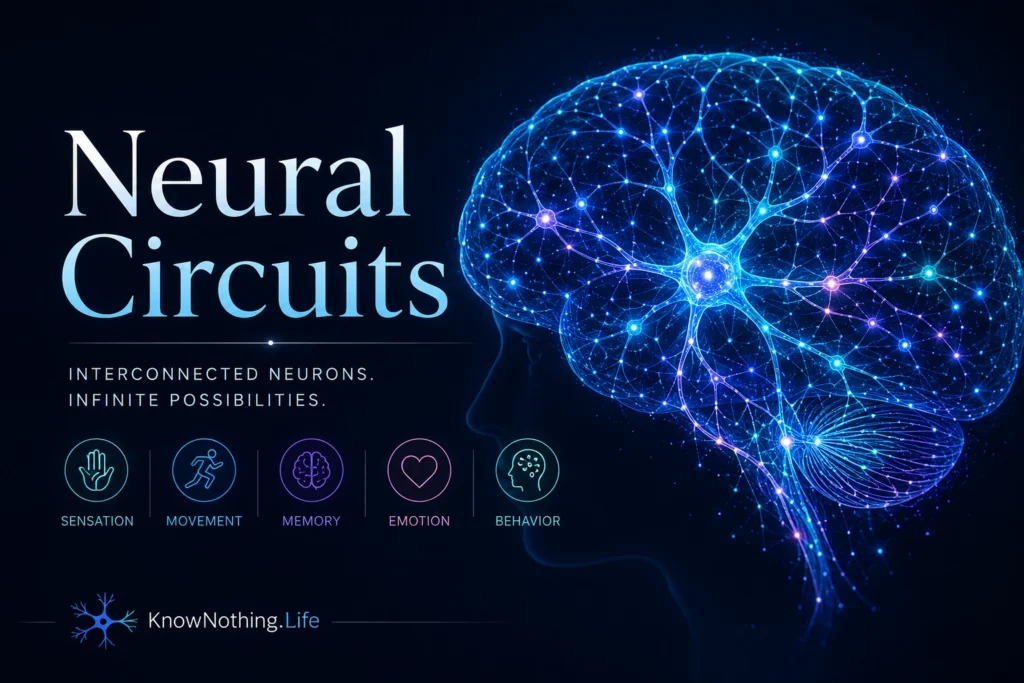
Neural circuits are organized groups of neurons connected by synapses that work together to perform a function. A circuit may be small and local, such as a spinal reflex pathway, or large and distributed, such as a network involved in memory, vision, language, attention, fear, or decision-making. The basic idea is that neurons do not create behavior alone. They create behavior through patterns of connection. NCBI’s neuroscience text describes neural circuits in terms of afferent neurons that carry information toward the central nervous system, efferent neurons that carry information away, and interneurons that participate in local circuit processing.
A neural circuit is not just a group of cells sitting near one another. It is a functional relationship among cells. Some neurons provide input, some shape or transform that input, and others produce output. A circuit can amplify signals, suppress noise, detect patterns, generate rhythms, store associations, or select actions. This is why the brain cannot be understood only by naming its parts. The visual cortex, basal ganglia, hippocampus, amygdala, cerebellum, and spinal cord matter because of how their neurons are wired into circuits. Neural circuits are the bridge between individual brain cells and whole behavior.
How Neural Circuits Are Built
Neural circuits are built through development, growth, guidance, synapse formation, and experience. During nervous-system development, neurons are generated, migrate to appropriate locations, extend axons and dendrites, and form synaptic connections with specific partners. NCBI’s chapter on construction of neural circuits explains that adult nervous-system organization requires both linking different regions through axon pathways and forming orderly synaptic connections among appropriate pre- and postsynaptic partners.
This wiring is not fully random and not fully fixed. Genes guide early patterning, but activity and experience refine connections. Some synapses are strengthened, others weakened, and some eliminated. Developmental pruning helps circuits become more efficient, while learning continues to alter circuit function throughout life. A child learning speech, an athlete refining movement, a musician practicing scales, or a patient recovering after stroke is relying on the nervous system’s ability to reshape circuit activity. Neural circuits are therefore biological systems with both structure and history. They are built by development, tuned by activity, and modified by use.
Input, Processing, and Output
Most circuits can be understood through the flow of information: input, processing, and output. Sensory receptors provide input from the world or body. Interneurons and projection neurons transform that input. Motor neurons, autonomic pathways, endocrine systems, or other brain networks produce output. A reflex circuit offers a simple example. A painful stimulus activates sensory neurons, spinal interneurons process the signal, and motor neurons activate muscles to withdraw the limb. This circuit is fast because it does not need to wait for full conscious interpretation before protecting the body.
Complex circuits follow the same broad logic but with many more layers. In vision, retinal circuits begin processing light, thalamic circuits relay and modulate information, visual cortex extracts features, and higher pathways help recognize objects or guide action. In memory, the hippocampus helps bind experience into context-rich episodes, while cortical and subcortical circuits support storage, retrieval, emotion, and future planning. In movement, motor cortex, basal ganglia, cerebellum, brainstem, spinal cord, and sensory feedback loops cooperate to turn intention into coordinated action. Neural circuits make behavior possible by transforming signals rather than merely passing them along.
Circuit Motifs: Feedforward, Feedback, and Recurrent Loops
Neural circuits use recurring design patterns called circuit motifs. Feedforward circuits move information in one main direction, such as from sensory receptors toward the brain. Feedback circuits send information backward to regulate earlier stages. Recurrent circuits loop activity back into the same network, allowing patterns to persist, stabilize, or evolve over time. These motifs are not abstract engineering metaphors; they are biological strategies for controlling information. A feedback loop can suppress irrelevant signals, refine movement, or help maintain a memory trace. A recurrent loop can help sustain attention, working memory, rhythmic firing, or emotional states.
Feedback is especially important because the brain is not a passive input-output machine. It constantly predicts, compares, corrects, and updates. When reaching for a glass, motor circuits send commands, sensory systems report whether the hand is on target, and cerebellar circuits help correct errors. When listening to speech, auditory circuits process sound while higher-level language and attention systems influence what is heard. Circuits therefore operate in loops, not straight lines. The brain’s intelligence depends partly on this circular architecture: signals return, revise, and reshape what happens next.
Excitation, Inhibition, and Circuit Balance
Every neural circuit depends on a balance between excitation and inhibition. Excitatory neurons make downstream cells more likely to fire, while inhibitory neurons make them less likely to fire. Glutamate is the main excitatory neurotransmitter in the brain, and GABA is the main inhibitory neurotransmitter. This balance allows circuits to activate without becoming chaotic. It also allows them to filter, time, sharpen, and stabilize activity.
Inhibitory interneurons are especially important in local circuits. They can control when principal neurons fire, synchronize groups of neurons, suppress competing signals, and shape rhythms. Without inhibition, neural activity could spread uncontrollably, as in seizures or other unstable network states. Without excitation, circuits could not process information or drive behavior. The functional brain is not a brain with maximum activity everywhere. It is a brain with controlled activity in the right places, at the right times, in the right patterns. Neural circuits work because they balance activation with restraint.
Neural Circuits and Learning
Learning changes circuits. Donald Hebb’s 1949 book The Organization of Behavior introduced influential ideas such as the “Hebb synapse,” the “Hebbian cell assembly,” and the “phase sequence.” Later neuroscience often summarized Hebb’s principle as the idea that neurons active together can strengthen their connection, although the original concept involved more precise causal relationships between cells.
Hebbian learning helps explain how repeated experience can alter circuit function. If a sound repeatedly predicts danger, circuits linking that sound to defensive responses can strengthen. If a movement repeatedly succeeds, motor circuits become more efficient. If a fact is recalled in meaningful contexts, memory circuits become easier to reactivate. Learning is not just information entering the mind. It is a physical change in the probabilities and strengths of circuit activity. Synaptic plasticity, receptor changes, gene expression, protein synthesis, and structural remodeling all help experience become circuit change.
Motor Circuits and Rhythmic Movement
Motor circuits show how neural networks create action. Voluntary movement depends on cortex, basal ganglia, cerebellum, brainstem, spinal cord, and sensory feedback. The basal ganglia are especially important for action selection. Alexander, DeLong, and Strick proposed an influential model of parallel, functionally segregated circuits linking the basal ganglia and cortex, showing that these loops contribute to motor, cognitive, and limbic functions.
Some motor circuits can also generate rhythmic patterns. Central pattern generators are neural circuits capable of producing repeated motor patterns such as walking, swimming, breathing, or flying. Reviews of locomotor CPGs describe walking, flying, and swimming as largely controlled by spinal neuron networks that generate rhythmic movement patterns. These circuits do not eliminate the need for the brain or sensory feedback. Instead, they provide basic rhythmic structure that can be adjusted by descending commands, sensory information, motivation, and environment. This layered organization allows movement to be both automatic and flexible.
Emotional, Memory, and Decision Circuits
Neural circuits also shape emotion, memory, and decision-making. The amygdala, hippocampus, hypothalamus, prefrontal cortex, striatum, thalamus, and brainstem all participate in circuits that evaluate threat, reward, context, motivation, and bodily state. Fear learning, for example, is not stored in one “fear center.” It depends on sensory input, amygdala salience processing, hippocampal context, hypothalamic and brainstem bodily responses, and prefrontal regulation. Emotion is therefore a circuit-level event that links perception, memory, body, and action.
Decision-making also depends on circuits rather than isolated thoughts. The prefrontal cortex may help represent goals and rules, the basal ganglia may help select actions, dopamine systems may update reward predictions, and sensory systems may provide evidence about the current situation. A decision feels like one mental act, but biologically it is distributed. Neural circuits allow value, memory, perception, emotion, and motor preparation to interact. This is why decisions can be influenced by stress, hunger, habit, fear, reward, and prior experience. The deciding brain is a networked brain.
Mapping and Manipulating Neural Circuits
Modern neuroscience has developed powerful tools for studying circuits. Electrophysiology records neural activity. Calcium imaging tracks activity in groups of neurons. Functional MRI maps large-scale human brain networks. Connectomics attempts to map structural wiring among neurons or brain regions. Harvard Medical School describes connectomics as a field that aims to create detailed structural maps of connectivity, ideally showing every neuron and connection in a circuit or brain region.
Optogenetics has also transformed circuit research by allowing scientists to control defined neurons with light. Karl Deisseroth described optogenetics as a technology that enables targeted, fast control of precisely defined events in complex biological systems, including freely moving mammals. This matters because observing activity is not the same as proving causation. If activating or silencing a defined pathway changes behavior, researchers gain stronger evidence that the pathway plays a causal role. Tools like optogenetics, chemogenetics, tracing, imaging, and connectomics have made neural circuits one of the most active areas of modern neuroscience.
Neural Circuit Disorders
Many neurological and psychiatric conditions can be understood partly as circuit disorders. Parkinson’s disease involves disrupted basal ganglia-thalamocortical motor loops. Epilepsy involves abnormal synchronized activity in neural networks. Addiction involves long-lasting changes in reward, habit, stress, and decision circuits. Chronic pain can involve sensitized sensory and emotional circuits. Anxiety and trauma can involve altered threat-detection, memory, autonomic, and prefrontal regulation circuits. DeLong’s review of basal-ganglia circuit disorders notes that dysfunction in individual circuits is associated not only with movement disorders but also with neuropsychiatric conditions such as obsessive-compulsive disorder and Tourette syndrome.
This circuit view is clinically important because symptoms often emerge from network dysfunction rather than damage to one isolated spot. A person with a movement disorder may have abnormal communication among cortex, basal ganglia, thalamus, and brainstem. A person with depression may have altered regulation among prefrontal, limbic, reward, stress, and bodily systems. Treatments such as medication, psychotherapy, rehabilitation, deep brain stimulation, transcranial stimulation, and behavioral training can all be understood partly as attempts to change circuit activity. Medicine increasingly asks not only “which brain region is involved?” but “which circuit is dysregulated?”
Why Neural Circuits Matter
Neural circuits matter because they explain how the nervous system becomes functional. Neurons are essential, but a neuron alone does not create perception, memory, movement, emotion, or thought. These functions emerge from connected cells arranged into circuits that receive information, transform it, store it, regulate it, and turn it into action. The brain is not simply a collection of parts. It is a living network of interacting pathways.
The deeper lesson is that the mind is relational. A memory exists because circuits can be reactivated. A habit exists because action pathways have been reinforced. A fear exists because perception, context, body, and defensive response have become linked. A skill exists because sensory and motor circuits have been refined through practice. To understand neural circuits is to understand one of neuroscience’s central truths: brain function depends not only on cells, chemicals, and regions, but on the patterns of connection that allow them to work together.