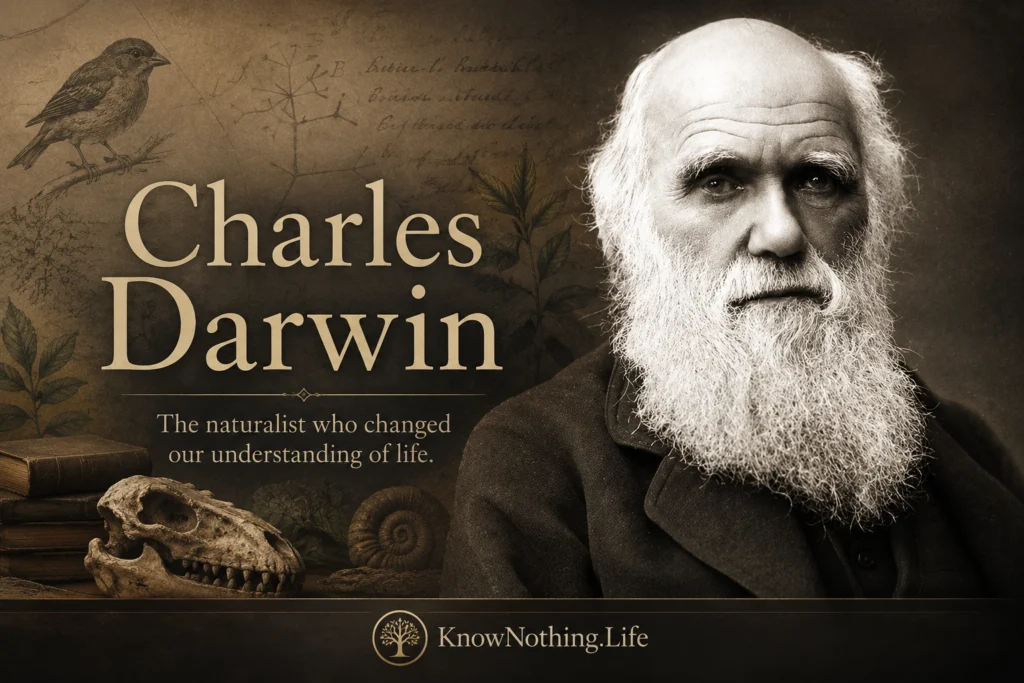
Charles Darwin was an English naturalist and geologist whose theory of evolution by natural selection transformed biology and altered humanity’s understanding of its place in nature. Darwin did not originate the general idea that species change over time, but he assembled an extraordinary body of evidence and proposed a mechanism explaining how adaptation and biological diversity could emerge through natural processes. By connecting variation, inheritance, competition, reproduction, and environmental conditions, he created a framework that unified observations from anatomy, paleontology, embryology, biogeography, and animal breeding.
Darwin’s reputation rests primarily on On the Origin of Species, yet his scientific interests were remarkably broad. He wrote about coral reefs, barnacles, orchids, climbing plants, human ancestry, emotional expression, carnivorous plants, domestication, and earthworms. His books reveal a researcher who moved constantly between ambitious theories and small observations, testing large questions through pigeons, seeds, flowers, worms, and household experiments. His enduring achievement was a historical vision of life in which organisms share ancestors and populations continually change across generations.
Early Life and Education
Charles Robert Darwin was born on February 12, 1809, in Shrewsbury, England. His father, Robert Waring Darwin, was a successful physician, while his grandfathers were the physician and evolutionary writer Erasmus Darwin and the industrialist Josiah Wedgwood. Darwin developed an early enthusiasm for collecting minerals, shells, insects, and birds, although his formal education initially gave little indication that he would become one of history’s most influential scientists.
Darwin entered the University of Edinburgh in 1825 to study medicine but disliked surgery and gradually lost interest in becoming a physician. Natural history, marine organisms, collecting, and geological debate attracted him more strongly. His father later sent him to Christ’s College, Cambridge, with the expectation that he might enter the Anglican clergy. At Cambridge, botanist John Stevens Henslow and geologist Adam Sedgwick encouraged Darwin’s scientific development, strengthening the observational and fieldwork skills that prepared him for his defining expedition.
The Voyage of the Beagle
In 1831, Henslow recommended the twenty-two-year-old Darwin for a place aboard HMS Beagle, a British surveying vessel commanded by Robert FitzRoy. The voyage began in December 1831 and ended in October 1836, carrying Darwin around South America and across the Pacific, Indian, and Atlantic oceans. He collected specimens, examined fossils, studied geological formations, witnessed earthquakes, and compared animals and plants across distant environments. Darwin later called the voyage “by far the most important event in my life,” because it established his career and supplied questions that occupied him for decades.
The Galápagos Islands later became symbols of Darwin’s evolutionary thinking, but his theory did not arrive through a single moment of revelation. It developed gradually from the geographic replacement of related species, the resemblance between extinct and living South American animals, and the unusual distribution of island organisms. Charles Lyell’s Principles of Geology encouraged Darwin to interpret dramatic landscapes as the accumulated products of continuing natural processes. The voyage trained him to see both the earth and life historically rather than as fixed arrangements.
Developing Natural Selection
After returning to England, Darwin entered London’s scientific community, arranged the study of his collections, and privately began investigating the transformation of species. In 1837, he opened notebooks on what he called transmutation and sketched a branching evolutionary tree. Reading Thomas Malthus on population in 1838 helped him recognize that organisms produce more offspring than their environments can support. When inherited variations affect survival or reproduction, favorable characteristics can become more common over many generations. Darwin called this process natural selection.
Darwin spent roughly two decades collecting evidence rather than immediately publishing the theory. He studied selection by animal and plant breeders, corresponded with naturalists around the world, prepared private essays, and completed an extensive investigation of barnacles. In 1858, Alfred Russel Wallace independently sent Darwin an essay proposing a similar evolutionary mechanism. Charles Lyell and Joseph Dalton Hooker arranged for writings by Darwin and Wallace to be presented jointly to the Linnean Society on July 1, 1858. Wallace’s discovery prompted Darwin to prepare his long-developed argument for publication.
On the Origin of Species
On the Origin of Species by Means of Natural Selection was published on November 24, 1859. Darwin began with familiar examples from domesticated animals and cultivated plants before extending selection into nature. Members of a species differ, some variations are inherited, and more organisms are born than can survive. Variations that improve reproductive success tend to be preserved, while unfavorable characteristics may disappear. Across immense periods, this process can produce adaptation, divergence, extinction, and the formation of new species descended from common ancestors.
Darwin addressed serious difficulties, including complex organs, incomplete fossil evidence, and uncertainty about the physical mechanism of inheritance. Instead of hiding these problems, he incorporated objections into his argument and examined whether gradual changes could explain them. His concluding image of “endless forms most beautiful and most wonderful” expressed the emotional as well as scientific scale of evolution. Darwin did not claim that natural selection explained the original emergence of life or that evolution inevitably advances toward perfection. It adapts populations to changing local conditions while extinction removes many branches from life’s history.
Human Evolution and Emotional Life
Darwin addressed humanity directly in The Descent of Man, and Selection in Relation to Sex, published in 1871. He argued that humans share ancestry with other animals and that human anatomy, intelligence, emotion, and morality should be studied within evolutionary history. Sexual selection explained traits shaped by competition for mates and reproductive preferences rather than immediate survival. Darwin also explored sympathy, cooperation, social instincts, and moral judgment, demonstrating that his evolutionary account included affiliation and mutual aid as well as competition.
The Descent of Man also reflects the prejudices and hierarchical assumptions of nineteenth-century European science. Darwin strongly opposed slavery and believed humanity formed one related species, yet he sometimes used language about cultures and peoples that modern readers properly criticize. His conclusion that humanity carries “the indelible stamp of his lowly origin” challenged claims of complete human separation from nature. Evolutionary ideas were later recruited into social Darwinism, racism, and eugenics, although those political ideologies were not direct or necessary conclusions of natural selection.
Down House and the Working Naturalist
Darwin married his cousin Emma Wedgwood in 1839, and the couple moved to Down House in Kent in 1842. They had ten children, seven of whom survived to adulthood. Darwin’s recurring illness restricted travel and social activity, but Down House became an unusually productive research center. Its gardens, greenhouse, fields, study, and Sandwalk provided settings for experiments and reflection. Emma, the Darwin children, servants, gardeners, breeders, and an international network of correspondents all contributed in different ways to his scientific work.
Darwin’s later books demonstrated how evolutionary questions could be investigated through detailed experiments. The Various Contrivances by Which Orchids Are Fertilised by Insects examined the dependence between flowers and pollinators. The Variation of Animals and Plants Under Domestication explored inheritance and selection, while The Expression of the Emotions in Man and Animals compared emotional behavior across species. He also produced Insectivorous Plants, The Power of Movement in Plants, and The Formation of Vegetable Mould Through the Action of Worms. Even the earthworm became evidence of how small, repeated actions can reshape the world.
Scientific Character and Lasting Legacy
Darwin’s scientific power came from careful observation, patience, comparative reasoning, and a willingness to abandon explanations that failed. In his autobiography, he wrote, “I have steadily endeavoured to keep my mind free” when evidence opposed a favored hypothesis. He constructed arguments by bringing facts from different disciplines into conversation and depended on thousands of letters to acquire specimens, observations, criticism, and expert knowledge. His notebooks expose uncertainty and discarded hypotheses, presenting science as a process of correction rather than instant revelation.
Darwin died at Down House on April 19, 1882. Following appeals from prominent scientists and public figures, he was given a ceremonial funeral and buried in Westminster Abbey. Modern evolutionary biology has transformed his theory through genetics, molecular biology, population mathematics, ecology, and developmental science. Many of Darwin’s ideas about heredity proved incorrect, but common descent and natural selection remain foundational principles. His deepest legacy is both a theory and a method: observe patiently, compare widely, test explanations, and understand every living form as part of one branching, unfinished history.