Alzheimer’s disease is a progressive neurological disorder that gradually damages memory, reasoning, language, judgment, and the ability to manage everyday life. It is the most common cause of dementia among older adults, although dementia is a broader clinical term rather than a single disease. Early symptoms often involve difficulty remembering recent information, but the condition can eventually affect orientation, communication, personality, movement, swallowing, and personal care. The progression varies considerably between individuals, and memory problems should not automatically be attributed to Alzheimer’s because medications, depression, sleep disorders, vascular disease, infections, vitamin deficiencies, and other neurological conditions can produce similar symptoms.
Alzheimer’s is now understood as a disease process that can begin many years before dementia becomes apparent. The revised diagnostic and staging criteria published by the Alzheimer’s Association Workgroup in 2024 define the disease biologically, beginning with the appearance of characteristic neuropathological changes even when a person has no measurable cognitive impairment. This perspective separates the underlying disease from its clinical expression: a person may possess Alzheimer’s-related brain pathology without yet having dementia, while another person’s dementia may result from vascular injury, Lewy body disease, frontotemporal degeneration, or several pathologies occurring together.
Amyloid, Tau, and the Degenerating Brain
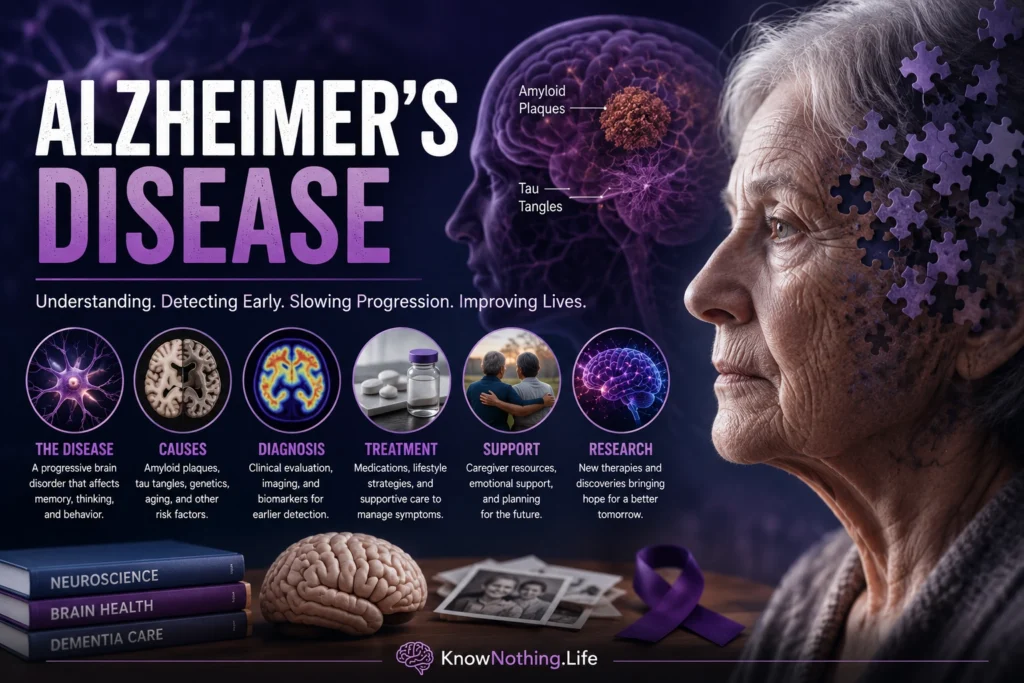
Two proteins have dominated scientific explanations of Alzheimer’s disease. Beta-amyloid fragments can accumulate outside neurons and form plaques, while abnormal forms of the protein tau collect inside cells as neurofibrillary tangles. These changes are accompanied by synaptic failure, inflammation, impaired cellular transport, metabolic dysfunction, neuronal loss, and progressive brain atrophy. In their influential 1992 paper “Alzheimer’s Disease: The Amyloid Cascade Hypothesis,” John Hardy and Gerald Higgins proposed that amyloid accumulation initiates a chain of events leading to neuronal damage and dementia. The hypothesis shaped decades of research, although scientists continue to debate how amyloid interacts with tau, immunity, vascular injury, aging, and other mechanisms.
Tau pathology appears to follow a recognizable anatomical pattern. Heiko and Eva Braak’s landmark neuropathological work showed that neurofibrillary changes tend to appear first in vulnerable regions around the entorhinal cortex before extending into hippocampal and broader neocortical areas. This progression helps explain why impaired formation of new memories is common early in typical Alzheimer’s disease, while language, spatial reasoning, judgment, and other abilities become increasingly affected as more extensive networks deteriorate. However, Alzheimer’s is biologically heterogeneous, and some patients initially present with language, visual-processing, or executive difficulties rather than the classic memory-dominant syndrome.
Genetics, Aging, and Disease Risk
Advancing age is the greatest general risk factor for Alzheimer’s disease, but the disorder is not an inevitable consequence of growing older. Most cases are considered late-onset and arise through complex interactions among genetic susceptibility, cardiovascular health, environmental exposures, education, immune responses, and biological aging. A small proportion of cases are caused by highly penetrant mutations involving genes such as APP, PSEN1, or PSEN2. These mutations can produce autosomal dominant Alzheimer’s disease, in which several members of a family develop symptoms, often at unusually young ages.
For the more common late-onset form, the APOE gene is the best-established genetic risk factor. In a landmark 1993 study, Eric Corder and colleagues reported that the APOE ε4 allele was associated with increased risk and earlier onset in affected families, with risk rising according to the number of ε4 copies. Carrying the allele does not guarantee that someone will develop Alzheimer’s, and people without it can still develop the disease. Genetics therefore influences probability rather than determining a simple outcome in most patients. The 2024 Lancet Commission also emphasized the importance of potentially modifiable contributors to dementia risk across the lifespan, including vascular, sensory, educational, environmental, and lifestyle factors.
From Silent Pathology to Clinical Symptoms
Research involving families with inherited Alzheimer’s disease has provided an unusually detailed view of its long presymptomatic phase. In a major 2012 study, Randall Bateman and the Dominantly Inherited Alzheimer Network investigators found that changes in cerebrospinal-fluid proteins, amyloid deposition, brain metabolism, brain structure, and cognition appeared in an approximate sequence over decades. Some biomarker abnormalities were estimated to emerge many years before the expected onset of noticeable symptoms. The researchers cautioned that inherited disease may not perfectly represent typical late-onset Alzheimer’s, but the findings helped establish the concept of a long biological continuum.
Clifford Jack and colleagues proposed a related dynamic biomarker model in which amyloid abnormalities emerge early, followed by signs of tau-related injury, neurodegeneration, structural loss, and cognitive decline. Although the sequence is more variable in real patients than a single model can capture, it transformed the design of clinical trials. Treatments aimed at slowing the disease are now commonly tested in people with mild cognitive impairment or mild dementia who have biomarker confirmation of amyloid pathology, rather than only in patients with advanced dementia and extensive neuronal loss.
Symptoms and Progression
Typical early symptoms include repeating questions, forgetting recent conversations, losing objects, becoming disoriented in familiar places, struggling to find words, or having difficulty organizing finances and multistep tasks. These problems are more persistent and disruptive than ordinary age-related lapses. As the disease progresses, individuals may need help with medications, appointments, meals, transportation, and personal hygiene. Changes in mood, anxiety, agitation, apathy, sleep, suspiciousness, or social behavior may also occur, sometimes becoming more distressing to families than memory loss itself.
Later-stage Alzheimer’s can severely impair communication, recognition, mobility, continence, eating, and swallowing. Patients may become vulnerable to falls, malnutrition, infections, and other medical complications. The apparent severity of symptoms can also be affected by pain, unfamiliar surroundings, sensory loss, medication effects, or delirium. Effective care therefore requires more than measuring cognition. Clinicians and caregivers must consider physical comfort, emotional well-being, safety, independence, personal history, family stress, and the individual’s preferences regarding future care.
Diagnosis and the Growing Role of Biomarkers
Diagnosis begins with a careful medical history, information from someone who knows the patient well, cognitive and neurological examinations, and an evaluation of daily functioning. Blood tests and structural brain imaging may help identify alternative or contributing causes, including thyroid disease, nutritional deficiency, medication effects, stroke, tumors, or normal-pressure hydrocephalus. Neuropsychological testing can clarify which abilities are impaired and whether the pattern resembles Alzheimer’s disease or another condition. No single office memory test is sufficient to establish the cause of cognitive decline.
Biomarkers can provide evidence of the underlying disease process. Amyloid and tau can be assessed through positron-emission tomography or cerebrospinal-fluid testing, while magnetic resonance imaging can reveal patterns of atrophy and vascular injury. Blood-based measures, particularly phosphorylated tau forms, are becoming increasingly important as less invasive screening and diagnostic tools, although their interpretation depends on the specific test and clinical context. The biological approach can increase diagnostic confidence and determine eligibility for amyloid-targeting therapy, but a positive biomarker does not by itself describe a person’s symptoms, prognosis, or care needs.
Symptomatic and Disease-Modifying Treatments
Traditional Alzheimer’s medications primarily address symptoms. Cholinesterase inhibitors such as donepezil, rivastigmine, and galantamine can temporarily support cognitive or daily functioning in some patients, while memantine is used in moderate-to-severe disease. These medications do not stop neuronal degeneration, and their benefits differ between individuals. Treatment also includes management of cardiovascular conditions, sleep problems, pain, anxiety, depression, hearing or vision impairment, and environmental triggers of confusion. Regular routines, physical activity, meaningful social engagement, caregiver education, and home-safety adaptations can support quality of life even when cognitive decline continues.
Lecanemab and donanemab represent a newer class of disease-modifying immunotherapies for early Alzheimer’s disease with confirmed amyloid pathology. In the Clarity AD trial, lecanemab reduced brain amyloid and produced moderately less cognitive and functional decline than placebo over 18 months. The TRAILBLAZER-ALZ 2 trial similarly found that donanemab slowed clinical progression in participants with early symptomatic disease. These treatments do not restore lost memories or cure Alzheimer’s, and their average benefits are modest. They can also cause amyloid-related imaging abnormalities involving brain swelling or bleeding, requiring careful eligibility assessment, magnetic resonance monitoring, and informed discussion of risks.
The Future of Alzheimer’s Research and Care
The arrival of anti-amyloid treatments provides evidence that changing a defining pathological feature can influence clinical progression, but it does not resolve the disease’s complexity. Amyloid removal may be only one component of future treatment. Researchers are investigating tau-directed therapies, neuroinflammation, vascular dysfunction, metabolic health, synaptic repair, genetic pathways, and combinations of treatments applied at different disease stages. Better biomarkers may eventually identify which mechanisms dominate in an individual patient and which therapy is most likely to help.
Scientific progress must be matched by accessible, humane care. Biomarker testing, repeated imaging, infusion services, genetic counseling, and specialist evaluation may be difficult to obtain, while families often provide years of unpaid supervision and assistance. Alzheimer’s disease affects not only memory but identity, relationships, autonomy, and the structure of family life. An authority-based understanding of the condition must therefore combine molecular research with early diagnosis, realistic treatment expectations, caregiver support, advance planning, and respect for the person who continues to exist beyond the diagnosis.