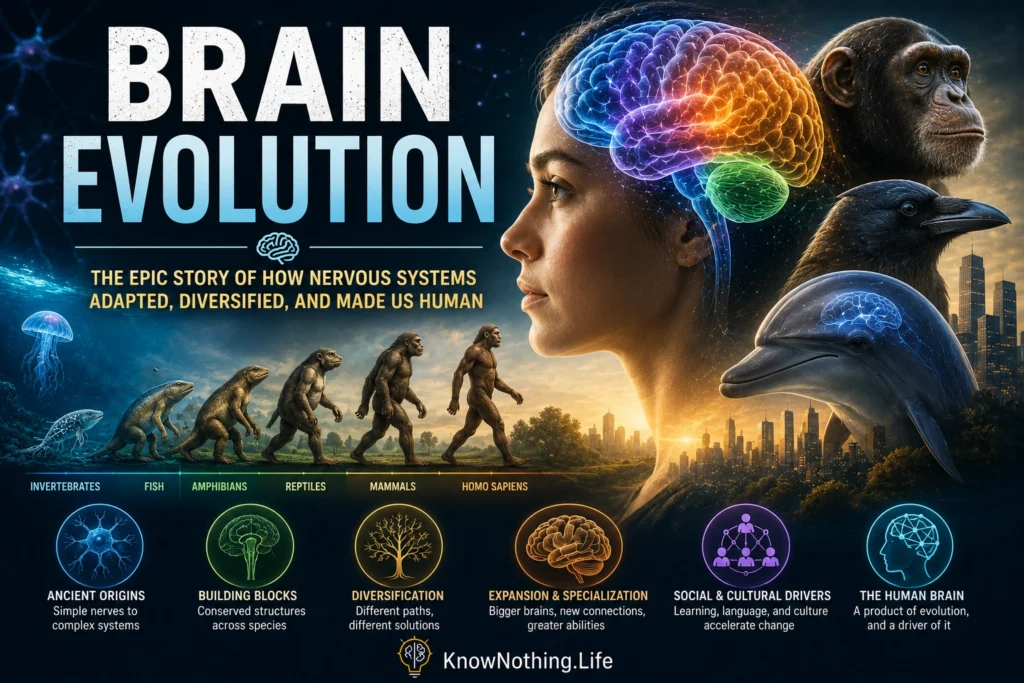
Brain evolution is the long history through which nervous systems changed as organisms adapted to new bodies, habitats, diets, social relationships, and ways of moving through the world. It is often described as a climb from “simple” animals to humans, but evolution has no predetermined destination. Every living species represents a surviving branch, and each brain is a compromise shaped by ancestry, development, energy demands, and ecological pressures. The nervous system of an octopus, crow, dolphin, mouse, or human is not an unfinished version of another species’ brain. Each is a specialized biological solution to the challenges faced by its lineage.
Researchers reconstruct this history through comparative anatomy, neuron counts, developmental biology, genetics, behavior, and fossil endocasts—the impressions left by brains inside ancient skulls. These sources reveal both continuity and change. Barbara Finlay and Richard Darlington’s influential 1995 study showed that many mammalian brain regions scale together in predictable ways and that later-developing structures tend to expand disproportionately as brains become larger. Their findings suggested that evolutionary changes in developmental timing can reshape several regions at once rather than requiring an independent genetic change for every anatomical feature.
Evolution Modifies Existing Neural Plans
Evolution generally modifies inherited developmental systems instead of constructing nervous systems from nothing. Vertebrate brains share major divisions of the forebrain, midbrain, and hindbrain because these structures arose deep in their common ancestry. New adaptations can emerge when existing circuits are enlarged, reorganized, connected differently, or recruited for additional functions. Brain evolution is therefore constrained by embryonic development, sensory organs, metabolism, blood supply, and the body that the nervous system must control. An anatomical change that improves one ability may also create costs involving energy use, development time, childbirth, movement, or communication between distant regions.
The brain does not, however, evolve as one inseparable unit. Robert Barton and Paul Harvey demonstrated that functionally linked mammalian structures can change together somewhat independently of other regions. Their 2000 analysis supported the idea of mosaic evolution: the neocortex differed substantially among mammalian groups even after overall brain scaling was considered, while connected visual, olfactory, and other systems showed correlated evolutionary change. The strongest explanation combines both perspectives. Development creates broad relationships among brain regions, while natural selection can place additional emphasis on neural systems that matter for a lineage’s ecology and behavior.
Brain Size Is Only Part of the Story
A large brain can contain more neural tissue, but mass alone is a poor measure of intelligence or computational capacity. Comparisons must also consider body size, neuron density, regional organization, connection distances, and energy use. Suzana Herculano-Houzel’s neuron-counting research found that the human brain contains approximately 86 billion neurons and broadly follows the cellular scaling pattern of other primates. Humans are unusual partly because primate brains place many neurons in the cerebral cortex, not because the human brain violates every mammalian rule. It can be understood as an enlarged, exceptionally neuron-rich primate brain rather than a completely new biological design.
Birds demonstrate another route to complex cognition. Seweryn Olkowicz and colleagues found that parrots and corvids possess extremely high neuronal densities in their forebrains, giving some species neuron counts comparable to or greater than those of primates with much larger brains. This finding helps explain how crows and parrots can display flexible problem-solving, tool use, planning, and social learning despite their relatively compact skulls. Evolution can increase information-processing capacity by building a larger brain, packing neurons more densely, reorganizing circuits, or combining these strategies. There is no single anatomical blueprint for an intelligent animal.
Energy, Ecology, and Evolutionary Tradeoffs
Neural tissue is metabolically expensive. A larger brain requires energy to grow and to maintain electrical signaling, synapses, ion gradients, and supporting cells throughout life. Karina Fonseca-Azevedo and Herculano-Houzel modeled this constraint in primates and argued that the hours available for feeding limit the combination of body size and brain neuron number. Their analysis proposed that cooking and the increased energy obtained from processed food helped make the human combination of a relatively large body and neuron-rich brain sustainable. Whatever the exact contribution of cooking, brain expansion could not have occurred independently of diet, digestion, growth, and life history.
Ecological challenges can also favor different sensory and cognitive abilities. Navigating large territories, remembering seasonal foods, locating hidden resources, coordinating hunts, avoiding predators, and maintaining alliances place different demands on neural systems. A 2021 study led by Manuel Will combined Homo fossils with paleoclimate reconstructions and found that temperature strongly predicted body-size variation, whereas brain size showed weaker relationships with the environmental variables examined. The results argue against a single climatic cause of human brain expansion and suggest that ecological instability, behavioral flexibility, competition, technology, and social learning likely interacted over long periods.
The Hominin Brain Did Not Expand in a Straight Line
The lineage leading to modern humans began with brains broadly comparable in size to those of living apes. Across later australopiths and members of the genus Homo, average cranial capacity increased, but the pattern was uneven. Multiple hominin species coexisted, some retained smaller brains, and changes in brain size occurred alongside changes in body form and life history. Fossil endocasts reveal approximate volume, external shape, and some surface features, but they cannot preserve neurons, microscopic circuits, neurotransmitters, or mental experience. They provide valuable records of anatomy, not direct measurements of intelligence.
Brain shape changed as well as size. Modern human brains are more globular than those of many earlier Homo species, reflecting changes involving parietal regions, the cerebellum, the cranial base, and other structures. A 2018 computational reconstruction suggested that early Homo sapiens had relatively larger cerebellar hemispheres and a smaller occipital region than Neanderthals. A 2025 comparative endocast study found especially rapid shape evolution in Homo sapiens and Neanderthals and associated major primate changes with cortical areas involved in higher cognition. These studies identify meaningful anatomical trends, but they do not justify placing extinct species on a simple ladder of mental ability.
Human Specialization Involves Development
The human brain’s distinctiveness is not explained simply by an oversized frontal lobe. Comparative work has challenged the popular claim that the human frontal cortex is disproportionately enormous relative to the frontal cortex of great apes. More consequential differences may involve internal organization, long-range connectivity, cellular properties, association regions, and prolonged maturation. Human childhood and adolescence create an unusually long period during which language, social learning, education, technical skills, and cultural practices can shape neural networks. The evolutionary expansion of learning time may be as important as the expansion of neural tissue.
Genetic changes contributed to these developmental differences, but no single “human brain gene” explains human cognition. Cécile Charrier and colleagues showed that the human-specific duplicate SRGAP2C could delay dendritic-spine maturation and increase spine density when expressed in mouse neurons. In 2018, studies of human-specific NOTCH2NL genes found that they can prolong cortical progenitor activity and increase neuronal output. These findings identify plausible mechanisms through which gene duplications altered cortical development, but their effects occur inside large genetic and developmental networks. They cannot independently explain language, reasoning, cooperation, imagination, or culture.
Culture Became Part of Brain Evolution
As hominins became increasingly dependent on tools, cooperation, communication, and shared knowledge, culture changed the conditions under which brains developed and individuals survived. Skills could accumulate across generations through imitation, teaching, and language rather than being rediscovered by every individual. Tools altered diets and physical environments, food sharing changed social relationships, and symbolic communication expanded the amount of knowledge communities could preserve. Biological and cultural evolution increasingly influenced one another, creating feedback between inherited learning capacities and socially constructed environments.
This interaction explains why human cognition cannot be read directly from skull volume. A brain develops within a social world filled with symbols, routines, technologies, institutions, and other minds. The central lesson of brain evolution is therefore not that nature produced a ladder ending in humanity. Developmental rules link the growth of regions, natural selection reshapes functional systems, ecological demands reward different abilities, and culture alters the environments in which brains mature. The human brain is extraordinary in neuron number, developmental duration, connectivity, and cultural dependence, but it remains one branch within a much older and more varied history of nervous systems.